
SEO Basics & Strategy
Google's E-E-A-T: Meaning and Influence on SEO Explained

Google faces the constant challenge of filtering out, from a gigantic pool of millions of websites, those that have the highest quality and thus help search engine users best. To master this challenge, Google has developed a so-called E-E-A-T filter.
In this article, you'll learn all about what exactly this concept is and how to optimize for it.
No time for the whole article? The 5 most important points about Google E-E-A-T:
- What is E-E-A-T? Stands for Experience, Expertise, Authoritativeness, and Trustworthiness – Google's concept for evaluating the quality of websites.
- Not a direct ranking factor – but indirectly influences the rankings via algorithm adjustments.
- Particularly important for YMYL pages – that is, websites on health, finance, or other life-relevant topics.
- Optimize for E-E-A-T – top expert content from specialist authors with an author profile, documented sources, and regular updates. In addition, build up backlinks, reviews, and professional engagement.
- Not a score that can be optimized quickly – credibility and authority must be built up over the long term.
What is E-E-A-T?
E-E-A-T is a concept that significantly helps the search engine assess the quality of websites. In this article, you'll learn what exactly it is, for which websites this factor is important, and how to optimize specifically for E-E-A-T.
At the latest since the Core Update of August 2018, E-A-T (expanded in 2022 by “Experience” to become E-E-A-T) has reached the broad mass of search engine optimizers. Back then, Google, unlike with Penguin or Panda for example, did not punish bad websites but rewarded good websites. Namely those it considered credible and trustworthy.
Because it initially looked as though the update would only affect websites from the healthcare industry, it was initially also called the Medic Update. A not uninteresting side note, because E-E-A-T does indeed play a bigger role for some industries than for others. However, all websites were affected that are potentially capable of changing the physical, psychological, or financial well-being of their visitors.
What does E-E-A-T actually stand for?
E-E-A-T is an acronym that stands for the following four terms:
- Experience = practical experience
Does the author have direct, real experience in the field they're writing about? - Expertise = specialist knowledge and know-how
Does the website convince with well-founded and in-depth content that comes from authors with specialist knowledge and know-how? - Authoritativeness = authority, decisiveness, and reputation
Is the website's content so high-quality that it contributes to opinion-forming and is recognized by third parties? - Trustworthiness = trustworthiness and reliability
Can visitors trust the content and the entire website now and in the future?
So the abbreviation stands for a multitude of characteristics that help Google assess the quality of a website.
Is E-E-A-T a ranking factor?
The most important document in connection with E-E-A-T is the Search Quality Rater Guidelines from Google (also called the Search Quality Evaluator Guidelines). The PDF, which is over 180 pages long, is aimed at the roughly 10,000 Quality Raters worldwide that Google employs. The guidelines provide clear specifications for how web pages and websites are to be analyzed and assessed.
The acronym E-E-A-T appears in the publicly accessible document no fewer than 135 times. A fairly clear indication of how important Experience, Expertise, Authoritativeness, and Trustworthiness are for the search engine.
Nevertheless, E-E-A-T is not a ranking factor, even if sometimes even relatively well-known and reputable websites claim otherwise. In the whitepaper “Fighting disinformation across our products” (2019), it is roughly explained how E-E-A-T is assessed. There it clearly states:
And in a post about the Core Updates on Google's Search Central Blog, it states:
So E-E-A-T is not a direct ranking factor, but it does have an indirect influence on the position in the search results. Google uses the results of the Search Quality Raters to derive patterns from them and adjust the algorithms.
Which websites does E-E-A-T (particularly) affect?
In principle, the criteria mentioned in the Search Quality Rater Guidelines apply to all websites. But it's in the nature of things that, for example, specialist knowledge and credibility are not equally important for all websites. In particular, websites that serve not information but entertainment have to be judged less strictly by the raters with regard to E-E-A-T. For a joke site, it's relatively irrelevant who the author is and how well they know the subject matter.
On the other hand, there are of course industries in which it is particularly important that they convey well-founded and independent content that you can trust without hesitation. Google calls them YMYL pages. YMYL stands for “Your Money Your Life.” This includes all websites that could potentially influence the personal life situation of users. Both positively and negatively.
The YMYL pages include:
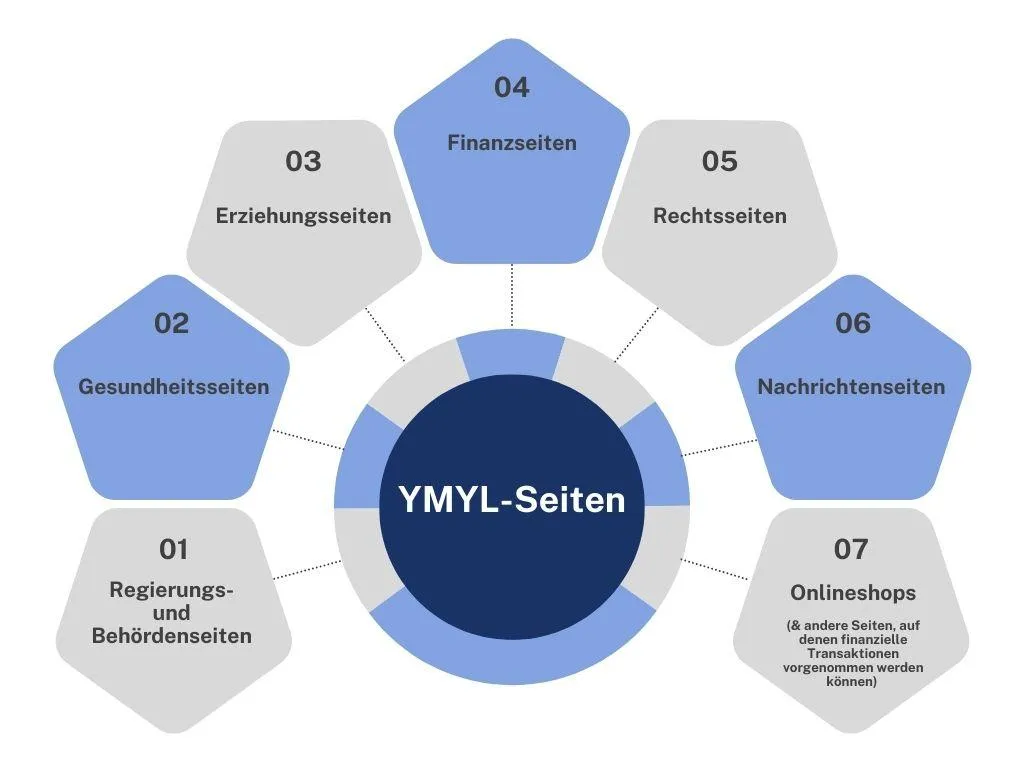
These websites deal with sensitive subject areas or have an increased potential for danger because they process users' personal data. Incorrect information on a medical website could, in the worst case, end fatally. Speculative investment tips on a stock market site could lead to financial ruin. That's why Google applies particularly strict standards to YMYL pages. E-E-A-T is weighted more heavily and rated more highly here.
Why is Google E-E-A-T so important?
Google is not without reason the search engine with the largest market share worldwide. The reason we all use this search engine is the search results, which quite obviously satisfy our needs better than those of the competition.
The top goal of Google Search is to present its users with the best search results for their individual search query. Because only in this way can Google defend its market power. The search engine is the foundation of Google's success story, even if by no means every offering still has anything to do with the core business. But through search, Google generates a large part of its valuable data about us. Delivering the best search results is therefore anything but a selfless act of kindness, but ultimately a win-win situation after all.
In addition, there's the enormous responsibility that a company as world-dominating as Alphabet has. The garage days are long gone. In the worst case, the spread of false information can not only destroy individual livelihoods but even lead to global catastrophes. Google wants to prevent this too, out of its own interest, and therefore relies, among other things, on E-E-A-T to recognize and limit risks.
So the search engine constantly faces the challenge of filtering out, among millions of websites, those that are most relevant to the respective search query. With Expertise, Authoritativeness, and Trustworthiness, Google can very well assess how high-quality, safe, and reliable a website and its content are. E-E-A-T thus fits perfectly into Google's philosophy.
How does the assessment work?
Understanding content semantically no longer poses a real challenge for Google today. However, checking its accuracy and truthfulness is currently still impossible for an algorithm. Google therefore relies on a multitude of signals that provide information about the relevance of the content and the authority of a website. That, at least, is what Danny Sullivan of Google says.
Gary Illyes, an analyst at Google, said a few weeks after this tweet at PubCon in Las Vegas that the correctness of the content is a ranking factor, especially for YMYL pages. This was also confirmed by Danny Sullivan, who at the same time emphasized once again that, technically, this is not as easy to measure as, for example, the page speed.
The Quality Rater Guidelines “do not state how the algorithm evaluates the results, but they fundamentally show how the algorithm should proceed.” E-E-A-T is therefore primarily a concept for identifying high-quality websites based on numerous different signals. These signals are measured by many different baby algorithms that have flowed into the algorithm with the Core Updates.
Because Google reaches its technical limits when assessing know-how, decisiveness, and trustworthiness, the Search Quality Raters (also Search Quality Evaluators) play an outstanding role. Their task is to assess websites according to quality criteria clearly defined in the guidelines, of which E-E-A-T is one but not the only one.
After the analysis, the Quality Rater classifies each website into one of the following quality classes (Overall Page Quality Rating):
▲ Highest Quality
▲ High+ Quality
▲ High Quality
► Medium+ Quality
► Medium Quality
▼ Low+ Quality
▼ Low Quality
▼ Lowest+ Quality
▼ Lowest Quality
In the guidelines – also with examples – Google explains in detail what characterizes a website of the respective quality level. Webmasters and SEOs, but for example also web designers, web developers, and copywriters, can learn a great deal from this. The document is therefore required reading for everyone who wants to contribute to good and successful websites.
What influences E-E-A-T?
The guidelines also provide information about what really influences Experience, Expertise, Authoritativeness, and Trustworthiness. The most important influencing factor is, as so often, the content, more precisely the Main Content (MC).
For YMYL pages, the correctness, completeness, and comprehensibility of the Main Content are decisive in particular.
Distinguished from the MC is Supplementary Content, which “contributes to a good user experience on the page but does not directly help the page achieve its purpose.” Google emphasizes that SC is also important because it can help a page achieve its purpose better and contributes to the overall experience.
In addition, Advertisements/Monetization (Ads) are distinguished. Whereby Google states that the “presence or absence of ads is not in itself a reason for a high or low quality rating. Without advertising and monetization, some websites could not exist, since maintaining a website and creating high-quality content costs money.”
Anything else would be surprising, too, considering that Google earns a hefty share from many ads. However, anyone who overdoes it with advertising or no longer informs objectively because they are too dependent on advertising revenue also loses credibility and trust.
Ultimately, both Main Content and Supplementary Content as well as Advertisements/Monetization influence E-E-A-T. Their influence, however, is weighted differently.
Optimization tips
Now that we have dealt extensively with what Google understands by Experience, Expertise, Authoritativeness, and Trustworthiness, which websites it particularly affects, and how it is analyzed, some optimization measures suggest themselves quite naturally.
Others can be derived by taking a closer look at the winners and losers of the recent Core Updates and their websites, as Lily Ray did for a non-representative study.
Optimizing Experience
- Integrate real experience-based content such as case studies or practical reports.
- Embed multimedia content such as videos, images, or infographics.
- Use user-generated content from real users (e.g., reviews, experience reports) to create new content.
- Supplement specialist articles with your own practical experience.
- Publish testimonials and success stories.
- Offer interactive tools or product simulations.
- Offer clear contact and support options.
- Use authentic, non-generic images.
- Show products or services in real-life situations.
- Incorporate user feedback for continuous improvement.
Optimizing Expertise
- Especially in the YMYL sector, websites should focus on a specific topic area instead of offering a variety of topics (a topic salad).
- There should be enough topic-relevant content on your own website – a few articles simply aren't enough.
- Main Content for a YMYL topic should always be created by experts with know-how.
- Main Content should be thoroughly researched, fact-based, and objective. In the spirit of holism, different aspects of a topic should be considered so that the reader can ultimately form their own opinion. Pro and con arguments, theses, antitheses, syntheses, fact checks, and summaries, for example, contribute to this.
- As far as possible, all substantive statements should be verifiably backed up with sources, and facts should be supported by expert statements. External links to other renowned websites are not a disadvantage here.
- For every article, the author should at least be named. Better is an author description that addresses the writer's expertise. This creates trust not only with Google but also with the reader.
- The more sensitive the topic of the website, the more useful detailed author profiles on their own pages are, which are linked to from the author box below the article. There, everything that makes the author an expert should be addressed in as much detail as possible: biography, education, title, professional experience, teaching assignments, client and work references, awards, etc.
- A somewhat leaner alternative is the editorial page, on which the authors are introduced.
- The more people are involved in content creation, the more useful uniform and binding editorial guidelines that apply to everyone are. Communicating them transparently on the website is a clear plus point.
- For particularly sensitive subject areas, it's better to do without user-generated content, since its correctness cannot be guaranteed.
- Even if the content comes from specialist authors, it should always be written in easily understandable language. Foreign words and technical terms must be explained.
- Easily understandable does not mean flippant: formal language increases the standing of the content.
- It doesn't hurt to make clear to your readers, and thus also to Google, how much work (e.g., research effort) goes into an article.
- Content should be regularly reviewed, updated, and expanded. These optimizations should be visible, for example by specifying an update date.
Optimizing Authoritativeness
- Mentions and backlinks are the strongest booster for authority, decisiveness, and reputation. They are all the more valuable the more respected their source is. But you only get mentions and backlinks through outstanding expert content that offers real added value.
- While backlinks are primarily registered by Google, good reviews also catch the eye of internet users. For this, not only review platforms can be used. With plugins, functions can be integrated quite easily that allow consumers to rate the content directly. An article, for example.
- Professional engagement strengthens your own authority. This can happen online, for example by writing guest articles and participating in forum discussions, but also offline, for example as a book author, lecturer, presenter, or speaker.
- The shine of other experts always rubs off on your own website, too. Inviting experts for guest posts or interviews therefore pays off. But be careful: having no idea about your own topic area yourself and then simply wanting to “rent” an expert simply doesn't work that way.
- Google likes to fall back on Wikipedia. Your own Wikipedia article triggers a massive reputation boost.
Optimizing Trustworthiness
- An imprint and contact information are among the basics for a website to at least appear trustworthy.
- Online stores and other websites on which data – especially payment data – is transmitted must offer encrypted data transmission (HTTPS) and secure payment options.
- Texts with flawless spelling and grammar radiate seriousness.
- No false modesty: awards, seals, association memberships, and the like may be presented on the website in an advertising-effective way. But please no dubious fantasy seals from the stock database.
- Advertising of any kind should be clearly labeled. Affiliate links, advertising slogans, sales promises, and calls-to-action must be used discreetly. On YMYL pages, they are rather counterproductive.
- Clearly formulated and publicly accessible advertising and sponsoring guidelines signal transparency, promise objectivity, and thereby also create trust.
- Conflicts of interest of any kind should be avoided.
- Brands enjoy greater trust than no-names, which is why active brand building should be pursued.
For optimization, it's important to understand that Expertise, Authoritativeness, and Trustworthiness apply not only to the website but also to the author or authors. Because without trust in the producers, no trust in the content is possible. That's why it's always important to keep both dimensions in mind.

E-E-A-T today: AI, HCU, and new signals
With the Helpful Content Update (integrated into the core algorithm in March 2024), Google has further tightened its quality check – especially with regard to AI-generated content. For E-E-A-T, this currently means:
- Real, demonstrable experience becomes more important. Your own photos, your own data, your own anecdotes make the difference compared to generic AI text.
- Transparency when using AI: if AI serves as a writing aid, this should be labeled – including a note on human review.
- Site Reputation Abuse Policy (March 2024): large domains that publish external third-party content under their name can be penalized. E-E-A-T applies to the entire domain presence.
- Author Schema (schema.org/Person) becomes more relevant – structured data about the author helps Google clearly attribute expertise.
- Brand search volume and unlinked brand mentions are counted as additional trust signals.
Note:
E-E-A-T now also plays a part in deciding whether content is cited in the AI Overviews of Google. According to an analysis by Wellows (2,400 evaluated AI Overview citations), pages with strong E-E-A-T signals are included as a source 2.3 times more often. This means: those who optimize for classic rankings simultaneously increase the chance of appearing in AI Overviews – a separate 'AI SEO strategy' is not necessary.
Conclusion: E-E-A-T is not a ranking factor, but not to be underestimated
E-E-A-T is on everyone's lips and will continue to gain importance in the future. The most important learnings at a glance:
- E-E-A-T is not a direct ranking factor, but it is an indirect one.
- There is no E-E-A-T score.
- E-E-A-T is not equally important for all websites.
- E-E-A-T helps Google present helpful search results and defend its market share.
- Optimizing for E-E-A-T does not lead to a direct boost in the rankings. It takes time to research and create excellent content, to earn expert status, and to build trust.
- E-E-A-T can't just be corrected quickly. That requires resources and patience. Trust once lost is laborious to regain.
Focusing on E-E-A-T is no substitute for technical SEO or other SEO measures. It's additional work, but work that pays off in the long term.
Need a GEO check?
Get in touch for more visibility – in search engines and AI answers.
- More visibility and leads via Google and AI chats
- Sustainable SEO & GEO strategies
- Personal support


