
SEO Basics & Strategy
SEO Audit Explained: Guide with Checklist


An SEO audit is an important foundation for every SEO campaign. During the audit, the entire website is analyzed from an SEO perspective and optimization potentials are uncovered.
Without a detailed audit, successful optimization is not possible, because only during the audit do the sources of error become visible that may be preventing good rankings. That's why you should invest as much time and effort as possible in the audit.
This investment pays off, because a successful SEO strategy is also derived from the audit in order to improve the visibility of your website.
Goal of an SEO audit
Three typical occasions make an SEO audit particularly worthwhile: first, a significant drop in traffic after a Google update or a technical error; second, an upcoming website relaunch, in which a professional should be involved early on; third, getting started with SEO, when no strategy exists yet. Anyone who forgoes a thorough audit in these situations risks turning the wrong screws.
In detail: The goals of an SEO audit are varied and can include, among others
- finding reasons why the website has lost traffic and visibility via the search engines,
- getting an overview, with a technical SEO audit, of technical problems that prevent good rankings,
- recognizing negative SEO attacks, such as link spam or CTR spam,
- analyzing all important SEO elements with an in-depth SEO audit,
- analyzing the quality of the content with a content audit,
- capturing the status quo of the website, both OnPage and OffPage, in order to develop a successful SEO strategy with a catalog of measures.
What should be checked in an SEO audit?
The SEO audit should take into account both the website itself and all important factors outside the website. These can differ from project to project and depend, for example, on the industry. In the following section, you'll learn what the most common analysis points are: from traffic to technical to content analyses.
Every SEO audit is unique – using the same templates every time only delivers standardized results. Don't forget: The more detailed the SEO audit, the better the optimization can be.

An SEO audit can be divided into four types depending on its objective:
In the technical audit, the focus is on crawling, indexability, and loading times. The OnPage audit checks structure, content, and internal linking. A content audit evaluates the quality and relevance of all existing content. The OffPage audit analyzes the backlink profile in comparison to the competition. Which type is suitable depends on the situation and goal – often a combination makes sense.
1. Keywords – no meaningful SEO audit without a keyword set
Is there already a master keyword list? For which keywords should optimization take place?
The previous results should be checked again with a current keyword research. If no research has been carried out yet, this amounts to flying completely blind and should be made up for. Without proper keyword research, no goal-oriented SEO is possible!
2. Current traffic via the search engines
At the beginning, the traffic figures of the website to be analyzed should also be analyzed. How many visitors currently come to the site? According to the Search Console, via which keywords do most visitors come through the organic search results?


The data on SEO traffic, click figures, and much more already allow interesting conclusions to be drawn, such as whether a page has already been optimized, whether there have been losses or gains in rankings and traffic, and much more.
If the website has already been optimized by the webmaster or an SEO agency, it's also interesting to find out here what has already been done.
3. Current rankings, keywords, visibility, and competitors
SEO tools like Sistrix or Metrics.tools also provide information about the website's current rankings. If a keyword master list already exists, it should be monitored regularly with the help of a tracker. Tools such as the Serpwatcher.
Here you can define keywords for your website that are checked every 24 hours. If you'd like a free SEO tool for this, watch the following video: here you'll be shown how, using Google Data Studio, you can build your own free rank tracker.
With these tools, the status quo of the website can be recorded – are there already good rankings for the keyword set? Are there possibly problems, such as strong ranking fluctuations? Which URLs rank and which don't? This and much more can already be checked here.
The rank tracker also makes it possible to immediately capture improvements (or deteriorations) in a later optimization process of the website.
With the visibility curves from Sistrix or Metrics.tools, you can, for example, analyze how the visibility of your own domain and that of the competition has developed and whether there have been any penalties (Google penalties).

With the Screaming Frog or with Sitebulb, the entire SEO traffic of the website can also be easily analyzed. This displays, for example, URLs that no longer receive any traffic via organic search. In the SEO audit, you then know which pages currently have the greatest need for optimization.

A standalone competitor analysis makes the audit complete:
Compare visibility, rankings, and link profile with the strongest competitors and, through a content-gap and backlink-gap comparison, uncover on which topics and with which sources the competition is better positioned.
4. Conversion tracking
Is there proper conversion tracking? Every website that wants to do SEO should have a goal (more leads, selling more products, etc.) – progress is measured by means of conversion tracking.
With the Tag Manager, goals on the website can be tracked easily. In this way, in particular pages with a particularly high conversion can be analyzed and further optimized. This is particularly helpful for creating a master keyword list – no SEO wants to optimize for keywords that don't trigger any conversion.
5. Technical / indexability 1
Flawless indexability is enormously important. Things to check include, among others:
- HTTP status codes: 4xx/5xx errors, broken links, SSL encryption.
- No internal redirects: avoid 301/302, link directly to the target.
- URL structure: short and descriptive (no numbers/jumbles of letters).
- Avoid dynamic URLs, as constantly new URLs can stand in the way of indexing.
- robots.txt: Are important pages blocked via “disallow”? Be sure to check.
- Sitemap.xml: helps search engines understand the website faster.
- Pagespeed: Optimize long loading times (e.g., with WebPagetest and Lighthouse).
In addition to classic search engine bots, AI bots such as GPTBot (OpenAI), ClaudeBot (Anthropic), Google-Extended, and PerplexityBot now crawl as well. The audit should check whether these bots are specifically allowed or blocked in the robots.txt and whether the most important content is findable for AI answers and Google AI Overviews.
Measure Core Web Vitals concretely: Largest Contentful Paint (LCP) under 2.5 seconds, Interaction to Next Paint (INP) under 200 milliseconds, Cumulative Layout Shift (CLS) under 0.1. INP replaced First Input Delay (FID) in March 2024. The values are shown by the Google Search Console (Core Web Vitals report) and PageSpeed Insights.
6. OnPage / indexability 2
In the OnPage analysis, it's about all the optimization potentials on the website itself. Here it's particularly important that the search engines understand the page and flawlessly read out all important information.
- Information architecture: Every URL should be reachable in a maximum of 3 clicks (click depth) from the homepage. More: information architecture.
- Site architecture: Proper internal linking positively influences crawling and indexing (tools: Gephi, Screaming Frog).
- Index management: Delete pages without search intent or set them to noindex in order to keep the quality of the website high. Stores in particular can exhaust the crawl budget; noindex or canonical tags help.
- Meta tags: Does every relevant page have a proper title tag and a description? No pages accidentally blocked via noindex.
- Structured data: check with validator.schema.org; they improve the snippets (e.g., star ratings).
- Multilingualism: Is the correct hreflang specification output for each URL? More on search engine optimization.
A server log file analysis shows which URLs the Googlebot actually crawls and how often, and where crawl budget is lost on unimportant pages (e.g., with the Screaming Frog SEO Log File Analyser). On large websites, this uncovers crawl problems that remain invisible in a pure OnPage analysis.
7. Content (relevance part 1)
A full-text search engine like Google needs above all one thing to understand websites: content! And this is exactly what should be analyzed very precisely during the audit. Only through appropriate content on the website can the search engine establish relevance to the keywords for which optimization is to take place.
- Optimization for keywords: The absolute foundation – have all keywords from the keyword set been used sensibly on the website? Are there hub pages or distribution pages for large, important topics?
- Search intent: Was the search intent of the respective keywords taken into account during creation? What information does the target group want, and do they find it on the website?
- Readability of the texts: Can the texts be scanned and grasped well at first glance? Is it ensured that it isn't a wall of text? Can the target group easily understand the content?
- Content design: Is the content visually appealing so that the target group is also willing to consume it?
- Content quality: Is the content convincing, does it offer very high added value, and can it stand out from the competition?
- Content quantity: Is there a sufficient amount of topic-relevant content (or, in the case of stores, products)?
- Content breadth: Does the site focus on a few main topics, or does it write about every topic that exists in the world?
- Is there a blog? A journal? A wiki? A news page? If so, how well is it maintained? Is there an editorial plan – was keyword research done for it (e.g., searching for interesting W-question keywords)?
- In addition to texts, is there also other content? E.g., podcasts, videos, and more?
- Internal competition: Are there duplicate content problems and keyword cannibalization? These should be cleaned up – there are often great optimization potentials here. The clearer and more unambiguous a website is, the better the search engines can understand it, too.
- H-headings: Every page should have only one H-1 heading. The heading structure should then consist of H2, H3, and H4 headings. It's important that the order of the numbers is consistent – example: after an H2, no H4 should come, but rather an H3 heading.
- Images: Has an alt tag been added for every image? How meaningful are the titles of the images? How high is their quality? Are they optimized for fast loading times? The search engines always need additional information in order to understand an image as well as possible and have it rank accordingly.
- E-E-A-T: For websites in the YMYL area (health, finance, but also online stores), Google has created a kind of filter called E-E-A-T (Experience, Expertise, Authoritativeness, Trustworthiness) in order to better detect dubious sources. Websites in the YMYL area must therefore prove their expertise, authority, and trustworthiness, for example through well-researched content, strong backlinks, credible authors, and much more. This is a fundamental component of every SEO audit.
8. OffPage (relevance part 2)
Backlinks are still an important ranking factor. The complete link profile should be analyzed with tools like Ahrefs or Majestic; bad links (off-topic, link spam) remove or devalue
The Disavow tool should be assessed with caution: Google (John Mueller) makes it clear that devaluing backlinks is not part of normal maintenance and isn't worthwhile for most websites, because the algorithm ignores low-quality links anyway. It's practically only recommended in the case of a manual action for unnatural links or with documented manipulative link building.
Further OffPage points: the competition's link profile, a plan for new link building, social media (YouTube videos on the website can create positive user signals. Therefore, these activities can also be taken into account in an SEO audit.) as well as a properly maintained Disavow tool use only in exceptional cases. Mandatory for businesses: a complete Google Business Profile.
For locally operating businesses, a dedicated local SEO block belongs in the audit: completeness and maintenance of the Google Business Profile, consistent NAP data (name, address, phone number) across all directories, listings in local business directories, as well as the quantity and recency of the reviews.
Usability / user-friendliness
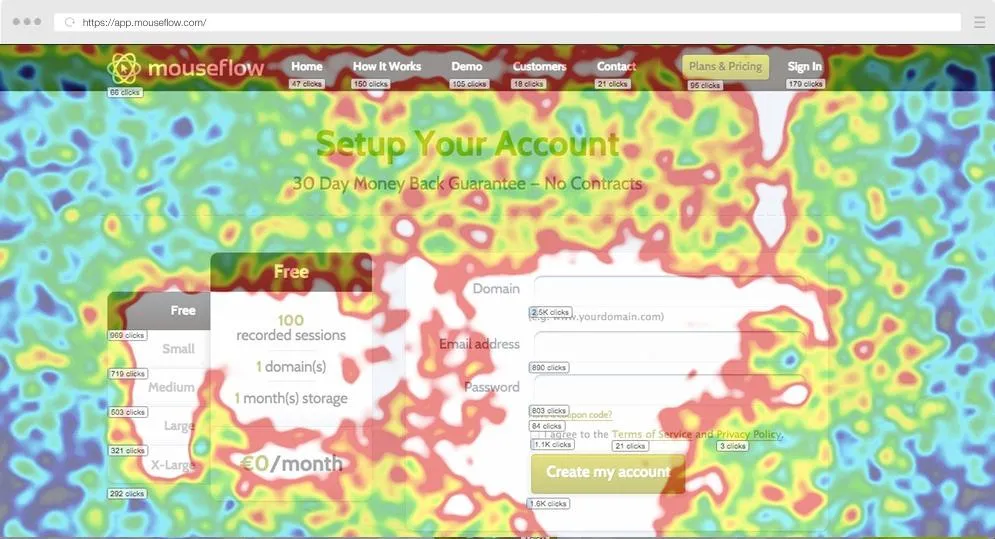
Every visitor should understand within a few seconds what it's about. It's not for nothing that one of the best books on web usability is called “Don't Make Me Think” (Steve Krug). The website must also be mobile responsive; tools like Mouseflow or Hotjar help you understand whether users find what they're looking for.
Since July 5, 2024, the switch to mobile-first indexing has been fully completed: Google crawls and indexes only the mobile version. In the audit, you should check whether all content, internal links, and structured data are present on the mobile version just as they are on the desktop – otherwise they won't be taken into account.
Which SEO tools are recommended for SEO audits besides the Google Search Console?
Analysis tools help enormously with SEO audits, especially with larger websites. There are various SEO tools – our recommendations for audits are:
Important: A Fool with a Tool is still a … Right! Without experience in the field of SEO, you can use as many analysis tools as you like and will still not manage to produce a full-fledged SEO audit.
The tools serve only as support and cannot replace an SEO freelancer or an SEO agency.
So if you want to carry out an audit but have too little experience in this area, it's always advisable to bring professional help on board in advance.
It becomes significantly more expensive if a website has been made worse by well-meant changes and then only in hindsight is help brought in. Better to get proper advice right from the start!
SEO audit checklist

Depending on size, competition, industry and keyword set, an audit is always different. The checklist helps to discover the first big potentials.
How often an audit is due depends on the size and dynamics of the website: a complete SEO audit at least once a year, a compact quick check every three to six months. After a larger Google update or a relaunch, an unscheduled audit makes sense.
Download checklist (Google Sheet)
Further sources:
https://seosly.com/technical-seo-audit/
https://sitebulb.com/resources/guides/how-to-approach-website-seo-audits/
Conclusion: No successful search engine optimization without an SEO audit
With the checklist here in the article, beginners as well as advanced users can subject their website to a first audit and thus advance their search engine optimization.
Every SEO audit brings important insights into the current status of the website and optimization potentials to light.
Don't forget that every website can bring different challenges with it and that every SEO audit is therefore different.
FAQ
What is an SEO audit and why is it so important?
An SEO audit is the analysis of a complete website from an SEO perspective in order to uncover sources of error. The goal of an audit is to show all optimization potentials and to derive a corresponding strategy including SEO measures from them, so that the website can receive more traffic and leads via organic search.
Which tools are helpful for an SEO audit?
Classic SEO tools here include, among others, Screaming Frog or Sitebulb for the OnPage and technical analysis. Google's own tools, such as Google Analytics, are also an absolute must, as are the tools Majestic or Ahrefs for analyzing the link profile.
Are tools and AI chats enough for a complete audit?
No, never rely only on tools and AI chats! For a good SEO audit, a professional who can correctly interpret the tools' possible error messages must always also check the website manually.
What happens after the SEO audit?
The audit serves as the basis for the development and planning of a successful SEO strategy and individual SEO measures. Without the information from the audit, no meaningful strategy can be developed.
What is the basis for an audit?
The website and the keyword research serve as the basis. With these, a meaningful analysis can be carried out.
What does an audit by an SEO agency cost?
The costs vary here depending on the effort involved and the size of the website. For smaller websites, an SEO audit can cost approximately €1,000 as a one-off. For larger websites, a complete SEO analysis can also be significantly more expensive (>€5,000).
Need a GEO check?
Get in touch for more visibility – in search engines and AI answers.
- More visibility and leads via Google and AI chats
- Sustainable SEO & GEO strategies
- Personal support


