
SEO Basics & Strategy
The SEO Competitor Analysis: 16 Points You Need to Check

The SEO competitor analysis is important.
No matter how small the niche you want to establish yourself in: Competition (almost) always exists – and you should make it your goal to get ahead of it in the Google search results (and by now also in AI answers).
Strength and size of the competitors (rivals) can vary greatly.
In the following article, we'll show you how to find your biggest rivals, analyze them correctly and derive further courses of action for optimization from them. From your competitors you can often still learn something …
The four pillars of SEO competitor analysis
Competitor analysis in SEO is based on four pillars, which we'll cover in more detail in this article:

1.) Find your biggest SEO competitors
Know your niche and find all the relevant keywords for it. How to conduct a detailed keyword research, we've already shown in a previous article.
Once you have all the important keywords for your website together, look at the TOP 10 on Google for these keywords. A simple but important step. Write down which pages rank ahead of you in the search results (SERPs) on Google.
Which websites appear especially often in the TOP 10 for various keywords? Is it always the same frontrunners that appear in the TOP 5 for your keywords, or do they vary greatly? This way you quickly get an overview of which competitors rank well ahead of you in the SERPs.
1.1) Determine all relevant keywords and the rankings of your strongest competition
We recommend the SEO module from Sistrix. It gives you the option to quickly and easily analyze your competitors' rankings.
Here you can also see for which relevant keywords they are optimizing their website.
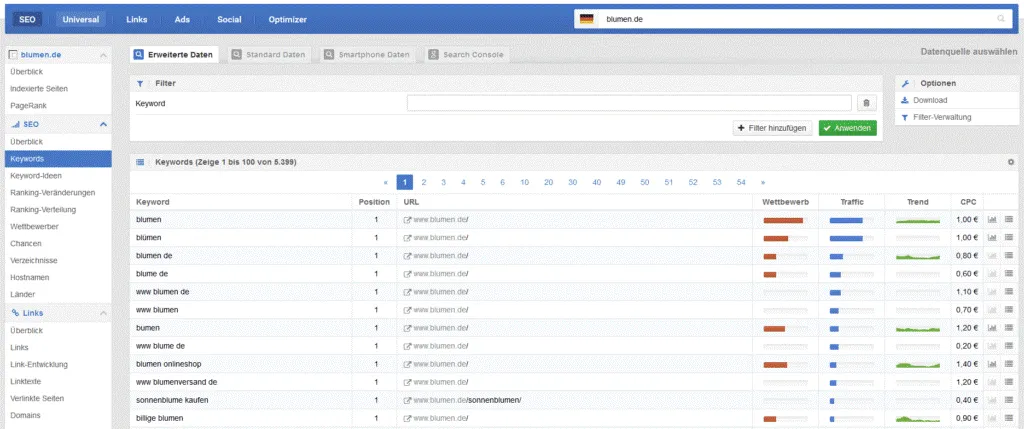
It's downright addictive to analyze your competitors' rankings with this tool, because it gives you the option to quickly discover new, interesting keywords for your site. You may have overlooked these during your own keyword research.
A good alternative to Sistrix is, for example, Metrics.tools. You'll find more tools for competitor analysis of visibility in this SEO tools overview.
1.2) Determine the organic traffic of your rivals
With tools like Ahrefs or Semrush, you can display the traffic that competitors receive via Google. The data is, of course, not 100% accurate, but it gives a good estimate.

It's especially interesting to see here which search terms bring your rivals the most organic traffic. This is where you can identify the “gold (traffic) nuggets” among your competitors' search terms.
Tools like Ahrefs or Sistrix also try to identify suitable competitors based on your existing rankings. It's often worthwhile to check their suggestions as well in order to identify additional competitors.
1.3) AI citations: Determine visibility in the AI Overviews
Classic rankings on page 1 are now only half the battle. In a time when Google AI Overviews and AI chatbots like ChatGPT, Claude & Co. strongly influence search traffic, you have to find out who is also named there as a source (as a mention or citation).
Often a competitor ranks first among the classic blue text links, while completely different websites are linked in the prominent AI answer above them. So for your most important keywords, always check which competitors the generative AI prefers to draw on as a source.
With tools like Sistrix, Ahrefs and Semrush, you can also analyze the competition's visibility in the AI chats.

1.4) Multimodal competitor analysis: Text vs. Video & Shopping
The look at the search results pages (SERPs) can no longer be limited to classic text rankings. The results have become highly visual and multimedia-driven.
Check which formats the competition ranks with. Do they dominate the video snippets (YouTube/Shorts) in the SERPs? Do they take up the majority of the organic shopping results (product grids)? Are the AI Overviews (AI overview) shown in the results?
If your competitors flood the search results page with short videos and Google obviously prefers this format for the search query, even the best analysis of their text content won't help you. You have to find out which media formats the “opponent” is positioned in – and where they might leave gaps that you can fill.
2.) Collect relevant data on your SEO competition
Once you have captured the competition, you should check a few SEO metrics in order to assess the competitor even better.
2.1) Domain age
Especially old domains (> 3 years) that are maintained regularly often enjoy a very high level of trust from Google. If there are many such old domains among your competitors, it could become difficult to achieve good rankings here in the short term.
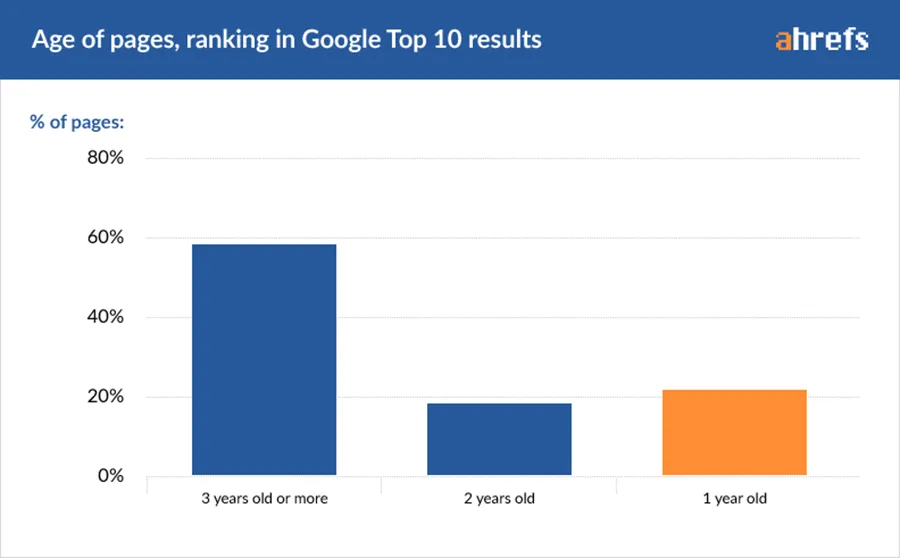
Of course, whether you can overtake this competition depends on your domain and your optimizations.
2.2) Domain Authority and Page Authority (alternative: Domain Rating)
The two metrics Domain Authority (DA) and Page Authority (PA) from Moz.com serve to give a first impression of the strength of a domain. Both metrics use various factors to evaluate domains. The higher these values are, the stronger the domain is (in theory).
If the values (DA and PA) are above 30, you may already be dealing with a well-optimized website. If the values are above 50, you can brace yourself for a really strong rival. However, you should never focus on these numerical values alone. Amazon.de, for example, has very high DA and PA values, including for subpages or subcategories. Nevertheless, it's possible to overtake a weakly optimized subpage of Amazon.de on Google.
An alternative to the paid tool Moz.com is the metric Domain Rating from Ahrefs: this likewise represents the authority of a website.


But you shouldn't let yourself be dazzled by all the values – just because the competition has a significantly higher DR, for example, doesn't mean you stand no chance against them in the rankings.
There are many different ranking factors, and the authority or strength of the link profile is just one factor among many. With significantly better content, you can, for example, overtake even such high-authority pages in your niche.
2.3) Visibility index and trend
As already described in 1.1), you can “spy on” your competitors' rankings with Sistrix or Semrush.
But not only the rankings shown to you there are interesting, but also the trend of the visibility index and the current visibility value.
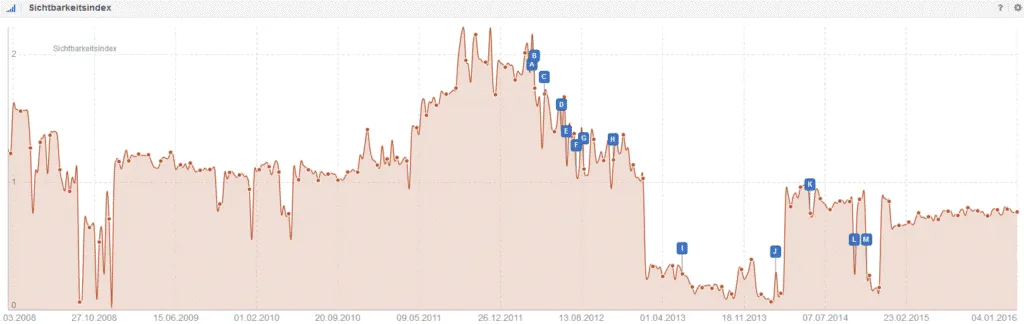
Depending on how your competitors' visibility develops, some conclusions can be drawn from it:
- How is the competitor's visibility index developing? Is a positive trend visible or does the curve tend to point downward?
A negative trend in a competitor's visibility does not necessarily mean that this site is easy to overtake. However, a negative trend can be seen as a sign that the site may be losing trust in Google's eyes or that no active SEO measures are being carried out here anymore. - Were there strong fluctuations in the visibility trend over the past few years that can be attributed to a Google penalty?
If so, it may be that your competitor subsequently declared some backlinks invalid using the Google Disavow Tool. This makes a proper backlink analysis of this competitor rather difficult, since it's not apparent which links they devalued and which they didn't. (More on this under “4. Backlinks of the competitors.”)

3.) OnPage status and content of the competition
The content of a website as well as other OnPage factors are decisive points that determine good rankings. Therefore, address the following points especially intensively during competitor analysis:
3.1) Web design and usability: Which target group is being addressed and which trust signals are there?
Is the design of the competitor websites appealing or rather old-fashioned? Compare the look of your website: can you keep up or even surpass your rivals with your web design?
With appealing web design that puts the user at the center (Don't make me think), you can already increase your visitors' dwell time.
Especially important: can visitors to the competitor websites understand their purpose within a few seconds? If not, that can be an advantage for your website … at least if you've designed your website so that every visitor grasps the purpose within seconds.
The design of the competitors also reveals a lot about how they address their target group: a large font on the website without a lot of gimmicks, for example, tends to appeal to an older, conservative target group.
So analyze your rivals' web presence very closely. Because in SEO, (almost) all optimizations are geared toward user satisfaction – that's exactly what Google also wants and is able to recognize better and better.
3.2) E-E-A-T analysis: Who is behind the content?
Since the internet is increasingly being flooded with generic AI text, Google today places massive value on E-E-A-T (Experience, Expertise, Authoritativeness, Trustworthiness). You absolutely must check how your competition demonstrates its human expertise.
Don't just look at the text length, but at everything around it. Do the top competitors work with verified author profiles? Are there genuine testimonials, certificates, detailed “About us” pages or verifiable expert opinions in the articles? If the top 3 in the chosen niche build up strong trust signals and real authors, it's no longer enough for you to simply write a better text. You also have to build up verifiable expertise and communicate it on the page.
3.3) Pagespeed (loading speed) of the competitor websites
What about the loading times (the pagespeed) of your rivals' websites? Does your site load faster or slower?
With the online tools Google PageSpeed Insights or Webpagetest.org you can check the loading times of any website and compare them with your own.
As an alternative, we can also recommend GTmetrix.com – with a free registration, several different pages (of your competition, for example) can be compared with one another here. The important Web Vitals, such as Largest Contentful Paint (LCP), Interaction to Next Paint (INP) and Cumulative Layout Shift (CLS), which are ranking factors, can also be analyzed and compared.

If your website loads significantly slower and your Web Vitals are also worse than those of your competitors, you should of course improve the loading times.
3.4) Site architecture
Check how the competitor website's site architecture is structured:
- Which menu items are there?
- Which keywords can be found in the menu?
- Is there a blog or advice section?
- Which categories are there for products, blog posts, etc.? Are there main and subcategories? How can they be reached? Can only the main categories be found in the menu, or subcategories as well?
- Are breadcrumbs used on the site?
- Are there landing pages for all important keywords?
- Is there an “About us” and “Contact” page?
3.4.1) Internal linking
Check how the rival links internally, vertically and horizontally.
What does vertical linking mean?
The website is structured so that every category can be reached with as few clicks as possible. This way, the main category can be reached with just one click from the homepage. The subcategories below it should be reachable with a few more clicks.
What does horizontal linking mean?
With horizontal linking, individual documents (posts, pages, etc.) that belong to a common category are linked internally with one another.
Example post 1 in category X -> links to example post 2 in category Y -> links to example post 3 in category Z -> etc.
This is often referred to as related content links. Such internal links are frequently found within the body text of a post / a page.
- Are there internal links in the body texts of the competitor website? If so, with which anchor texts do they link there?
- Apart from the menu and the body text, are there other internal links on the website, for example in the sidebar or in the footer?
Optimal internal linking is important in order to distribute as much link juice as evenly as possible across a website. Internal links also say a lot about which keywords a page has been optimized for.
3.4.2) Outgoing links
Which websites do the competitors link to?
Do the rivals link to many external sources to back up claims, or is the linking rather stingy?
Outgoing links are probably not a direct ranking factor, but they do help to back up certain statements with sources and thereby gain more trust with visitors and Google.
3.5) The content of your SEO rivals
A very important point: what are the texts for your keywords like at the SEO competitors?
Are the individual keywords fobbed off with a short, meaningless text, or do these texts have a high informational value?
Which questions do the texts answer, and do these answers match your experience?
If you want to overtake the competition for the keywords, it's important to have even better and more informative texts. So analyze your competitors' texts closely.
Also look at the way the content is prepared at your competitors:
- Which search intent is answered per URL/text? Is there a strong focus here?
- Are there e-books or videos on certain topics?
- Are there article series on especially large topics?
- Are hub pages or distribution pages used to offer an entry point into a large topic?
- How many words do the texts have on average?
- Are infographics and checklists used?
- Are there other content ideas that you can also apply to your site, such as podcasts, interviews or free tools?
- Which terms are used besides the obvious main keywords? (TF*IDF analysis tools like Surferseo.com help with this)

But you can also analyze your competitors' website content even further:
- Are guest posts by other authors published?
- Are their own images created or are stock photos purchased?
- Do the texts operate on a factual or rather emotional level?
- Is content marketing being done, for example via their own YouTube channel and much more?
- Definitely take a look at how much content/text there is in total. Is it kept up to date and is new content published regularly?
Checking the content is a very important step in an SEO competitor analysis. Google is still a full-text search engine. So the better the content, the better the ranking chances.
3.6) Closing the entity gap
Until now, when looking at the competition, people almost exclusively searched for the “keyword gap” – that is, which search terms the competitor ranks for that I don't yet cover on my site.
The shift to semantic search means that Google (and AI) prioritize topic concepts (entities) instead of individual words.
You have to analyze: Which subject-matter connections, people, places or concepts does the top competitor address in their content that are missing from your site? Only those who cover the topic comprehensively (holistically) and serve all relevant entities are recognized as a topic leader and sustainably push out the competition.
4.) The backlinks of the competitors
Besides content, backlinks are one of the most important ranking factors at Google & Co. Anyone who has strong, topically relevant backlinks has a lot of advantages and the best chances for very good rankings.
So use tools like Ahrefs.com or Majestic.com to check the link profile and the backlinks of your competition.

However, you shouldn't rely 100% on the data from these tools, since the competition may have declared one or another backlink invalid via the Google Disavow Tool, for example to prevent a Google penalty for unnatural links (see 2.3 Visibility index and trend).
Nevertheless, it makes sense to analyze the competition's link profiles in order to find interesting link sources for yourself. But before you blindly start to rebuild these 1:1, the link sources should be checked for their strength.
The ratio of deep links to homepage links as well as the distribution of the anchor texts also reveals a lot about the competition's link building.

The number of backlinks in the competition's link profile should also be checked. Did the competitor achieve their top rankings with a few weak forum links or with some very strong guest posts from large portals?
The ways to get backlinks are diverse – and knowing how the rivals build backlinks can bring very interesting learnings for your own link building.
Possible uses of AI: SEO competitor analysis with AI
The possibilities of AI are also extremely helpful for competitor analysis. For example, with the CustomChatGPT “FREE SEO Reverse Engineering GPT” the SERPs can be analyzed and valuable information can be extracted from the TOP search results.

Check your competition's content: On notebooklm.google.com you can upload individual texts from your competitors and compare them with your text. This way you quickly see whether you've forgotten important topics and terms in your article.
In the case of the four pillars of SEO competitor analysis mentioned above, smaller tasks can also be taken over by an AI, e.g. asking ChatGPT who it considers the biggest competitor and having it provide corresponding data on domain age etc.
Note: ChatGPT & Co. can simplify OR complicate competitor analysis. Many people simply rely too blindly on the statements of an AI. Yet ChatGPT itself points out that the AI can make mistakes and that all information must be verified.
Conclusion: An SEO competitor analysis is a must
Once you've found your competition, you should examine their website closely. Every little detail reveals valuable information to you about target group, keywords, content and many other topics, without you having to invest much work yourself into an SEO competitive analysis.
The goal of the SEO competitor analysis is ultimately to recognize the competitors' SEO strategy and draw conclusions from it for your own SEO measures. For example, which keywords the competitors optimize especially heavily for, how they build backlinks, which content strategy they pursue and much more …
The better you understand the competition in the top positions, the more easily you can also optimize your own website in order to likewise achieve TOP rankings.
Still have questions? Then watch our video on it now:
FAQ
What is an SEO competitor analysis and what is it good for?
An SEO competitor analysis is about analyzing the competition with regard to their SEO performance. Examined here are, among other things, the competitors' rankings for keywords, the SEO traffic according to Ahrefs or Semrush, the competitors' SEO strategy and much more.
Why should you check the competition regularly?
The market changes constantly in many industries, and Google also frequently changes its ranking factors or their weighting. New ranking factors are added as well, and much more makes SEO a continuous process. The competitors aren't sleeping and also optimize their website regularly. So you always have to stay on the ball and keep optimizing your website continuously.
Which tools are recommended for an SEO competitor analysis?
In order to analyze the competitors in as much detail as possible, the use of tools is indispensable. Whether it's the analysis of rankings for interesting keywords or the SEO traffic – that and much more can be analyzed specifically via tools. Here we recommend Sistrix for the German-speaking region and Ahrefs or Semrush for analyzing websites in the international markets.
From an SEO perspective, is it important to also analyze the competition's activities on the social networks?
No – for a complete competitor analysis it is indeed interesting on which platforms the rivals are present, however company fan pages on social networks, for example, have no influence on SEO. They therefore do not need to be considered in an SEO competitor analysis.
How expensive is an SEO competitor analysis by an SEO agency?
The costs of an SEO analysis of the competitors by an SEO agency vary depending on the effort. Do two small websites need to be analyzed here, or several very large rivals? Depending on the effort, a competitor analysis starts at approx. €800 and can easily cost more than €2,000 for larger sites. An SEO agency will usually only offer an SEO competitor analysis in connection with an SEO audit and an SEO strategy, since all three areas belong together and you can derive sensible SEO measures for an SEO campaign from them.
The perfect SEO strategy for your company
We develop a tailor-made SEO strategy for your company and support you month after month with the implementation through our ongoing SEO support. Contact us now for a no-obligation initial consultation.
Need a GEO check?
Get in touch for more visibility – in search engines and AI answers.
- More visibility and leads via Google and AI chats
- Sustainable SEO & GEO strategies
- Personal support


