
SEO Basics & Strategy
Developing an SEO Strategy: A Guide with Practical Examples


An SEO strategy is the foundation of every successful SEO campaign. Without a strategy, search engine optimization is like flying blind – success then comes either by chance or not at all.
In this post, you'll therefore learn how to create a successful SEO strategy for your project and what you need to pay attention to.
What Is an SEO Strategy?
The success of a website with search engines depends on many different factors. Every website faces different challenges – an SEO template that fits every website to achieve good rankings simply doesn't exist.
During optimization, therefore, a plan (the SEO strategy) is needed as to which measures must be deployed for the respective website in order to achieve the desired SEO goals.
Difference: Strategy vs. Tactics
For the sake of completeness: strategy and tactics are not the same. A strategy is always about long-term goals that are to be achieved. A tactic is about short-term goals.
In this short post, however, I don't want to draw such a strong dividing line, because it simply doesn't contribute to the success of an SEO campaign and I will therefore always write about an SEO strategy.
The Phases of SEO Strategy Development
The development of an SEO strategy is subject to several phases. Only if these steps are carried out properly can a full-fledged SEO strategy be determined that can have a corresponding impact.
The phases of an SEO strategy development:
- Audit of the website / status quo
- Keyword research
- Competitor analysis
- Action plan
Let's take a look at the phases in detail:
Audit / Status quo
An SEO audit of the website is the most important foundation of an SEO strategy development. Only if the website has been thoroughly analyzed can the right measures be derived from it. That's why it's important, during an audit, not to blindly trust only tools, but to always analyze the complete website yourself.
The gamification approach of many on-page tools tempts you into just staring at some percentage values and rigidly designing the optimization according to them. But an SEO tool can only capture and evaluate complex topics, such as user-friendliness, a sensible information architecture, and much more, to a limited extent.
That's why it's so important to always analyze the website yourself and to have tools like Screaming Frog, Ryte, and Co. as a helping hand along the way.
The audit isn't just about on-page measures, but about all SEO potentials. What does the website's link profile look like? What is the competition doing in the area of SEO? … and an SEO audit should be able to provide answers to much more.
Here you can find more info on everything that belongs in an SEO audit.
Keyword Research
The Keyword research is the second major foundation – only if you know for which search terms the website should be found can you really tackle the corresponding measures, such as content creation, landing page optimization, and much more.
Super important with keyword research: Always determine the search intent! This helps immensely to significantly increase your ranking chances.
You can find more about Keyword research in this blog article.
Competitor analysis
Thanks to tools like Sistrix or Metrics.tools, you can quickly find out how the competitors in the market are acting in the area of SEO. Is proper optimization already happening here? Are there interesting rankings for important keywords? What is the competition doing to achieve good rankings?
It's precisely through such questions that you find out how strong the competition is in SEO.
Even more about SEO competitor analysis can be found on our blog.
SEO Action Plan
Once the first three phases have been successfully completed, the optimization potentials and insights have to be organized into meaningful measures – and that is exactly what the SEO strategy is. Based on the numerous insights, it sets out the path for how you can achieve your SEO goals accordingly.
But what can such measures look like? What can you expect here? Don't worry, we have plenty of examples …
Guide: Developing an SEO Strategy Yourself - Here's How
Now that you know which phases belong to an SEO strategy development and which measures there are, we'll show you a guide here on how you can develop an SEO strategy yourself:
1. Record the current status of your website: How properly is the website structured in the areas of on-page and off-page?
2. The competition: Compare your website with those of the competition.
3. Rankings: How does your website rank? For which keywords from the keyword research are there no good rankings?
4. Define the catalog of measures: Where does your website need improvement in the areas of on-page, content, and off-page? Where is the competition stronger?
5. Define a priority list and schedule: Prioritize all measures (everything at once usually isn't possible) and define a schedule.
6. Set up monitoring: Monitoring the implementation and measuring the results in order to see whether the SEO strategy is working.
Examples: SEO Strategies and SEO Measures
Let's start with the area of on-page. Here are three examples of SEO measures that are very often used in an on-page SEO strategy:
- Fix technical errors, such as URLs with a 404 status code, broken links, etc.
- Improve technical user experience (UX): Core Web Vitals and especially the INP value (Interaction to Next Paint) are also important. A fast, responsive mobile-first page is a must for SEO.
- Improve index management: Too many URLs without added value for the user, duplicate content, and more can turn into real SEO problems.
- Optimize the information architecture, dig out important subpages that are hidden too deep in the website's architecture and are therefore also not interesting for Google. Here, of course, internal links can help.
In the area of on-page alone, there are countless possible measures – the ones mentioned above are only meant to give a brief overview.
Content Strategy
For a full-text search engine like Google, content is still immensely important. With many measures, the content of the website is therefore also often optimized. For example, SEO strategies in the area of content can look like this:
- Answer informational keywords: Shops in particular often rely only on transactional keywords. But via a wiki or a magazine, informational keywords can also be specifically tapped, and additional traffic can thus be generated.
- Create hub pages/pillar pages/distributor pages: Call them what you want, but creating so-called overview pages for a main topic with many subtopics is a popular means in a content strategy for SEO.
- Texts for shop categories: Still super important for online shops is an additional text below the respective product category – but this should have high added value and not be an SEO wall of text. More on this here on our blog on the topic “Optimizing shop categories”.
Generative Engine Optimization (GEO) for AI Overviews, ChatGPT & Co.
Classic Google search is changing rapidly. AI-generated answers (like Google AI Overviews or ChatGPT) are now often right at the top of the search results. A modern SEO strategy must therefore necessarily include GEO.
- Goal: To be named as a trustworthy source in these AI summaries (as a mention or citation).
- Implementation in practice: Away from a pure keyword focus, toward facts, strong entities, and easily extractable information in your content that language models (LLMs) can process particularly well and output as an answer.
E-E-A-T: With Real Experience Against the AI Content Flood
Since the internet is increasingly being flooded with automatically generated AI texts (AI slop), Google places massive importance on E-E-A-T (Experience, Expertise, Authoritativeness, Trustworthiness). A future-proof SEO strategy must necessarily demonstrate real human “experience”.
- Build up verified author profiles, integrate personal insights, original data, real tests, and expert opinions into your content. Create content that an AI simply can't copy together from existing data.
Zero-Click Searches & New KPIs
Today, users increasingly get their answers directly on the search results page, without even clicking on a result at all (zero-click searches). The classic equation “rank 1 = lots of traffic” hardly works anymore for simple informational keywords.
- An SEO strategy therefore also focuses on complex long-tail search queries that are so in-depth that the user necessarily has to go to your website. At the same time, SERP marketing – that is, pure brand presence and visibility in the search results, even without a click – is becoming a decisive new KPI.
Multimodal SERPs: Choosing the Right Format
Users often still type their search queries into Google in the classic way, but the search results pages (SERPs) have changed massively. The top 10 have long since stopped consisting only of blue text links.
In order to still capture maximum visibility today, an SEO strategy has to show which formats you can rank with.
In e-commerce, optimizing your product data for the organic Product Grid (free listings) is an absolute must in order to appear directly and visually with an image and price.
For many informational search queries, you often only get to the top spots with video content (like YouTube or Shorts) or image carousels. So in the strategy phase, find out which media format Google prefers for your most important keywords, and deliver exactly that.
Building the Brand
The topic of building the brand is becoming increasingly important for SEO, because Google often grants brands higher trust. A company that is searched for and creates trust among users has also earned receiving a certain amount of trust from Google. That's why SEO strategies are increasingly aiming at optimizing brand search. Here's an example:
- Videos & podcasts: Additional brand awareness can be achieved via YouTube. A simple example here is Whisky.de, which was able to significantly push its shop with short, informative videos on YouTube.
Do you think building a brand is only for very large budgets? No, it works on a small scale too! An example: Thanks to our SEO podcast and YouTube channel, we were also able to additionally increase our brand search – so it doesn't always have to be a mega-expensive TV advertising campaign for building a brand.
Link-Building Strategies
A super important ranking factor is still backlinks. Here, too, there are various strategies for link building, such as:
- Link earnings with content marketing: Regularly publishing interesting content, becoming a thought leader in your niche, studies, and much more can generate backlinks.
- Link baits: Targeted actions to get webmasters to link to your link bait. A bit old-school, but it can still work incredibly well.
As you notice, there simply can't be any SEO strategy templates. It always depends on which strategies and SEO measures fit the website and the market.
Two Practical Examples
Enough of the theory; here are two more exciting SEO strategies from practice:
Content and On-Page Strategy of Vita34.de
Vita34 is a provider for freezing umbilical cord blood from newborns. The provider has the “problem” that the target group, young adults expecting offspring, often doesn't even know about this service. Vita34.de therefore tries to reach this target group not only via transactional keywords such as “freeze umbilical cord blood,” but to reach expectant parents when choosing a suitable name for their offspring.
So there are, among others, the directories /namenslisten/vornamen-fuer-jungen/ and /namenslisten/vornamen-fuer-maedchen/ on the website. Here, then, a target group is reached that may not know the product but might nevertheless be interested in Vita34's product.
That's how a clever SEO strategy works!

Off-Page Strategy of kaufda.de:
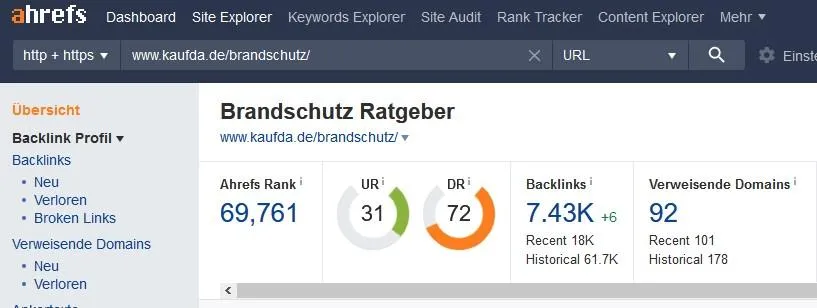
With a fire safety guide (kaufda.de/brandschutz/) on Kaufda, a really good link bait was created that brought the website some really strong backlinks.
That's another way a good SEO strategy can look.
Be sure to watch our video above on the topic of SEO strategies; there you'll find a third practical example.
Possible Hurdles for the Successful Implementation of the SEO Strategy
An SEO strategy and its implementation particularly often fails on these points:

- The marketing mix doesn't fit: SEO can be ever so good, but if the product or service doesn't appeal to the target group, SEO simply can't work miracles either.
- Not all stakeholders in the company pull together: With SEO, ideally everyone in the company has to go in the same direction. If employees or departments obstruct things, no successful SEO can be carried out.
- No monitoring to check whether the strategy really works out. It's annoying when the measures aren't checked for their success, because then no one can know whether the SEO strategy really works.
The biggest mistake, however, is: Not adapting the strategy when the desired SEO goals, despite the implementation so far, don't materialize. Google can release new updates, but also the behavior of the competition, changes in the market and much more require that an SEO strategy is adaptable. Otherwise you're optimizing according to a strategy, but the rigid specifications won't get you anywhere. Flexibility and adaptability simply always win in SEO.
Need a GEO check?
Get in touch for more visibility – in search engines and AI answers.
- More visibility and leads via Google and AI chats
- Sustainable SEO & GEO strategies
- Personal support


