
SEO Basics & Strategy
E-Commerce SEO (2026): How Your Online Shop Dominates the Search Results

The e-commerce market is truly gigantic.
According to the current European E-Commerce Report, 79 percent of people in Germany now shop online, and according to Statista this market will grow by a total of 4.1 million users (+8.6 percent) by 2029.
But how do you ensure that your own shop benefits from this positive development?
Successful SEO for online shops is much more than adding a few keywords: the entire customer journey must be covered, technical hurdles must be mastered, and external signals must show that your own shop is worth finding.
In this practical guide, you'll learn exactly that: what matters in e-commerce SEO and how your own shop achieves the best possible visibility. Let's get started!
Overview
- What is e-commerce SEO? E-commerce SEO improves the ranking of online shops in order to generate more organic traffic.
- Why SEO for e-commerce? A huge market (Google Search, but also AI answers) can be tapped with e-commerce SEO and bring free traffic to the shop. In the long term, SEO often has the best ROI.
- Which shop system? There is no single right system. What matters in a CMS is clean technology, fast loading times, little unnecessary JavaScript, as well as flexible adjustment of the most important SEO elements (e.g. title tags, canonicals) and easy content maintenance.
- AI, SEO and e-commerce? AI can make many things easier, but beware of uncontrolled automation! Content created by AI, for example, must always be revised beforehand.
- What is the Google Shopping Graph? Google's search for products. Anyone who maintains their Merchant Center properly ends up here with product cards and can additionally generate free traffic (Free Listings).
What is e-commerce SEO? (Definition)
E-commerce SEO refers to the optimization of online shops for search engines, in order to be found for relevant search queries in the organic (unpaid) search results and answers of Google & co.
A major focus in SEO for online shops is on the optimization of category and product pages, in order to guide purchase-ready users from the search engines to the shop. With a glossary or advice sections, a shop can additionally build authority.
More insights on SEO for online shops:
Magento SEO tutorial: How to get your Magento shop fit for the search engines Updated: February 27, 2026

Shopware SEO: The most important basics for a better ranking of your online shop Updated: October 2, 2025

The Shopify SEO guide for more visibility and traffic Updated: October 2, 2025

E-Commerce SEO Agency Updated: May 28, 2026
Which CMS system is suitable for e-commerce SEO?
The foundation of a shop's SEO success is the CMS system used. An old shop system that does not meet modern requirements has hardly any chance of being found on Google.
The shop system must meet current technical standards and have important SEO functionalities:
- Technical flexibility: The system must make all important SEO elements freely configurable – this includes title tags, meta descriptions, hreflang tags, canonical and noindex tags, headings (H tags), as well as URL structures (permalinks).
- Page structure and navigation: Categories, filter pages and the shop navigation must be individually customizable – including pagination, product count and custom content per category.
- Performance and code quality: The system should generate clean, lean code and avoid excessive use of JavaScript. Technical errors and sloppiness here can make good rankings significantly harder.
- Mobile-friendliness, appearance and updates: Since Google evaluates the mobile version of a page (mobile-first), a responsive design is not a nice-to-have, but an absolute must. The same applies to regular updates as well as an appealing appearance of the shop that resonates with the target group (Google also evaluates user signals).
- Content extensibility: The system should offer the possibility to create new landing pages, blog posts or glossary pages without technical effort. For the greatest possible SEO success, not only optimized product & category pages are important, but also informational content that engages users early in the customer journey.
Excursus: Classic systems vs. headless commerce
Classic systems (monolithic systems): With systems like Shopware, Shopify or WooCommerce, the frontend and backend are firmly connected. They are often very beginner-friendly and offer many SEO standards right away, but are less flexible when it comes to certain performance requirements.
Headless commerce: Here the frontend is decoupled from the backend and content is delivered via API. This usually allows much better loading-time optimization and design freedom. Examples are specialized systems like commercetools, Spryker or also Shopify Plus (in a headless setup). Only for technically skilled shop operators and teams.
Recommended CMS shop systems for SEO
There are numerous shop systems that can be optimized very well. Which system is the right one depends on your own needs.
Here are our personal (SEO) favorites:
Google does not prefer any particular shop system, so the choice should not be made from an SEO perspective alone, but should be aligned with your own needs, such as the ERP system, interfaces to large marketplaces and much more.
You can find the current market shares of CMS systems on w3techs.com.
Keyword research for online shops
With keyword research it's like with the shop systems: without knowledge of the keywords relevant to the shop, SEO success will also fail to materialize here. In order to be able to engage the target group throughout the entire cycle of the customer journey, an analysis of all relevant keywords is important.
Everything important about keyword research:
Anyone who wants to learn the important basics of keyword research and more about handling tools like Sistrix, KWfinder or Ahrefs will find help in the following guide and in the video.

Keyword research: A complete guide from A to Z – how to find the best keywords! Updated: March 15, 2026
Transactional vs. informational keywords in the shop
Google & co. now recognize the user intent behind search queries very well. A shop that tries to rank with transactional advertising content for information-driven search queries will fail and receive no traffic via SEO. Keywords must therefore be strictly analyzed and, depending on the search intent type, separated and assigned to the appropriate page types in the shop.
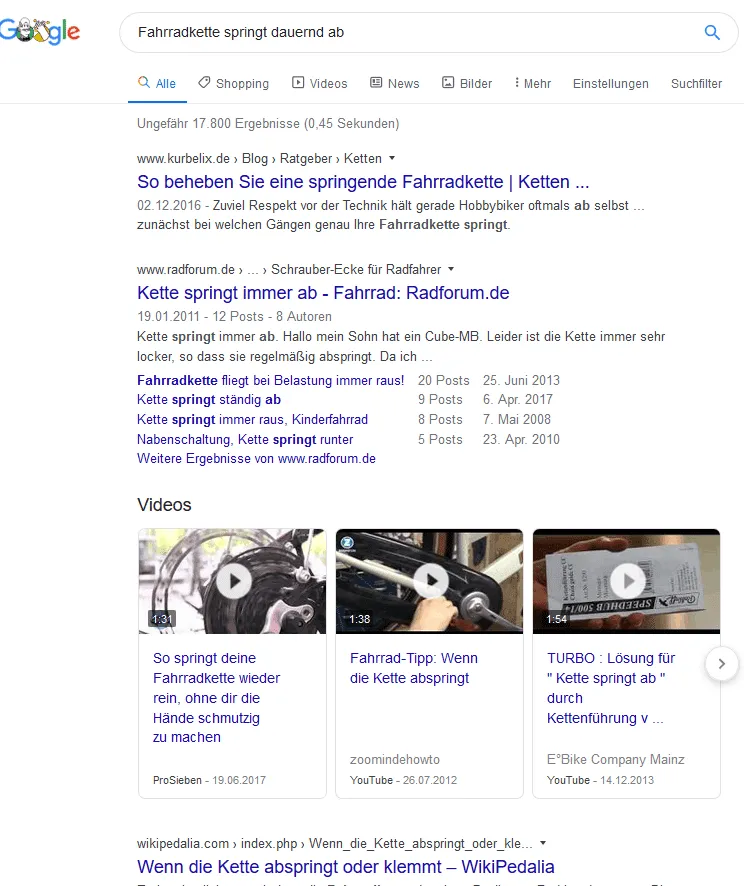
Information-driven keywords (advice & magazine): The user has a problem or a question and is looking for a solution, not primarily for a product. They are still at the very beginning of the customer journey.
Example: “bicycle chain keeps falling off”
Where to use: These search terms belong in a shop blog or a separate advice section. Pure product or category pages usually do not rank for these purely informational search queries.
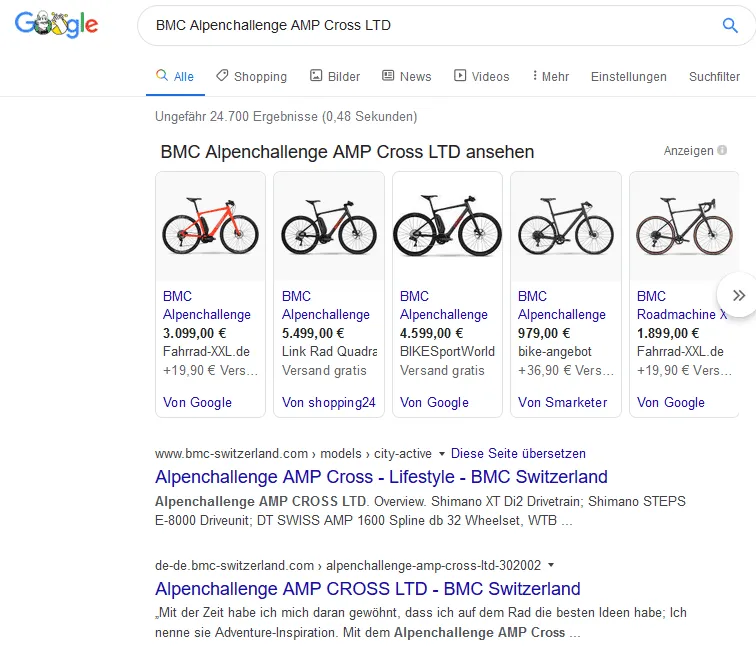
Transactional & commercial keywords (categories & products):
The user is relatively at the end of the customer journey and has a clear purchase intent. They want to compare specific products and possibly order directly online from an online shop.
Examples: “buy e-bike step-through” (product-unspecific = wants a category page) or “BMC Alpenchallenge AMP Cross LTD” (product-specific = wants a product page).
Where to use: Commercial search terms (generic) belong on the category pages (the most important revenue drivers in e-commerce), while specific search queries (such as model names) target the product page.
Keyword mapping for e-commerce
One big SEO problem that many underestimate is keyword cannibalization. When a shop tries to rank for an exact search term with multiple URLs, this unfortunately only confuses Google instead of having a positive impact.
A typical scenario: A high-revenue category page is optimized for the transactional keyword “buy e-bike.” In parallel, a detailed blog post is published with a focus on exactly the same search term.
Search engines can then no longer clearly decide which of the two URLs should be preferentially served in the search results.
Keyword map (master list)
With a structured keyword map, you can show exactly which URL in the shop is optimized for which keywords. Using such an Excel list, exactly one primary focus keyword is defined for each URL of the shop. Each keyword may appear only a single time as the main focus in the entire structure.
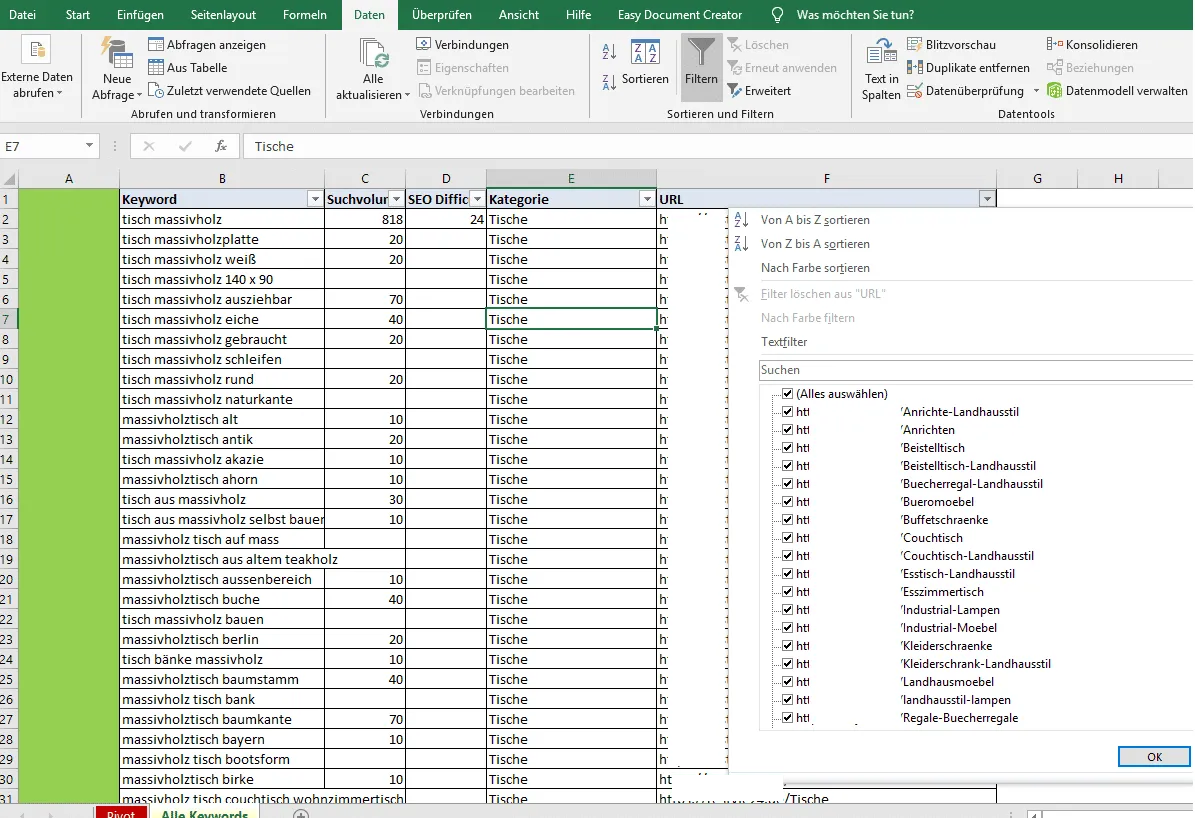
Once this architecture is planned cleanly and without overlaps, you can begin creating and optimizing the actual shop content.
On-page SEO & content for online shops in the AI age
On-page optimization encompasses all content-related and structural adjustments on the shop website itself.
In addition to a clean technical basis, it is above all the quality of the content and meta data (meta tags) that determines how well categories and products rank in the search engines.
Title tag and meta description (snippet optimization)
Every relevant URL needs optimized meta tags.
- The title tag is a direct (and important) ranking factor and should always have the respective main keyword at the beginning.
- The meta description is only an indirect ranking factor, but it can improve the click-through rate (CTR) in the search results and should therefore also be optimized.
- Caution: Keyword stuffing (the stringing together of keywords) has no place in the title tag and generally in successful e-commerce SEO.

Best practices for snippet optimization:
- The title tag should be about 50-60 characters long (max. 600 pixels) and should be meaningfully worded and encourage clicking. In addition to the main keyword, clear selling points (USPs) like “Free shipping” or “24h delivery” should be built in.
- The same also applies to the meta description: put USPs in the foreground, subtly include HTML icons if appropriate, and max. 150 characters long.
- Extra tip: Snippets are often clicked more frequently when concrete prices or years appear in the title. Individual tests are important here.
- Check: The snippet display of the shop (at least of all important URLs) should be regularly checked in the SERPs. Tools like the Sistrix SERP Snippet Generatorhelp to simulate the display in advance.
Automation and AI for meta data
With a large number of products, the manual maintenance of meta data is far too big a time drain. Many shop systems therefore offer dynamic patterns for product pages that automatically pull product data from the database. A classic template looks like this, for example:
“[product name] buy online | [shop name]”
By integrating variables such as price, brand or delivery time, these snippets always stay up to date and scale with the assortment. If such native shop functions are missing, AI tools like the add-on “GPT for Sheets and Docs” can convert large amounts of product data via API into finished meta titles & descriptions. The work must be checked beforehand in order to uncover typical AI errors such as hallucinations about product properties, ignoring the 150-character limit, as well as an overly generic tone.
Optimizing categories
Category pages are the most important landing pages of an online shop for generic, product-unspecific search queries (for example “Adidas sneakers men”).
With product-unspecific search queries, the user is looking for a product selection and not yet for a specific model. Since such search queries usually have a significantly higher search volume than product-specific search terms, the optimization of categories is especially important and in SEO for online shops usually has priority no. 1.
An SEO-friendly category structure (that also engages users) is divided, based on best-practice experience, into two sub-areas:
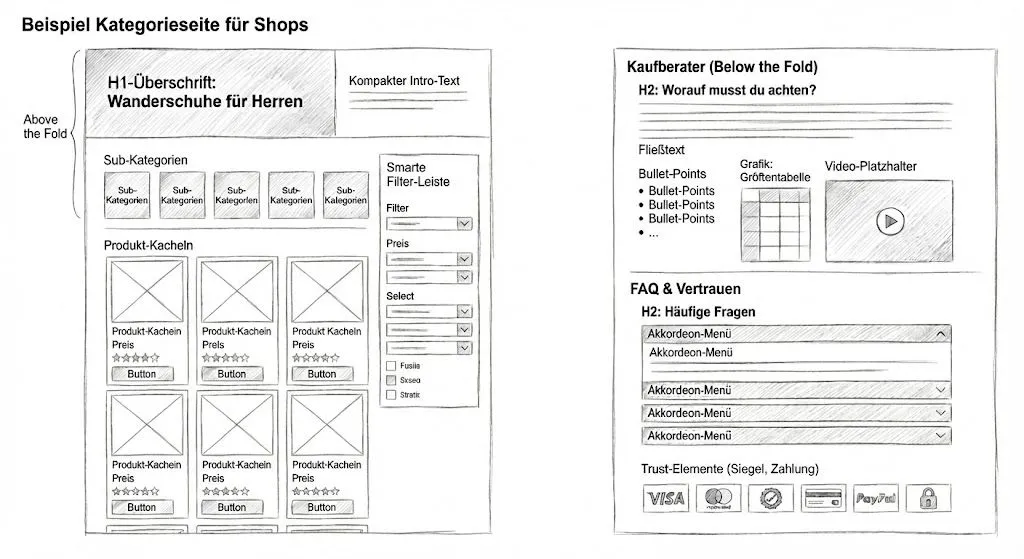
1. A short intro text above the products (in the above-the-fold section)
This immediately engages the user (and the search engines) thematically and integrates the primary main keyword organically in the visible area, without blocking direct access to the products.
The intro text may well be worded very directly (depending on the desired target-group address).
An example for a shop that sells moving boxes: “Moving without stress? Guaranteed with our moving boxes! Sturdily made and built to be load-bearing, they offer safe protection for everything that should reliably arrive in your new home.”
2. Buying-guide content below the products (below the fold)
Below the product listing is the actual purchase advice.
Caution: Nobody needs content-empty “SEO texts” and they will not contribute to good rankings.
The text must accordingly provide plenty of information, not be run-of-the-mill standard SEO content, offer instructions and contain images, tables and possibly videos, in order to ensure the best possible user experience and answer all open questions of the users. Exactly such content helps categories of shops gain enormously in visibility.
Design and text length
A wall of text is neither read by users nor rated positively by search engines. The content must be visually prepared and made easy to scan. This includes:
- Subheadings with a logical structure (H2, H3)
- Short paragraphs that encourage reading.
- Highlight boxes for the most important tips, possibly additionally with videos
- Comparison tables for quick overviews
- Bullet points for more structure
- FAQ sections with all important questions and answers
Do it better than the competition:
There is no optimal text length and no minimum word count (that would be SEO from 2006). An analysis of the top-10 search results provides the best benchmark for how detailed a topic should be covered.
Even more on SEO for shop categories:

SEO for shop categories: Better rankings and more traffic for online shops Updated: October 2, 2025
Optimizing product pages
Product pages are perfectly suited to capture specific search queries for long-tail keywords with transactional search intent and exact article names. The users who land on these pages are at the end of the customer journey, have a concrete purchase intent and want to make a purchase.
Important SEO elements in product descriptions:
- Scannability: Formatting with short paragraphs, bullet points, etc. makes it possible for everyone to quickly grasp the most important points about the product.
- Completeness: Information on dimensions, materials, compatibilities or scope of delivery should be quickly graspable for the user.
- Communicate benefits clearly: Instead of a mere listing of technical details, the practical added value of the product should be in the foreground.
Practical example product page:
Under the specification “60 cm height,” buyers often can't picture much. In the following example, the shop solves this nicely and visually and shows the plant in a person's hands to make the actual size tangible. Also well done is the nice overview of all important product info (how much water, light sensitivity, toxic to cats, etc.).

SEO problem: Products that are no longer available
With many online shops, it happens that a product is no longer deliverable at some point. Many shop operators then delete the product subpage or URL. If this URL previously had traffic and rankings, however, this can have a negative effect. It is clearly better to have the old URL of the no-longer-deliverable product lead to an alternative product via a 301 redirect. This way, customers who have saved the old URL, e.g. as a browser bookmark, in an email or similar, are directed straight to the correct successor product.
For Google, too, this has the advantage that the rankings for the old URL can usually be retained if a 301 redirect to a similar product is built in in time.
- Before a product is deleted, check whether rankings and traffic exist
- If yes, 301 redirect to a similar product
- No redirect to the homepage – this can be interpreted as a soft-404 error
- If there is no traffic and no rankings, delete the URL and serve it as 404 or 410
AI content & SEO: Warning about uncontrolled AI use
Creating content can cost a lot of time and money, which is why more and more people are deciding to use AI. Google clearly says that content creation by means of AI does not violate its webmaster guidelines (source) as long as the content is still good and correctly provides the reader with all the important information.
However, an uncontrolled, mass-generated content proliferation by means of AI can, according to Google, very well be regarded as manipulation and correspondingly penalized.
Smaller product texts can be created with AI chats like ChatGPT, Claude or Gemini and should be checked and revised afterwards in order to correct, e.g., hallucinations and errors of AIs. Content for relevant pages such as important categories, blog and glossary should for the most part be created by professional writers who know the subject matter, in order to really deliver high-quality content that answers users' questions as best as possible and provides problem solutions.
You can learn more about the design of landing pages (categories, product pages and much more) in this video:
Structured data (Schema.org) for e-commerce
Search engines (and also AIs) receive information about a shop through structured data, so-called schema markups. This can be used excellently to enrich your own online shop with important information and thus ensure that the crawlers understand the page and its content better.
Some important e-commerce markups at a glance:
- Company (LocalBusiness / Organization): With this markup, a company or a local retailer (LocalBusiness) can pass on information such as name, address, phone number or opening hours. For pure online shops without a local store, the type Organization is recommended.
- Product: The Product markup is used to describe products unambiguously. Here, information is entered such as product name, a description, images, a brand or an article number.
- Offer: With Offer, concrete offer information for a product is stored. This includes, for example, price, currency, availability or the link to the product page.
- Price: Price is a property within an Offer markup and indicates the current price of a product.
- AggregateRating: The AggregateRating markup summarizes reviews of a product. It can contain, among other things, the average rating as well as the number of reviews submitted, and can be displayed in the search results as a star rating.
Schema data, such as Product with Price and AggregateRating, can make rating stars and price information appear in the SERPs on Google.

The implementation can be done in various ways, such as via a plugin, direct insertion into the source code or simply via the Google Tag Manager.
On validator.schema.org you can check whether the data has been embedded correctly.
Structured data is not a direct ranking factor, but search engines and AIs can understand the shop's content better. With structured data, rich snippets (e.g. star ratings or price information) can be generated directly in the Google SERPs.
You can find more information on schema data in this YouTube video:
Shop structures & information architecture
A good online shop works according to the same principles as a supermarket.
Customers as well as search engines need clear orientation. If the assortment in your shop is illogically sorted or hard to find, that has exactly the same effect online as in the offline world (in a supermarket). The customers are confused, can't find their way around and leave the store or online shop frustrated again.
Each category should be logically composed of matching products. Every filter option should be used sensibly to offer visitors quick orientation. The menu should be clearly structured so that users find everything immediately without much thought.
An important metric of information architecture is the click depth. Every important page should be reachable with a maximum of three to four clicks from the homepage. URLs that are hidden too deep are also less relevant for the search engine crawlers.
Tools like the Screaming Frog SEO Spider or Gephi are suitable for analyzing and visualizing this click depth.
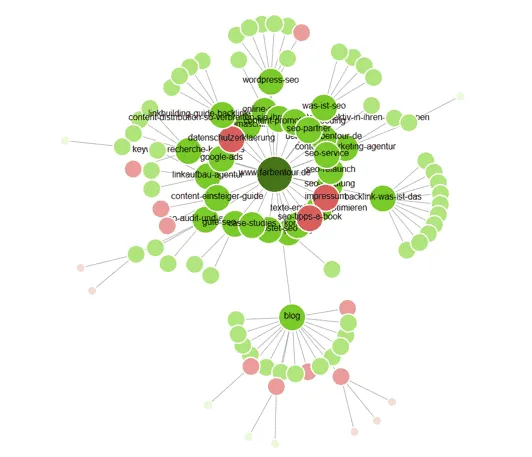

If, during an analysis, important URLs are identified that are more than four clicks away from the homepage, these must be prioritized further forward in the hierarchy.
A flat, logically structured hierarchy is classically divided into four levels:
- Homepage (the entrance area)
- Main category (the department, e.g. shoes)
- Subcategory (the specific shelf, e.g. sneakers)
- Product page (the concrete article, e.g. Adidas Original TREZIOD 2.0 sneaker)
To support this structure, the implementation of a breadcrumb navigation is helpful. It shows the user their exact location in the shop at all times and thus offers good orientation.
Everything about information and page architectures can be found here:

Information architecture – definition & explanation Updated: May 25, 2026
Technical SEO for shops
A common topic that unfortunately can cause a lot of headaches is the technology.
While small websites are completely crawled by search engines without problems, online shops with thousands of articles quickly reach their limits. If a large shop has many technical errors, such as broken links, long loading times, etc., many search engine bots abort their crawling and leave the shop again, without fully capturing all content. In the long run, this can lead to severe ranking drops or prevent good rankings entirely.
The technical setup must therefore precisely control which URLs are indexed and which are not.
Crawl budget optimization for million-item assortments
With enterprise shops with huge assortments, the crawl budget becomes a critical bottleneck. Once the time that the Googlebot allocates to the shop is exhausted, new products or price changes are often indexed only with a strong delay.
The following measures maximize crawling efficiency:
- Broken links & status codes: All links should always be checked for 404 pages, unnecessary redirect chains and faulty status codes. Every unnecessary redirect or unreachable URL consumes crawling resources. With many errors, especially in large shops, this can become a real SEO problem.
- PRG pattern (Post-Redirect-Get): Since million-item assortments generate countless filter combinations, simple canonical tags are no longer sufficient. The PRG pattern sends filter clicks as a POST request, so that search engines don't even see the billions of possible filter URLs in the first place and thereby save valuable budget.
- Logfile analysis: The evaluation of the server logfiles shows exactly which irrelevant shop areas devour budget (crawler traps) and which high-revenue categories the bot ignores instead.
- Sitemap segmentation: XML sitemaps should be strictly divided by brands or categories and bundled in an index file. This enables isolated error analysis in the Google Search Console.
- Strategic internal linking: It is strongly recommended to actively push the most important categories in the shop via targeted internal links. This deliberately steers the crawler to the highest-revenue and most relevant areas, instead of getting lost in unimportant subpages.
Controlling faceted navigation and filter pages
Faceted navigation is important for usability, but from an SEO perspective it can become a problem. Dynamic parameter URLs like “?farbe=blau&größe=43” generate numerous URL combinations that tie up crawling resources and can lead to duplicate content.
Zalando is a good example here for avoiding such problems:
Even the smallest category at Zalando with any product is a standalone URL, such as “https://www.zalando.de/herrenschuhe-kurzstiefel/aldo/”. Only when searching with filters (shoe size, material, etc.) do the URLs here also have parameters, but these are excluded from the search engine index with canonical tags.
Further solution approaches for filter handling:
- Exclusion of URLs via the robots.txt: Parameters and filters that waste crawl budget or offer no added value can be excluded for search engine bots via the disallow command. But careful: Google and other crawlers then also cannot read any tags (like canonicals) on these pages.
- Meta tag “noindex”: Filter combinations that are meant to be crawled but not appear in the search result receive the “noindex” tag.
- Canonical tags: Parameters that do not change the content but only display it differently (e.g. sorting ?sort=price_asc) point via canonical tag to the main category, in order to prevent duplicate content.
How bad is duplicate content (DC)?
Duplicate content is for Google no direct reason to penalize a website. However, if URLs contain identical or very similar content, this can make the evaluation by search engines (and AIs) more difficult.
Especially when multiple URLs (subpages) are optimized for the same keyword, there is the risk of keyword cannibalization. In such cases, the URLs compete with each other, which can weaken the overall visibility. Particularly with online shops, it is therefore advisable to avoid duplicate content.
Implementing pagination (category subpages) correctly
When categories contain hundreds (or even thousands) of products, these are, with most CMS shop systems, automatically split across several subpages (called pagination). Here, too, duplicate content can arise. However, it is not recommended to set category subpages wholesale to noindex. In the long run, a noindex can lead to the internal links on these subpages no longer being followed by the search engines, and thereby products falling out of the index.
Tips for pagination:
- Keep important SEO elements unique: Title tag and meta description of the subpages in the paginations must differ from one another, e.g. by dynamically appending text elements (“- page 2”, “- page 3”)
- Avoid text duplicates: The category text that appears below the products (buying guide) should appear exclusively on the first page of the category. On the following subpages, this text area should be hidden
- Self-referencing canonical: Every paginated page should point to itself via canonical tag
URL structure for SEO
The URL structure does have “only” an indirect influence on the rankings, but it already conveys initial information about the page content to both users and search engine crawlers before the click. In addition, technical errors in the URL structures can make crawling more difficult and jeopardize proper indexing.
Sources of danger: Dynamic parameters and session IDs
Dynamic parameters within a URL (for example ?id=8458) or appended session IDs likewise lead to duplicate content problems. As soon as identical content is accessible under changing parameter URLs, the search engine wastes resources during crawling and can no longer clearly assign the relevance of the page.
The use of static URLs is therefore the basic prerequisite for successful shop SEO.
Recommendations for an optimal URL structure:
- Speaking URLs: The URL must be so meaningful that the page content is immediately recognizable from the URL (positive example: shop.de/schuhe/herren -> This is about shoes for men)
- Short and hierarchical: URLs should be kept as short as possible. A flat directory structure without unnecessary subfolders is an advantage, since deep paths (like shop.de/cms/de-de/shop/prod/marke-schuh) are often crawled worse by crawlers
- Avoiding parameters: Session IDs or other unnecessary parameters within the URL should be avoided
- Using canonicalization: If dynamic parameters or other filter functions cannot be technically avoided, a canonical tag must clearly point to the clean, indexable main URL (master URL) in order to resolve duplicate content
Caution with subsequent URL changes
Subsequent adjustments to an already indexed URL carry a certain risk. Every change to the URL structure causes search engines to evaluate the URL as a completely new page. The history and the ranking power built up until then can be lost.
With unavoidable URL changes, permanent 301 redirects must therefore mandatorily be used. These signal to search engines that the old URL has permanently moved to the new address.
Loading times & performance optimization (page speed)
The loading speed of an online shop should be given special attention, since it has a direct influence on rankings and conversion rate.
Every delay in loading times can lead to measurable purchase abandonments and also jeopardize the rankings, since neither users nor search engine crawlers accept long waiting times.
Core Web Vitals
Google has, through the introduction of the so-called Core Web Vitals, made it clear that they measure the actual user experience during page load and let it flow into the ranking calculations:
- LCP (Largest Contentful Paint): The main product image or the largest element in the visible area must be loaded in under 2.5 seconds.
- INP (Interaction to Next Paint): The responsiveness of the shop/website to inputs (e.g. click on the shopping cart) should be under 200 milliseconds.
- CLS (Cumulative Layout Shift): Unexpected layout shifts during loading should be avoided in order to ensure visual stability.
Strategies for performance improvement
In order to achieve the Core Web Vitals and the best possible loading times, there are various levers that can be tackled.
1. Headless commerce: As already mentioned in the CMS chapter, the decoupling of the frontend in combination with a CDN can ensure very fast loading times.
2. Powerful hosting: For the best performance, choosing a good premium host that specializes in shop systems is important. Cheap shared-hosting providers are like a “ball and chain” for performance.
3. Image optimization: Product images often cause a large data load. In addition to modern compression and formats like WebP or AVIF, lazy loading is standard today.
However, so that images are reliably indexed by search engines despite this technique, the browser's native lazy loading (loading=“lazy”) must be used. This ensures that the Google crawler recognizes the image URLs immediately in the source code, without having to physically scroll the page. Images in the immediately visible area (above-the-fold), on the other hand, should be excluded from this technique (eager loading), in order not to negatively affect the LCP value (Largest Contentful Paint).
4. Script and cache management: The amount of data when loading a shop can be reduced, e.g., by caching systems like Brotli, which significantly surpasses the old gzip method in compression rate. By combining JavaScript & CSS files, the number of server requests (HTTP requests) is additionally reduced. By means of browser caching, the data load can also be reduced, since static resources are cached locally, which significantly shortens the loading times on repeat visits.
5. Technical infrastructure (SSL & HTTP/2): An SSL encryption is not only a necessary obligation, but also enables the use of the fast HTTP/2 protocol, which allows parallel data transfers and likewise improves the page speed.
Tools like cruxvis.withgoogle.com or WebPageTest.org are very well suited for regularly checking the performance.
SEO for AI searches: Being found in ChatGPT, Gemini & AI Overviews
Many people today search, in addition to Google Search, directly via AI systems like ChatGPT and Gemini, or receive their answers via the Google AI Overviews.
Thus users at AI search engines no longer expect classic hit lists, but finished, prepared answers.
In order to appear as a shop in the AI answers, classic SEO with a focus on keywords alone is often no longer sufficient. A new sub-discipline has developed from this, called GEO (Generative Engine Optimization).
The goal of GEO is to be, in the generated AI answers, either recommended as a brand (mention) or linked as a source (citation).
You can learn more about GEO in this YouTube video:
Some important GEO factors at a glance:
Timeliness is important (grounding)
As Jeff Dean (Chief AI Scientist at Google) explains, AI models do not read the entire internet live for a search query. They use a complex funnel process that reduces billions of documents in fractions of a second to a few highly relevant sources.
Since the AI compares facts in order to avoid hallucinations (the so-called grounding), absolute timeliness is decisive.
If your product data, prices or availabilities are outdated, you are useless to the AI and immediately drop out of the ranking.
Information gain (closing knowledge gaps)
An LLM (large language model) already knows general basic knowledge from its training.
A generic text like “What is an e-bike?” gets you no link (citation) in the answers. To be cited as a source, you must provide the AI with exclusive data that it absolutely must look up. Deliver highly specific problem solutions and granular data, e.g. “comparison of the best e-bikes for hilly terrain at over 100 kg body weight under 3,000 euros.”
The more specific the human expertise, the more likely the shop will be taken as a primary source in the answers.
Brand authority for recommendations (mentions)
When a user asks a chat AI “Which online shop for soccer shoes is the best?”, the underlying large language model (LLM) generates an answer based on statistical patterns that it learned during training from large amounts of text.
In order to be named here, your brand must beforehand frequently appear in a positive, professional context on the net (co-citations). PR, genuine test reports, mentions in trade magazines and discussions in forums train the AI to store your brand as the de facto standard in your niche.
LLM-friendly information architecture
AI language models process information statistically. A pure wall of text is not only hard to analyze for real humans, but also for AIs.
The content should be prepared in such a way that the crawlers can extract the facts immediately: Clear H headings, product specifications in clear HTML tables, important statements far up and clearly highlighted, and much more helps to be understood better.
Technology is (more) important
Some AIs use open-source crawlers like the Common Crawl. These are often less resource-strong than the crawlers of large search engines. Technical errors or technically complex websites can therefore more easily lead to content being captured incompletely. Extensive JavaScript elements can also significantly complicate processing.
Therefore, an online shop should not only be technically optimized for Google, but be built cleanly overall. This includes reduced JavaScript use, clear URL structures, the avoidance of duplicate content, as well as fast loading times.
You can learn even more about GEO here

What is GEO? Generative Engine Optimization explained (2026) Updated: May 28, 2026
E-E-A-T in e-commerce
E-E-A-T is a kind of quality filter from Google, and it stands for Experience, Expertise, Authoritativeness and Trustworthiness.
The filter is used to evaluate the quality and credibility of websites and shops – especially in the YMYL area (YMYL stands for Your Money Your Life). Into this area, all online shops automatically fall, because here the user pays for goods/services with real money. So that no “fraudsters” or “fake shops” stand right at the front on Google, there is this trust filter.
In e-commerce, especially T (trust) is an important criterion: If Google and the users do not place trust in a shop, it will not rank either – regardless of how well the rest of the SEO measures are implemented.
In order to optimize specifically for E-E-A-T, some areas must be optimized:
1. Experience
Only someone who knows and has tested a product can also report truthfully about it. That is exactly what Google wants to ensure with the “Experience” filter: In Google Search, only pages whose authors really know the product should stand at the front.
- Genuine customer reviews: Verified product reviews are prominently visible on the article page.
- User-generated content (UGC): Customer photos and videos that show the product in real use are a clear signal of genuine product experience.
- Own product tests: When a shop publishes its own test reports, unboxing videos or comparisons, this underlines the practical experience.
2. Expertise
The online shop must prove that it knows its assortment much better than a pure dropshipping retailer.
- Detailed buying guides: Comprehensive guides and FAQ sections on the category pages that best answer common customer questions (e.g. “Which soccer shoes in rainy weather?”) professionally.
- Author profiles: Blog or glossary articles as well as guides should not come from an anonymous “admin,” but from real, named experts from the industry. These should receive a short author box and there should be links to their social media profiles (e.g. LinkedIn).
3. Authoritativeness
Authority is primarily granted by other websites and their experts.
- Backlinks & mentions: Links from industry-relevant trade portals, manufacturers or well-known blogs show Google that the shop is a recognized entity in the industry.
- Building industry recognition: Participation in conferences (e.g. as a speaker), trade fairs (e.g. with your own booth or as an advertising partner) and the like also shows the connectedness to a certain industry and conveys authority. Important: The whole thing must of course be visible online, otherwise this measure naturally has no effect.
4. Trustworthiness
The foundation of every online shop. If trust is lacking, all other measures are of no use.
- Transparency: A large “About us” page with real team photos and images of the company, a complete imprint, as well as easily findable contact options (phone, email).
- Policies: Clearly worded, easily understandable terms on returns, shipping costs and data protection.
- Trust seals: Official seals (like Trusted Shops or TÜV) as well as transparent information on secure payment methods (PayPal, credit card, purchase on account) strengthen trust.
Everything about E-E-A-T
Further optimization possibilities for E-E-A-T can be found here.

E-E-A-T from Google: Meaning and influence on SEO explained Updated: June 9, 2026
Google Merchant Center & Free Listings
With the Google Merchant Center (GMC), online shops can display their products on various Google channels such as the Shopping/Products tab. Frequently, the GMC is used for Google Ads Shopping campaigns – for SEO this tool is unfortunately used far too rarely by many shops.
But that is precisely a good opportunity to receive, via Google, additional free clicks from potential buyers. With the help of the so-called “Free Listings”, a free placement of products is possible, among other things, in the organic search results and in the Shopping tab.

Since Google increasingly displays products as visual “product cards” in the SERPs, participation in the GMC is important in order to continue receiving organic traffic.
Optimizing the product data feed:
- Completeness: Every product from the shop that can be sold should be created in the Merchant Center. Via an attribute [excluded_destination], these can be enabled only for the organic display (Free Listings), which increases the visibility of all products on Google (and raises the chance for sales).
- Optimizing titles: The product title [title] is an important ranking factor here. All relevant information such as product name, brand, color, etc. should appear in the title.
- Image quality: Good, high-resolution images that display the product optimally are a must (also without watermarks please). Further images and views of the product can improve visibility and the conversion rate via the attribute [additional_image_link].
- Clean tracking: In the feed, the paid parameter (such as “utm_medium=ads”) should not be used, since this distorts the analysis. Instead, the automatic tagging in the Merchant Center should be used.
- Technical basis: The use of structured data (especially important: Schema.org's “ProductGroup” for variants) ensures that the search engine can always correctly reconcile the prices and availabilities with the shop.

Off-page SEO for online shops: Link building and authority
Backlinks are (and remain) an important ranking signal and form the basis for proving the authority of an online shop (the “A” in E-E-A-T). They show Google that other “experts” trust the shop and recommend it.
However, link building also harbors dangers: Anyone who relies on cheap link packages (e.g. from Fiverr) risks a penalty for link manipulation. Really strong and high-quality links come from topically relevant websites that themselves have good traffic and high authority.
With the following off-page strategies, good backlinks for e-commerce shops can be built in a targeted manner:
Tip 1: Quick wins through manufacturer links
Your own network can already provide (first) strong backlinks. If you have a network of suppliers, you can use them in a targeted way for building first backlinks.
- Implementation of manufacturer links: Manufacturers from whom shops source their products often have subpages like “Our partners” or a “dealer search.” Here a shop can build links by simply asking via email or phone.
Tip 2: Analyze the competition's link profile (reverse engineering)
When competitors rank ahead of your own shop for highly contested search terms, that is often due to a stronger backlink profile.
- Implementation of competitor analysis: With SEO tools like Ahrefs or Majestic, the competition's backlinks can be evaluated. This way, relevant trade portals, blogs or news sites that link to the competitor can be identified. Afterwards, you contact these site operators and offer them, e.g., a guest post or a cooperation.
Tip 3: Content marketing & linkbait (outreach)
As already discussed in the keyword chapter, advice content (informational keywords) is excellently suited as linkbait, since transactional pages are rarely linked.
- Implementation of content marketing: Content must be created that covers search queries at the beginning of the customer journey (e.g. “Which lawn mower for tall grass?”).
- Implementation of content distribution (outreach): A good text alone generates no links. The content must be actively brought to online journalists and specialist bloggers (outreach). For content to be linked, it must offer genuine added value, be professionally researched, solve a problem or deliver new insights through data and studies.
Practical example:
Horst Lüning, who together with his son runs the shop “whisky.de,” shows how it's done. Through his numerous YouTube videos, he was able to make himself, but also his shop, known to millions of people. The content is entertaining (no or hardly any advertising), which is why he was able to build a real fan base. That's how successful content marketing works!

Practical example 2:
The online shop Kartenmacherei shows how content marketing can work for link building. Regularly, the shop publishes its wedding study “So heiratet Deutschland” (This is how Germany marries) – a representative survey among hundreds of married couples on topics around getting to know each other, the proposal, planning and wedding costs. The study delivers exclusive, citable figures that no other shop prepares in this way – from the finding that almost every third proposal (33%) now happens on vacation, to concrete budget data.

The result: Media, wedding blogs and lifestyle magazines pick up the study results every year and link to the study as a primary source. According to Majestic, the study has thereby collected well over 100 organic backlinks (referring domains).

Tip 4: The right way to deal with bad links
Bad links (e.g. from foreign-language spam directories, purchased link farms or casino sites) accumulate almost on their own over time. Here, however, there is a common misconception:
- Correction on devaluation: Just a few years ago, webmasters had to laboriously write to these links or devalue them via the Google Disavow tool. In the year 2026, this is usually no longer necessary. The Google algorithm (SpamBrain) is now so mature that it automatically ignores toxic links, so that they no longer do any damage.
- When to intervene? The Disavow tool should today only be used when the shop has received an official notification about a “manual action” in the Google Search Console or has become the victim of a targeted negative-SEO attack. A proactive, ill-considered devaluation of links today often does more damage than it helps.
Further articles on the topic of link building (for online shops):

What is a backlink? Simply explained + definition Updated: May 7, 2026
Link building guide – generate backlinks for your website Updated: June 9, 2026

DR 83, 54 and 50 – how you get strong backlinks in a targeted way with linkbaits Updated: March 16, 2026
Link building for online shops: What you must consider when building links for shops Updated: October 2, 2025
E-commerce practical example: +2,048% more visibility
Using the example of a German online shop for stationery, it can be shown what consistent e-commerce SEO can achieve in reality.
The initial situation
The shop started with a Sistrix visibility value (SI) of 1.05 – not a bad starting value, but far away from the most important competitors, which already had SI values of over 10 or even over 20.
The most important problems at a glance:
- No structured keyword research and no competitor analysis available
- Too few categories to cover all relevant keywords
- Category pages without content and meta data
- Numerous technical on-page errors that made crawling more difficult
- Weak internal linking
- No link building, no digital PR
- No blog for informational search terms
- No SEO monitoring for measuring success
A classic picture: A lot of potential, but hardly any of the measures described in the guide implemented consistently.
The strategy
After a complete SEO audit, all identified problem areas were systematically worked through.
A detailed keyword research uncovered numerous topic areas that the shop had not covered at all until then. New categories were created and filled with high-quality buying-guide content.
In parallel, a blog was built that captures informational search terms along the customer journey. Month after month, technical errors were fixed in close cooperation with the customer.
Complementing this, continuous link building in combination with digital PR ensured more brand awareness and stronger backlinks.
A clean SEO monitoring made it possible to transparently track the success and to continuously refine the strategy.
The results after three years


Learnings
This example shows: E-commerce SEO is not a sprint, but a marathon. The biggest levers here were not a single measure, but the interplay of all disciplines – keyword strategy, category optimization, technical SEO, content and link building.
Anyone who only turns a single screw will not achieve the results that would be possible.
You can find the complete case study here:

Ecommerce SEO Case: +2,048% more visibility Updated: March 28, 2026
Conclusion
Search engine optimization is interesting for all online shops that want to reach their target group at every point of the customer journey. Through SEO, every shop has the opportunity to specifically engage its potential customers via Google Search.
In addition, millions of users use the search every day, and with a correct SEO strategy and implementation, not only a lot of traffic but also higher revenue can be generated.
Need a GEO check?
Get in touch for more visibility – in search engines and AI answers.
- More visibility and leads via Google and AI chats
- Sustainable SEO & GEO strategies
- Personal support


