
SEO Basics & Strategy
What Is a Backlink? Simply Explained + Definition


Building backlinks is not rocket science: There really are many creative ways to acquire links – but first you need to know a good deal about one of the strongest ranking factors in search engine optimization (SEO).
Just like on the stock market, newcomers to link building quickly fall flat on their face if they don't understand the basics.
You first need to understand how Google evaluates off-page optimization and which dangers you need to avoid; only then can you build the right links that will really move your website forward.
What Is a Backlink? (Definition)
A backlink (or hyperlink) is a reference that points from one website to another website. When your own website receives such a link, you have gained a backlink.
Simply put, a website recommends to its visitors, with the help of a backlink, that they visit the linked website. These are precisely the recommendations that Google evaluates.
The more backlinks your page has from other websites, the more likely (in theory) the website will also climb in the rankings on Google and co.
STOP!
That's how simple it was a few years ago (or even decades ago), but in the meantime the rules at Google were heavily changed.
Too many link spammers have diluted the search results with poor websites and mass backlinks, which is why the search engine factors additional evaluation criteria into its rankings more heavily and very quickly penalizes the excessive building of backlinks with poor rankings.
That's why it is important, when actively building backlinks, to proceed very carefully and to focus on quality over quantity.
Backlink Video
Don't want to read this article but still want this information? Then check out our YouTube video “Backlinks FAQ and Guide” – there you'll learn everything important on this topic.
Structure of a Backlink
What does a backlink look like technically?
A link is technically defined in HTML in the source code/source text of the website. Example:
< a href=”https://www.farbentour.de/backlink”>Backlink< / a>
- “< a href=” is the beginning of a link.
- The URL https://www.farbentour.de/backlink is the hypertext reference – the location (the URL) where the linked page can be found.
- The text after it (“Backlink”) before the closing </ a> is the anchor text, also called link text.
Additional information can be built into the link's source code, such as:
- target=”_blank”: Opens the target document in a new browser tab when the link is clicked
- noopener noreferrer: Protects pages that are opened in a new browser tab from a potential hacking attack
- NoFollow: Is a link attribute that instructs search engines like Google not to include the linking page in the calculation of link power – more on this later in the article
- title: The title of the link (is not SEO-relevant)
Significance: How does Google evaluate backlinks and what do you need to watch out for?
Are backlinks even still important?
Backlinks from other websites are still immensely important to be classified by Google as a relevant and trustworthy website on a particular topic. Google is getting better and better at figuring out whether backlinks were placed artificially en masse in violation of the rules, or whether they were honestly “earned.”
For example, a website that offers its readers helpful and informative content often receives, thanks to this added value, natural links, whereas websites without noteworthy content hardly receive any backlinks or often only obtain them through detours (e.g. buying, swapping, etc.). This approach is strictly rejected by Google, because the search engine wants to offer its users the best search results and does not want to spark a contest over who buys the better backlinks
That's why the search engine pays close attention to which sources websites obtain their links from. The Google algorithm is now so advanced that it recognizes unnatural, manipulated link profiles of websites and penalizes them with a correspondingly poor ranking.
These are the points to pay particular attention to when building backlinks:
- Anchor text
- Authority of the linking website (domain)
- Link power of the linking page (no matter how strong the domain is, if the link comes from a deep directory, hardly any link power is passed on)
- Text context (from which topic/content does the link come?)
- Location (e.g. is the link placed in the footer or in the sidebar?)
- Relevance (does the linking page fit thematically with the website?)
- Trust (does the link come from a website that Google trusts?)
So it is important, when link building, to always maintain a natural link profile and at the same time to ensure good content on your own website, because otherwise Google may become suspicious.
Thanks to the links between different websites, the Google crawlers can also discover new content and crawl/read the web accordingly.
Backlinks are still important for Google and (presumably) will remain so in the future! For search engine optimization, building backlinks is one of the most important factors.
How do backlinks work?
PageRank, here I come!
To check the value of a website, the search engine Google measures, with its PageRank algorithm, primarily the number and quality of a website's backlinks (link profile).
The PageRank was developed in 1996 by Larry Page and Sergey Brin at Stanford University and registered as a patent for their search engine. This method ushered in a new era of search engines at the time, and the algorithm still secures Google's dominance in many countries today.
Google also measures the link power of every single link in order to check the quality differences between individual backlinks and thereby also, among other things, distinguish between good and bad backlinks.
Example:
If page A links to page B, then page B receives the link power (link popularity metric) of page A. If page A is an especially high authority in its niche with a clean link profile and many strong backlinks, then page B receives especially much link power from A. The stronger the link power, the better (stronger) the backlink.

Link attributes NoFollow, sponsored and ugc explained:
What needs to be considered with link attributes?
As already described, backlinks pass their link power on to the linked website. If the webmaster wants to link to a website for a particular reason but not pass any link power on to the linked website, the backlink can be given the attribute “NoFollow” (“rel=nofollow”).
Note: Google introduced the NoFollow attribute in 2005 (source) to make the massive link spam via forums, blog comments and guestbooks more controllable. Google's top goal: to be able to distinguish good links from bad ones.
A normal backlink without the “NoFollow” attribute is therefore always “DoFollow” and thus passes on link power. This does not mean that NoFollow links are fundamentally bad. A NoFollow backlink on a well-visited website (e.g. Wikipedia) can additionally bring traffic and is therefore also a valuable backlink – despite the NoFollow attribute.
Pro tip: NoFollow used to not be followed by the Googlebot – now Google sees NoFollow more as a hint. It can therefore be assumed that NoFollow links may be taken into account more strongly. Keep in mind that every natural link profile always has NoFollow backlinks too.
The two link attributes “sponsored” and “ugc” were introduced by Google in March 2020 and give webmasters the option to label their outgoing links even more specifically. For example, the “ugc” label can be used to mark backlinks that are set by users, e.g. in a forum or a blog comment section.
With the attribute “sponsored” a paid backlink in a sponsored post can be marked – alternatively, according to Google, the “nofollow” attribute can still be used.
Link attributes overview

Effect of the NoFollow, UGC and Sponsored attributes on crawling, indexing and rankings
Until February 2020, Google stated that NoFollow, UGC and Sponsored links were not taken into account for crawling and indexing – and thus also for the rankings. From experience, however, we can say that such backlinks from strong authority websites (like Spiegel or Wikipedia) still passed trust on to the linked target website.
As of March 1, 2020, in “some cases” the attributes can also have an influence on crawling and indexing and thus also on the rankings
Pro tip: Every natural link profile also has NoFollow links. If you're unsure whether you should build some yourself, use tools like ahrefs or majestic to check how many NoFollow links the competition has and then build some too if necessary.
No-gos for Google backlinks: These mistakes you should avoid
Google Penguin Update 4.0
Backlinks can be harmful and significantly worsen your own rankings instead of improving them. For example, the following is not advisable:
- Unnatural link growth: It is not beneficial to receive thousands of backlinks from various sources within a very short time.
- Off-topic links: Backlinks from thematically unsuitable pages can also seem unnatural in large numbers. After all, backlinks signal thematic relevance to Google.
- Unnatural websites: Pages that were set up solely for the purpose of building backlinks (so-called link farms) do not provide good backlinks.
- Link farms: Link sources that were exploited excessively in the past, such as social bookmarks, blog comments, press portals or guestbooks, no longer have any trust with Google and are harmful in large numbers.
- Unnatural link positions: Here, too, Google pays ever closer attention to which position you get the link for your website from. Too many links from the sidebar or the footer (sitewide) are often a sign of link manipulation.
- Anchor text spam: If you always choose the same anchor text with a keyword you want to be found for, a very unnatural pattern emerges.
Important: Nowadays, when building backlinks manually, you should try to always use a different link text and to link with hard money keywords as little as possible. A money keyword is a keyword that the linked page is supposed to rank well for.
With the introduction of the Google Penguin 4.0 update, Google is now able to monitor link profiles constantly and in real time and to act correspondingly quickly if webmasters overdo it with link building.
Backlinks in the Age of AI (GEO)
In the age of Generative Engine Optimization (GEO), the role of the backlink is changing. Today it works on two levels: as a ranking signal for Google and as proof of trust for AI models like ChatGPT or Claude.
For a brand to appear as a recommendation in AI-generated answers, brand mentions in high-quality contexts are essential.
Timeliness is particularly important: a study by ahrefs shows that 79% of the sources and lists cited by AI engines come from the current year.
For a successful backlink strategy, this means: a static link profile is no longer enough. To remain relevant for AI systems, you have to be continuously present in current “best-of” lists, news articles and trend reports. For the AI, a backlink from today is the necessary citation that confirms your authority in the here and now and ensures that you are not sorted out as an outdated source.
What makes a good backlink?
The good, the bad, the ugly …
Good backlinks are references from real websites that regularly have visitors, ideally visitors who might also be interested in your website (topical relevance). Especially if you want to position your company as an expert in a niche and achieve great recognition there, backlinks from strong authority websites in your niche can help you achieve better rankings on Google.
Characteristics of a strong backlink:
- Relevance: Thematically, the linking website should fit your page – exceptions here are websites that can write about a broad range of topics, such as newspapers.
- Authority: The linking website should have high brand awareness and correspondingly many backlinks in order to pass on as much link power as possible.
- Traffic: A strong website also has a lot of traffic! If a link brings traffic to your own website, that is a particularly good signal. This link is useful and the (relevant) target group comes to your page through it.
- Placement: A link from a topically relevant text context is particularly strong. Since links from sidebars, footers, etc. were often used as spam tools in the past, they have less trust with Google.
- The harder it is to get a backlink, the stronger it is: Links that cannot be bought or otherwise “easily” arranged are often the strongest.
Backlink checker and checking backlinks
Link building metrics: Important for building backlinks, analyzing links and recognizing link spam dangers
Various tool providers, thanks to their own crawlers, offer the option to analyze your own link profile and that of the competition. Some providers are:
Ahrefs and Semrush offer a complete SEO suite, e.g. for ranking monitoring. But like Majestic and Linkresearchtools, these two tools are also especially strong at analyzing link profiles.
It is advisable to analyze the link profile here regularly, e.g. to
- recognize negative backlinks: Competitors can sometimes build bad backlinks to harm your website (according to Google this no longer works, but it is still a potential danger).
- discover link sources: Where do my current backlinks come from, what are the strongest links, and which bad links are present?
- draw comparisons: The competition's backlinks can provide insight into where they get their backlinks from.
With the link analysis tools Majestic and Ahrefs you can display the strength of domains (do I want a backlink from the website or rather not?) and you can regularly monitor where you have gotten new backlinks from and whether any have possibly been lost. Websites that were penalized by the Google Penguin can also be analyzed with a backlink checker, and this way harmful links can be discovered.
- Ahrefs.com works with the link building metric “DR,” which stands for domain rating and, simply put, represents the authority of a website. The higher the value, the stronger the link power of the domain.

- Majestic provides the metrics “TF” (Trust Flow) and “CF” (Citation Flow). The higher the Trust Flow, the more backlinks from trustworthy pages (trusted domains) the domain has. The Citation Flow value reflects the number of links. If the TF and CF values are too far apart (>20), this can be a sign of a spam domain.

- Linkresearchtools aims to provide a PageRank replacement with LRT Power*Trust. Here, too, the higher the value, the stronger the linking page and the higher the quality of the backlink. With the LRT browser add-on you can display the metric for free on any website.

Anyone who wants to build links professionally absolutely needs one or more backlink analysis tools.
Tip: Never blindly copy the competition's links. You can never know which links have been devalued via the Google Disavow Tool. If possible, only copy the strongest links and not smaller, insignificant links, such as forum links.
How do you get backlinks?
The art of building good backlinks
No, it is not easy to get good backlinks. The more work it takes to obtain a link, the more valuable it usually is. There are countless link building techniques, but only a few lead to real, strong backlinks.
Creating link-worthy content with content marketing
Easier said than done: create content that gradually receives backlinks from other websites. But that only works after a certain amount of time, and moreover there is no guarantee. One or two blog articles won't cut it. But the ways and possibilities here are limitless. Starting with interesting studies, through online tools, all the way to browser games and much more.
Even a simple blog that regularly publishes interesting content is happily linked to – that's how our Farbentour blog, too, has received links from other websites over the years.
Pros and cons:
- Difficult and time-consuming
- No guarantee that links will be built this way
- Safe – this is the path Google rewards the most
- Links can arise here that you wouldn't otherwise get
But content alone usually doesn't bring backlinks – it also has to be made known, so that it can earn the links (also called link earning).
Content Distribution
You have great texts and content, but no one sees them? Then they won't receive any backlinks either. Here you need to lend a hand with content distribution (also called outreach or seeding). By contacting potential cooperation partners, such as bloggers and online journalists, collaborations can arise and voluntary links (without payment) can be generated. It's important that your content is so good that it also appeals to the target group of the blogger or journalist.
Example 1:
The “SEO RPG Game” by Alexis Sanders received a number of backlinks because her browser game is truly exceptional and is accordingly well received in the scene: https://www.seroundtable.com/fun-seo-rpg-28671.html.

Example 2:
The website kaufda.de was able, with a guide on fire protection (https://www.kaufda.de/brandschutz/), to build countless backlinks from clubs and cities. The guide is free and offers real help and thus high added value for the linking target group. That's why it was linked to so often. However, without the distribution, so many links would never have come about.

Pros and cons:
- Can quickly lead to good links
- But it depends on the text and content (which has to be really good and well received by the target group that is supposed to set the link)
- It can turn into a lot of work to contact journalists, bloggers, etc. individually
- There is no guarantee that links will be built this way
- Links can arise here that you wouldn't otherwise get
- In Germany there is a kind of fear of linking: many will reject the request for a link
- Tip: Don't write emails; instead call publishers directly and ask for a collaboration (show the win-win situation)
- A kind of pre-outreach helps you find out whether your idea goes down well and whether webmasters will really link to you later. You'll find more on this in our linkbait guide.
In order to get really strong links through content, you simply have to do PR! Contacts with bloggers and journalists are therefore worth their weight in gold!
More examples of link-worthy content + content distribution can be found in this article about link building.
Guest articles with blogger outreach
Through guest articles you can make yourself known with your expert opinion in your niche. Depending on the industry, there are blogs and portals that regularly publish such guest articles. To get a rough picture of whether this is possible in your niche, simply type “your niche + guest article” into Google. You'll quickly see whether guest articles have been published here in the past. It's important that you only publish high-quality guest articles, and that on really strong websites.
Pros and cons:
- According to Google, guest article links are not taken into account (source), which, however, we cannot confirm through numerous tests.
- In our experience, guest article links have a lot of power and can bring good traffic to the linked page.
- They can also show the author's expertise and increase authority = particularly important on the topic of E-E-A-T and YMYL websites.
- Tedious and time-consuming – you first have to make a name for yourself and build trust before you're allowed to write a guest article for large portals.
Link lists
With search operators such as:
- “your keyword + links”
- “your keyword + blogrolls”
- “your keyword + link list”
- “your keyword + useful links”
you can use Google search to look for thematically fitting link lists. Take a close look at everywhere such a list links to. If your website fits in as well, you should contact the webmaster and ask for a link.
Pros and cons:
- Such links can pass on a good amount of power.
- Don't build too many of them (>20). In bulk, this can seem unnatural.
- Can also be very time-consuming. Many webmasters are contacted very often and asked for a link.
- The higher the quality of your content and your website, the greater the chance of being included.
Affiliate websites are often not included in link lists.
Tip: Call and ask. Such requests by email often go unnoticed.
Blog parades
Blog parades are campaigns by bloggers for bloggers, in which a topic is set by the organizer and all interested bloggers also have the opportunity to blog about it. At the end of the blog parade, the organizer summarizes all opinions and (now it gets exciting) links to all participants and their articles on this blog parade. The participants also frequently link to one another.
Pros and cons:
- Perfect for small blogs to get their first strong links from their niche.
- However, only suitable for bloggers – very personal – therefore not for companies.
- As a blogger, perfect for building new contacts in your niche (possibly useful for being allowed to write guest articles later).
For local businesses: business directories
Business directories, also called trade directories, are referred to in English as citations. A kind of “mention of the business.” These mentions can be increased, for example, through directory entries. If you have a business and want to rank for local search terms, it is therefore advisable to obtain such entries.
The best-known service here is from Google itself with Google Business Profile. But other providers such as dasoertliche.de, gelbeseiten.de and cylex.de are a must as well. You'll find a complete list here: whitespark.ca/top-local-citation.
Pros and cons:
- In many cases only useful for local SEO
- Links are relatively weak
- Easy to submit
- This way, first simple links can be created
And what about buying backlinks?
Ever since Google has been trying hard to prevent link buying and threatens penalties, or has even imposed them on some incorrigible people, a large part of the SEO scene has become frightened and publicly presents it as though not a single person would ever buy a link anymore.
The truth often looks quite different, and so many SEOs still diligently buy links for themselves and their clients. It's just that no one goes public with it anymore. Google has been, and will presumably continue to be, only able to recognize with great difficulty whether a link was bought or set voluntarily.
So for everyone who is unsure, my advice: be careful with the topic of buying backlinks and rather rely on safe methods, like creating link-worthy content.
Tip: The competition buys backlinks and you don't – what then? The answer: go for linkbaits – unique content, Google simply rewards that, because users will be happier with your content.
Interim conclusion: networking FTW in link building
The personal contact with other webmasters and decision-makers in your niche will enable you to get the really strong links.
Don’t build links. Build relationships.
–Rand Fishkin (source)
So the tip for everyone who doesn't want to buy links is to build a strong network in order to be able to generate links with it.
15 extraordinary link building methods
In our video we show you how, with these 15 methods, you can create simple to strong backlinks for your website.
What needs to be considered with the link mix?
What does a natural link profile look like?
A good link mix means that a website's link profile has different, strong backlinks from various sources. A natural link mix of a website grows over time and gets its backlinks from the most varied sources. Whether forums, blogs, or newspapers – it is normal for different platforms to link to you. The link target on your website also varies – not everyone links to the homepage, but often to subpages as well.
If you help along with building the links for your website, it's important to maintain this naturalness. Analyze the competition and where they get their links from and what their link mix looks like – this gives you a rough guideline.
Pro tip: How should the anchor texts be distributed?
It is best to vary every anchor text – this way, no conspicuous patterns emerge. Anchor texts with money keywords (link texts with the exact terms the page is supposed to rank for) should make up a maximum of 10% of the entire link profile. Otherwise, better link with the brand name or the URL. Look at the competition with Ahrefs or Majestic to see what is normal here.
For everyone who is afraid of hard anchor texts (money keywords): Wikipedia's link profile has grown naturally, and here you can see very nicely how a natural link profile should look. In places there is a share of hard anchor texts of up to 30%.
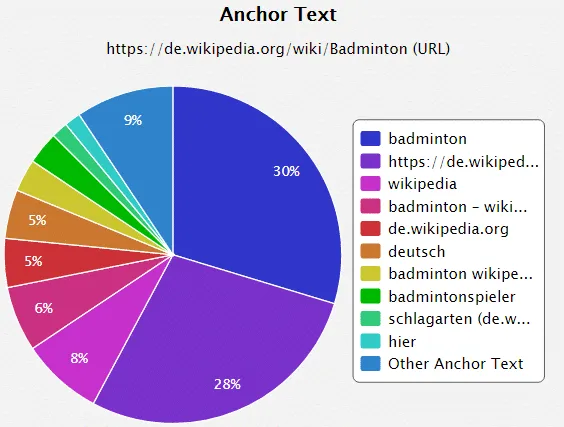
Naturally, you still shouldn't overdo it and should closely follow the quality of the competition's link profiles.
How long does SEO take? When do backlinks take effect?
When a link passes on its link power cannot be said with 100% precision.
As is so often the case with search engine optimization, it depends on many factors. If the link comes from a strong domain but is hidden very deep in the information architecture, it will take a long time before a Google crawler discovers the link.
Often, links are crawled multiple times over a longer period before they are recognized by Google. On average, it takes 2-8 weeks for a link to take effect. There are exceptions, for example when a link comes from a heavily visited domain. Here the link power can unfold within just a few days.
Thinking that a single backlink is enough to bring you TOP rankings for all your keywords is the wrong approach. Link building, like search engine optimization itself, has to be carried out over the long term and continuously.

Backlinks as a lever for E-E-A-T problems?
E-E-A-T is a filter used by Google to identify trustworthy websites on sensitive topic areas (health & finance = YMYL) and to determine their quality. Webmasters who fall through this filter can hardly achieve good rankings anymore. Whether active link building helps here to get out of this filter depends on various factors:
- Do the author/authors demonstrably have Expertise & Experience (expert knowledge & experience) in their niche?
- Have they distinguished themselves through studies, books or other academic works?
- Is the author well-known in the niche?
- Are there interviews, guest articles on other strong domains in the niche?
- Is the content of very high quality on the website, which is also cited by other high authority websites, such as Wikipedia?
These and even more factors determine whether a website falls through the E-E-A-T filter or not. Link building can indeed help to make the author/authors better known online, but if there are content errors on the website and the content is too weak, off-page measures cannot help further.
FAQ: The most frequent questions about backlinks and our answers to them
Will backlinks still be important in the future?
Probably yes, since Google has a dominant position in the search engine market. The model is successful, so why should Google change something big here and no longer take backlinks into account? But it is quite possible that links will become far less important in the future and that other ranking factors will then become more relevant, such as user signals, content, etc.
What does link juice mean?
So-called link juice refers to link power. Google has hinted several times that something like link power does not exist for them. Link power is therefore a value that can be measured via various metrics (e.g. Domain Authority).
What is Domain Authority?
Domain Authority (DA) is a metric from Moz.com and denotes the strength of a website and its chances of ranking in the TOP 100 on Google: https://moz.com/learn/seo/domain-authority
Link audit: Which metrics for link analysis should I use?
In a link audit, the complete link profile should always be analyzed and every linking page visited manually, instead of relying only on metrics. With the large amount of data, the tools' results can contain errors. That's why manual review is important. But you can't do it without tools either. You should always analyze the domain count (Dom Pop), Domain Rating and Trust Flow. More metrics are welcome too, such as LRT Power*Trust.
How many links should you build per month until results are visible?
It always depends – a completely new domain should not immediately get hundreds of backlinks. Better to build a few backlinks at the beginning and then carefully increase them little by little.
What does link velocity mean?
“Velocity” refers to the speed of a website's link growth. With a negative velocity, a domain loses more backlinks than it gains. You can check this via Ahrefs, but also Majestic. Always analyze the competition as well in order to be able to draw the right conclusions here.
External vs. internal links: What is the difference?
An external link always points from one page to another website, whereas the internal link always stays on the site and links internally to another subpage.
Buying cheap links from Fiverr and co?
NO! Never! Such links are harmful, since they are not topically relevant and are mostly pure link spam.
What about grey / black hat SEO like PBNs, tiered link building, etc.?
Such link spam tactics can hardly be recommended anymore these days – you get discovered too quickly and, if things go badly, you lose all your rankings. Therefore, for serious projects, never use such grey/black hat techniques. Even if the competition uses forbidden spam techniques to get ahead, you should not resort to the same means, since these techniques will sooner or later be discovered by Google.
Are press releases useful for link building?
NO! Press releases exist to draw the press's attention to you and are not suitable for link building. This is also link spam.
Build links yourself or through an agency?
Building links yourself can be very time-consuming. In addition, beginners can quickly make serious mistakes that can lead to ranking losses. Anyone who can budget accordingly can, with a professional link building agency build high-quality backlinks faster and more safely.
Need a GEO check?
Get in touch for more visibility – in search engines and AI answers.
- More visibility and leads via Google and AI chats
- Sustainable SEO & GEO strategies
- Personal support


