
Link Building & Digital PR
Link Audit: 10 Points You Have to Check (incl. Backlink Audit Template)


Backlinks are still a decisive ranking factor at Google. And this ranking factor can quickly become a disadvantage for your own rankings if you overdo it with your link-building measures.
Then only a link audit and the subsequent link removal can help to prevent falling rankings and drops in traffic.
In this post, you'll learn what exactly a link audit is and how to go about evaluating links.
What is a link audit and why is it important?
In a link audit, also called a backlink audit, all backlinks that point to a domain are checked. Not only are all links recorded, but they are also checked against various criteria, such as link origin, anchor text distribution, deeplink ratio, and much more.
The link audit is so important because unnatural link building can be penalized by Google through the so-called Google Penguin 4.0 – then the domain, or the corresponding subpage of a domain, quickly loses rankings and visibility. But a backlink audit can also uncover optimization potential – for example, by checking the competition's link profile to identify new link sources there.
Note
Google has repeatedly confirmed that it is increasingly able to detect spam links on its own and webmasters no longer have to intervene here. However, Google has also confirmed that websites, due to over-optimized link building, run the risk of being penalized. So if you have an overly manipulated link profile, be it through poor link building in the past or through negative SEO attacks, you should devalue links to be safe. A link audit helps you to discover the truly harmful links and derive measures from them.
When should a link audit be carried out?
A website's link profile should be checked regularly: Where do new links come from? Have important links perhaps been deleted again? And so on. During the link profile analysis, a lot of important information for your own link building can be gathered.
We recommend carrying out a complete analysis of the link profile at least once a year. The annual link analysis spring cleaning, so to speak. More often is fine too, since the motto here is “better safe than sorry.” Once Google has penalized you due to an unnatural link profile, it can take a while before the search engine trusts you again.
Link Audit – 10 Important Points You Have to Check
There are a few important points to keep in mind during a link audit. First of all, you need enough data for the audit. To obtain the largest possible amount of data on a link profile, you should not rely on just one link analysis tool, but on several at once. Among others, we recommend:
- Ahrefs
- Majestic
- Semrush
- LRT Detox Tool
- Google Search Console
In a link audit, every single link has to be checked and questioned. Does it serve to manipulate, or was it placed naturally? Google is currently less strict here and forgives a few slip-ups. However, anyone who overdoes it is still penalized today for link spam, buying links, and much more.
Note for beginners:This article uses a great many abbreviations and technical terms. If you are still at the beginning in the area of link building, you should first read our articles on backlinks and link building :-)
Therefore, the following 10 points always have to be checked in a backlink audit:
- Number of backlinks from referring domains: How many backlinks does the website have, and from how many domains do they come? This is the data foundation. Without it, no audit can be carried out. For a link audit, we recommend using the LRT Detox module right away – even if it is expensive – because it has the largest possible data source of all backlink tools.
- Sitewide links: Have excessively many links from footers or sidebars been placed? In large quantities, such links in particular can sooner or later become dangerous.
- The ratio of anchor texts (also called anchor text or link text): Are link texts placed naturally, or is there an excessive use of money anchor texts (link texts with keywords that the website is meant to be found better for)? If too many such money anchor texts are used, there is a risk of over-optimization, which could be penalized.
- Deeplink ratio (the ratio of backlinks that point to the homepage versus to deep links): Are certain subpages linked especially often? If so, what could be the reasons for that? Many shops have already been penalized when, for example, only one particular shop category was always linked – Google quickly regards such an unnatural link pattern as manipulation.
- Link attributes: What is the ratio of “do-follow” to “no-follow links”? How often are the further link attributes “sponsored” and “ugc” used? Blog comment spam in particular can quickly be detected through this.
- Link quality: What is the quality of the backlinks? Do especially strong websites link to you, such as newspapers or well-known domains from your niche? What is the ratio of high-quality to low-quality links? The backlink quality is decisive and not the quantity.
- Link velocity (ratio of link growth): Are there unnatural patterns here, and are very many links created in a very short time? Then manipulation can also quickly be detected through this.
- Link sources: Are links excessively generated only from certain sources (e.g., forum links or footer links)? Then that is also a bad signal.
- Topical relevance: Is there a large number of off-topic domains linking? Or does the link profile mainly consist of links from topically relevant sources that fit your website?
- Language: Especially poor link spam places backlinks from off-topic link sources and from those that are in another language.
Important:Always observe the competition and compare their link profile with yours. That way, you can better find out what, for example, a natural ratio of do-follow and no-follow links is in your niche.
At the end of the link audit, you should have a list of all the toxic links from your link profile. This list is important for the next step: the link devaluation.
Removing or Devaluing Links (Google Disavow Tool)
Once you have filtered out all the bad, toxic links during the link analysis, you should consider how you can get rid of these links again.
Google itself recommends contacting the respective webmasters and asking for a removal of the link or the setting of the “no-follow attribute” (e.g., for purchased links).
Only if the webmasters do not respond to the repeated contact attempts should the Google Disavow Tool be used. Through this tool (link to the tool) you can tell Google which links should not be factored into the ranking calculations.
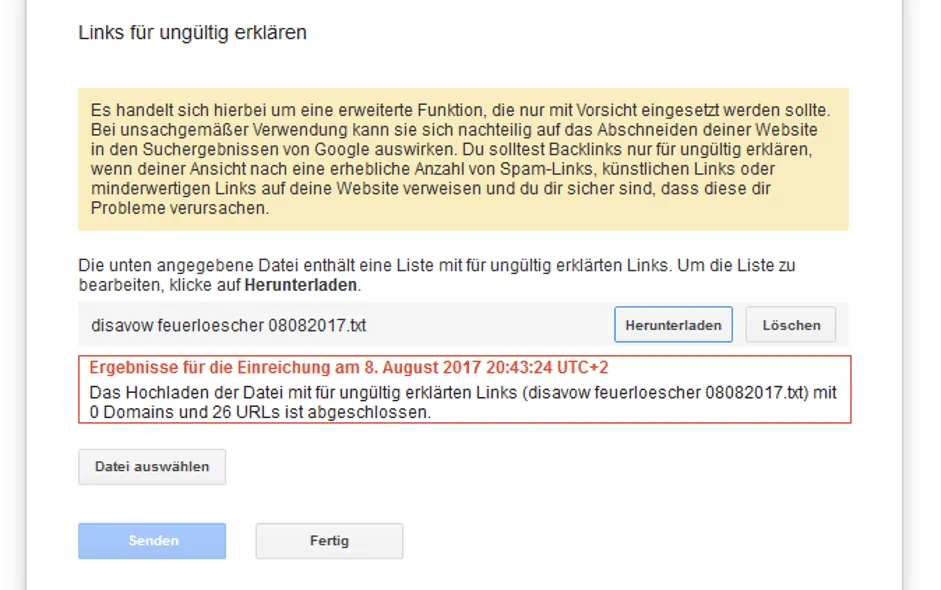
In the disavow file, you include all the harmful links that are to be devalued. This file must always be kept clean, and, for example, no links that have already been deleted should go into it.
Important: Always have entire domains devalued using the “domain:” command, and not individual links using the “URL” command. That way, you make sure that really no backlink from the harmful domain is counted anymore.
Example: This is what a Google Disavow file can look like:
# Negative SEO Spam
domain:das-ist-eine-domain.info
domain:das-ist-eine-domain1.com
domain:das-ist-eine-domain2.com
# Webmaster contacted, no response received
domain:das-ist-eine-domain.de
domain:das-ist-eine-domain2.de
Pro tip:Utmost caution when devaluing backlinks! If you accidentally remove strong backlinks, your rankings can collapse. Caution is especially advised when you want to devalue a large number of links via Google's Disavow Tool. It is better to devalue the links carefully in small numbers and not all at once.
Conclusion
Google itself has repeatedly confirmed that it is now good at detecting toxic links from negative SEO attacks, and that webmasters rarely still have to remove or devalue such links themselves.
Nevertheless, it is advisable to play it safe and, with a large number of toxic links, to devalue them yourself.
Template for Backlink AuditNo audit without a template! Download our free link audit template here (Google Sheets):
FAQ
What does a backlink audit cost through an agency or a freelancer?
The most common billing model is charging per link. Every link has to be checked. So the more backlinks a link profile has, the more expensive it also becomes. Audits for smaller link profiles with up to 500 backlinks usually start at €2,000. Prices can rise sharply here, the larger the link profile is.
Which tools do I need for a link audit?
We recommend the LRT Detox module here – no tool has a larger amount of data. And that is what matters in a link audit. If the data source is too small, not all the bad links can be found. However, the LRT tool is not exactly cheap. If you want to fall back on cost-effective (and similarly good) tools, we recommend using tools such as Majestic, Ahrefs, or Semrush.
Request a link audit now!
- Many years of experience in the area of SEO and link building
- Already over a hundred successfully carried-out link audits
- A dedicated SEO expert as a permanent contact person
- Free analysis consultation to get to know each other
We look forward to your inquiry:
Need a GEO check?
Get in touch for more visibility – in search engines and AI answers.
- More visibility and leads via Google and AI chats
- Sustainable SEO & GEO strategies
- Personal support


