
Link Building & Digital PR
Evaluating Backlink Quality: How to Recognize Good Backlinks

Generating a backlink is actually not difficult. There are a few tools on the market with which even absolute SEO newbies can automatically create countless links for their website. Such tools are, for example, Scrapebox or the GSA Search Engine Ranker.
These two little helpers find, among other things, websites that are not moderated by webmasters or have other “gaps.” The tool places the links of your choice on such sites. Link building was never so easy :-)
Too good to be true, right?
You've surely recognized it: Such link building very likely gets your site removed directly from the Google index (Google penalty).
But why won't such link building lead to success?
Quite simply: It doesn't come down to the sheer mass of links. What may still have worked a few years ago is today quickly penalized by Google as link spam with a penalty (removal of the website from the Google index). It is much more important to suggest naturally growing link building to Google, so that the risk of a Google penalty stays as low as possible.
Backlink Quality – But How Do You Recognize Good Backlinks from High-Quality Websites?
Good backlinks are references from topically relevant websites to the target website.
If you have carefully built up some such links bit by bit, e.g., through guest posts, commenting in forums, links from link lists, etc., the chances of also rising in the Google ranking with them are often not bad.
However, even links from topically relevant websites can miss their goal and even be harmful to your own link profile.
It is therefore very important to be able to analyze a website (from which you can get a link) enough to tell whether a link here brings something or would even result in a penalty/Google penalty. That is why you should be able to distinguish good websites (blogs, magazines, portals, forums, etc.) from bad ones.
First Impression: How to Recognize Good Backlinks
If you have found a topically matching website, you can check whether it's worth getting a link from this site. Does the site make a good first impression? Is there a Facebook group with many followers? Is the content up to date and does it have high informational value? Are there primarily only articles on the website in which each article links only to other websites?
That is usually a sign of a website that was created only for selling links. It is not advisable to get a link from such a site, because here the site can quickly be caught by a Google penalty and our site may get dragged down with it. If, based on the first impression, the site was created for readers and not for selling links, you should analyze the website further.
Here's an example: lingscars.com. Such a website probably doesn't make a good impression :-)

Inner Values Count
The first impression is important, but the quality of a website can be analyzed even more precisely through metrics.
For this, I recommend the visibility index and the Trust Flow and Citation Flow for analysis.
You can check the visibility index at smart.sistrix.com (free registration required). If there are strong (negative) fluctuations in the graph here, you should be careful; the site may have fallen out of “favor” with Google and been punished with a penalty. From such a website, it would of course not be very advisable to want a link.
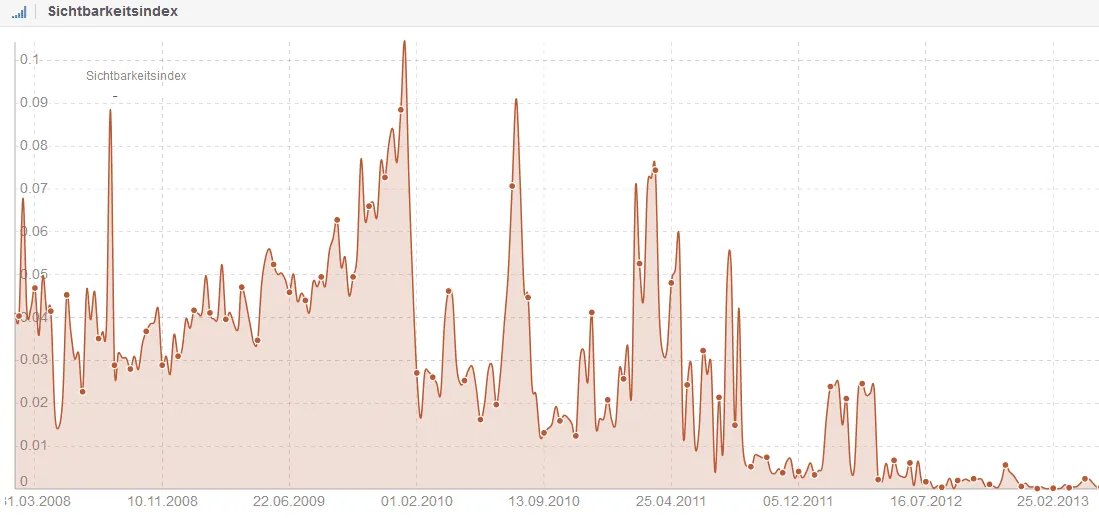
The visibility trend of the following site is significantly more positive and shows no penalty; even if there were smaller dips, as long as the visibility hasn't dropped too much, a link from the website is still completely fine.
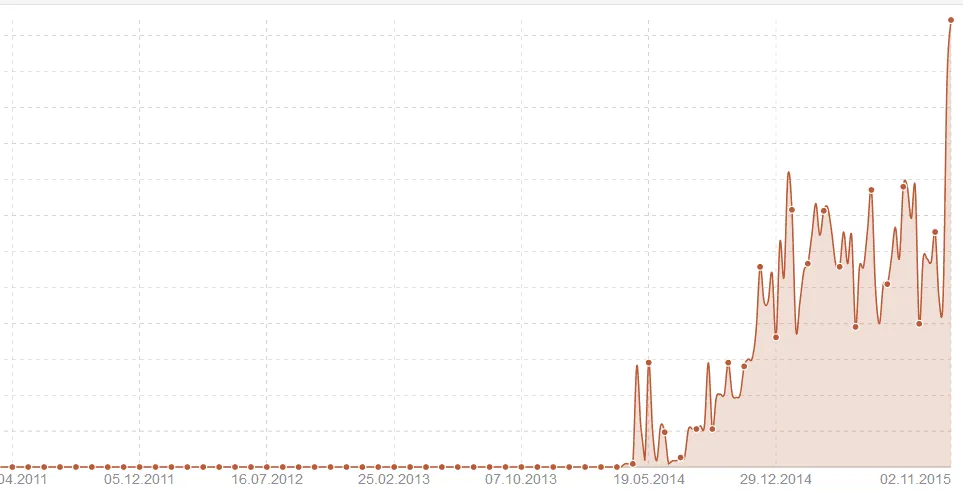
Once the visibility index has been checked, the metrics Trust Flow + Citation Flow on the website Majestic.com (free registration required) help you determine the quality of a site.
If the Trust Flow and Citation Flow on Majestic are above a value of 10, that is already a good sign of a high-quality website (the higher, the better). It is important that the two values do not deviate too strongly from each other.
If the website has, for example, a Citation Flow of 27 but only a Trust Flow of 1, this can also be an indication of a spam website that is used to place cheap links in bulk. From such a “link farm,” you naturally shouldn't want a link either.
It is important to also analyze the graph in the middle on the right:

If most of the points here are below the line/graph (see image), that is also proof that this website has received backlinks from rather low-quality sites. Also note that you should never trust just a single value. Therefore, pay attention to as many criteria as possible in order to find out how “natural” a link profile is. The more natural a profile is, the lower the chances of being penalized by Google.
Further criteria (viewable on, e.g., Majestic.com or Ahrefs.com) that you should check when evaluating a website:
a.) Anchor texts
If the same names were always placed here for a backlink, a website can also quickly be penalized by Google. A few years ago, you could achieve excellent search results with the same anchor texts over and over. Here, Google pays close attention to naturalness and a healthy mix of different anchor texts. It is rarely normal for a website to have 1,000 backlinks and 900 of them to have the same anchor text!
b) Ratio of DoFollow to NoFollow Backlinks
There is no correct ratio between Follow and NoFollow backlinks. What's important is that a link profile does not consist only of Follow backlinks. It is completely normal to also have NoFollow links.
Since 2019, Google has known two further link attributes besides the classic nofollow: rel="sponsored" for paid placements and ads, as well as rel="ugc" for user-generated content such as comments or forum posts. All three count as hints for Google, not as strict instructions — so Google can take them into account or ignore them in its evaluation. For your link profile, this means: If you leave comments or publish guest posts on sites that use rel="ugc" or rel="sponsored" instead of rel="nofollow", that is not a disadvantage. What remains decisive is whether the link fits topically and whether the linking site is trustworthy.
c) Age of the domain
The older a domain, the more valuable a backlink here can also be. The age is not a knockout criterion, but should nevertheless be checked as a precaution, e.g., on seo-ranking-tools.de.
d) Referring IPs, also called Domain Pop (see image above from Majestic.com)
The more backlinks a site has from different IP addresses, the better for now. It is very suspicious for Google if a site has received several thousand backlinks from one and the same IP address.
e) Origin of the backlinks
Pay attention to where the links come from. If a German-language website has links from foreign websites (e.g., Russia or China), you should check these closely.
Non-topically-relevant backlinks are also very suspicious, if, for example, with a blog about marketing you suddenly get links from an adult site.
f) Quality of the backlinks
What is the quality of the websites the site has backlinks from? Are they perhaps link farms or rather high-quality websites, such as universities or city websites? Definitely pay attention to this! Getting backlinks from low-quality websites with an unnatural backlink profile can really be very harmful to your website, which is why it is so important to check closely here before backlinks are placed.
g) Visibility trend
Examine the visibility trends with tools such as Sistrix or Seolytics (free version available). Was there a crash (>30%) in visibility for the linking website? Then this could be a penalized domain here, and it would be advisable to investigate the domain further.
Another quality feature that many overlook: the position of the link on the linking site. A link in the main text, ideally in the upper area of the page, is valued more highly than a link in the footer or in the sidebar. Links placed there have significantly less effect — especially if the page contains dozens of such footer or sidebar links with different targets. So, with a potential link source, also look at where on the page your link would end up.
Quick checklist for recognizing high-quality websites:
Once you have checked the following points, you can be relatively sure whether you have a decent or a bad website in front of you. This list is of course not a guarantee. So always also use your common sense when evaluating ;-)
- Domain age > 0.5 years? – Younger domains usually still pass on very little trust
- Does the website make a natural impression through regular posts, comments, high user-friendliness, a reasonable layout, Facebook, and other social media channels?
- Or was the site bred into a link farm? Features here can be, for example: unnaturally many links in the sidebar, in the footer, or similar. Many outgoing links with “strange” link texts (e.g., with “buy Viagra cheap now immediately,” you should give the website a wide berth)
- No large (>30%) losses in visibility or ranking within a few weeks (if yes, the site may have received a penalty from Google)
- Which hard anchor texts (also called money keywords) were used for the domain's links (can be examined on Majestic). The same hard anchor texts over and over can bring about a penalty from Google.
- Quality of the domain's backlinks (were there only links from comment sections, or does the site have links from large authority sites?)
- How many links does the domain have in total (Domain Pop or also Ref IPs)?
- Visitor numbers are also not to be scoffed at. If you have the opportunity to find out the visitor numbers, you should use it too. It is always nice when a link also brings a lot of new visitors to your own website.
Conclusion: Do I now have to check these quality criteria for every new backlink?
Yes and no!
If you only leave a blog comment, you don't have to spend hours going through all the metrics first. Since most links from blog comments are “NoFollow,” they probably won't pass on any link juice directly anyway.
You should check the link profile when, for example, you publish a guest post on another site or pursue the link-building strategy “broken link building.” Here, a link from a good or a bad site can already have strong effects on your rankings.
If you notice that your website has accumulated unwanted backlinks from spam sites or link farms, you can ask Google with the Disavow Tool to ignore these links when evaluating your site. The tool is available for free via the Google Search Console and accepts a simple text file with the URLs or domains that you want to reject. Important: You should only use the Disavow Tool when you see a real accumulation of bad links — Google now filters out most spam links on its own.
Building links manually is becoming increasingly dangerous, and therefore links should be built only with caution. So never rely on mere metrics, but also listen to your “gut feeling,” since every metric can be manipulated. Rather ask yourself whether the site you can get a link from makes a good/trustworthy impression.
Does the linking site offer added value for your readers? Does the site seem alive?
If you have the opportunity, you should find out how many visitors the linking website has. If the site has many visitors per month, a well-placed backlink can bring many new visitors to your site.
There is not one single factor that decides the quality of a link, but very many different ones. If you follow the points mentioned in this post, you can form a passable impression of the quality of a link.
Need a GEO check?
Get in touch for more visibility – in search engines and AI answers.
- More visibility and leads via Google and AI chats
- Sustainable SEO & GEO strategies
- Personal support


