
SEO Basics & Strategy
What Is SEO? An Introduction to Search Engine Optimization


Search engine optimization (SEO) is an important part of online marketing for many websites and online shops. But chat AIs and other new search engines are currently changing the SEO world dramatically.
In this article, you'll learn exactly what SEO is and what matters in 2026 and beyond when it comes to being found online.
Overview
- What is SEO? SEO refers to all measures aimed at achieving the best possible visibility in the unpaid (organic) results of search engines like Google.
- How does a search engine work? Through crawling: collecting content, indexing: storing relevant content, search query: serving matching results.
- Why is SEO important and what's the benefit of being found on Google? For many, Google is THE gateway to the web. Google is THE (free) driver of traffic and customers.
- Which measures are part of SEO? On-page, content, and technology as core measures, complemented by off-page optimization to boost authority.
- How are AI and LLMs changing user behavior and search engines? ChatGPT and the like offer new search options and faster access to information, which changes user behavior in web search.
What Is SEO? Definition
SEO stands for Search Engine Optimization and refers to all strategies and measures that serve to make the content of a website as findable as possible in the organic, unpaid search results of search engines (such as Google or Bing) for the search terms relevant to the desired target audience.
SEO measures are divided into optimizations on the website (on-page) and optimizations off the website (off-page).
The goal is to deliver the greatest informational value to users on their topic while, at the same time, being recognized as an authority in your niche by the search engines.
Note: The art of SEO is to place your website as high as possible—ideally in position 1—for relevant search terms in the unpaid search results of search engines.
The focus here is on classic Google Search, but also on AI searches such as the Google AI Overviews or the Google AI Mode, since Google has the largest market share worldwide at nearly 90% (Source: Statcounter).
How does a search engine work?
A modern search engine works in several steps to make information on the internet findable.
Simplified, this process can be compared to a library:
- Google acts as a central catalog in which all books are listed.
- Websites are individual books and each URL of them is a specific page.
- In order for content to appear in the search results it must first be found, classified, and served for matching search queries.
A search engine works in three stages:
During crawling, bots discover new content, which is then analyzed and stored in the index. For a search query, the algorithm delivers the most relevant results from this storage.
Simply put: without indexing, there are no rankings.
Even more knowledge…
If you want to dive deeper into the science behind search engine algorithms, you'll find more information here:

How does a search engine work? Updated: April 28, 2026

The Science Behind Search Engines: Information Retrieval Explained Updated: June 9, 2026
Where Does SEO Take Effect?
The days when Google was merely a simple search engine with “10 blue links” are long gone.
The search engine results pages (SERPs) have evolved into a complex answer machine. User questions are meant to be answered as quickly as possible, ideally directly on Google itself. The advantage for the search engine is that no traffic goes to external sources anymore and the user can keep interacting directly with Google.
Anyone who wants to understand Google's evolution should look at a direct comparison:
1.) Google and its simple list of links in the early 2000s

2.) The structure of the Google SERPs has changed over time. Google has introduced numerous additional features (such as AI Overviews)
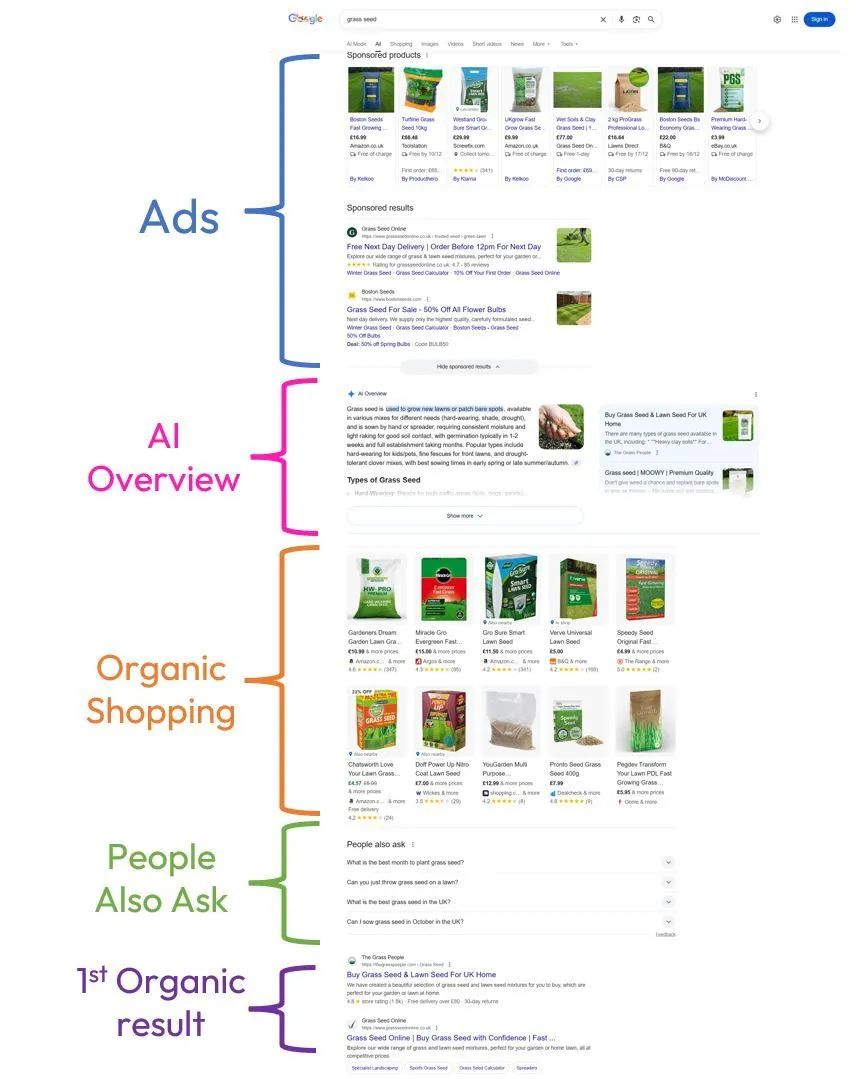
This shift has a massive impact on visibility. Anyone doing SEO today is no longer just competing against other websites, but also against Google.
The Three Zones of Modern Google Search
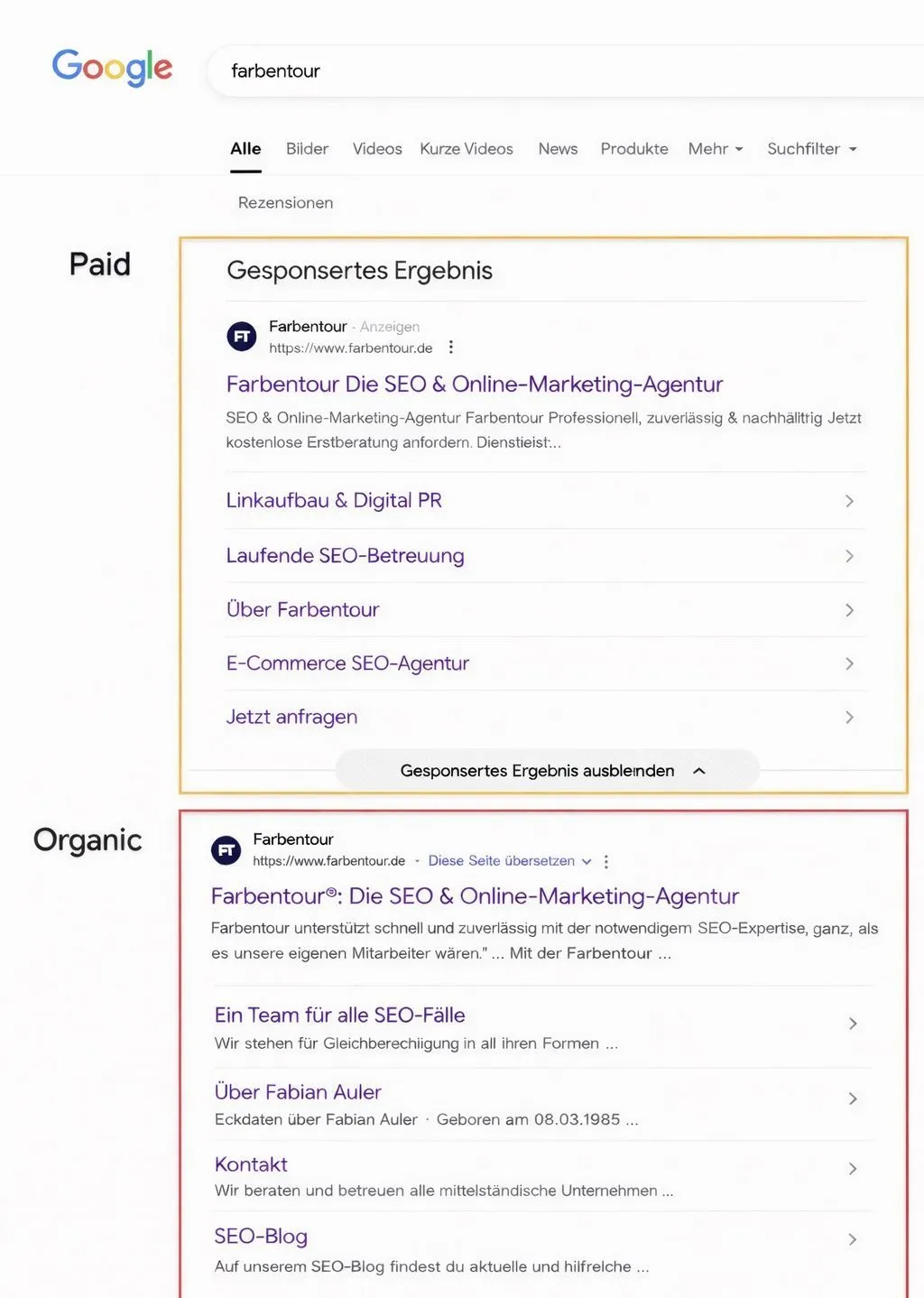
Today, the search results are divided into three main areas that compete for users' attention. SEO only takes effect in specific zones.
Paid Ads (SEA – Not SEO)
This area belongs to the advertisers. Ads usually appear at the very top, at the bottom of the page, or (for products) in the shopping bar on the side. They are marked as “Sponsored” or “Ad.” Here you buy your visibility.
Classic SEO measures have no influence here. Ads, however, visually push organic results far down.
Organic Results (This Is Where SEO Works!)
This is the heart of search engine optimization. Once a plain list, organic results today are often “rich snippets” – enriched with star ratings, images, or FAQs to stand out in the visual chaos.
Google is moving further and further away from being a mere intermediary toward becoming a content supplier. Today, SEO no longer means just ranking in position 1, but being noticed at all in this visually overloaded environment.
AI Overviews and Featured Snippets
Here Google delivers the answer immediately in its search results (“position 0”), even before the first classic organic result.
However, you have to distinguish between…
- Featured snippets: This is an answer directly in the SERPs. The information is presented as a highlighted text excerpt from a website (e.g., a definition or table).
- AI Overviews (formerly SGE): Here the AI generates a summary of information from various sources (websites).
Zero-Click Searches
While a featured snippet often still results in a click on the website (the source), clicks on AI Overviews drop significantly, because the answer is so detailed that the user no longer needs to visit any website. This increases the risk of so-called “zero-click searches.”
A study (source: SparkToro) reveals the problem: out of 1,000 Google searches in the EU, only 374 clicks end up in the “open web” (i.e., on regular websites). Of those, 74.6% go to the organic search results, 24% to YouTube and the like, and just 1.4% click on the paid search results (ads).
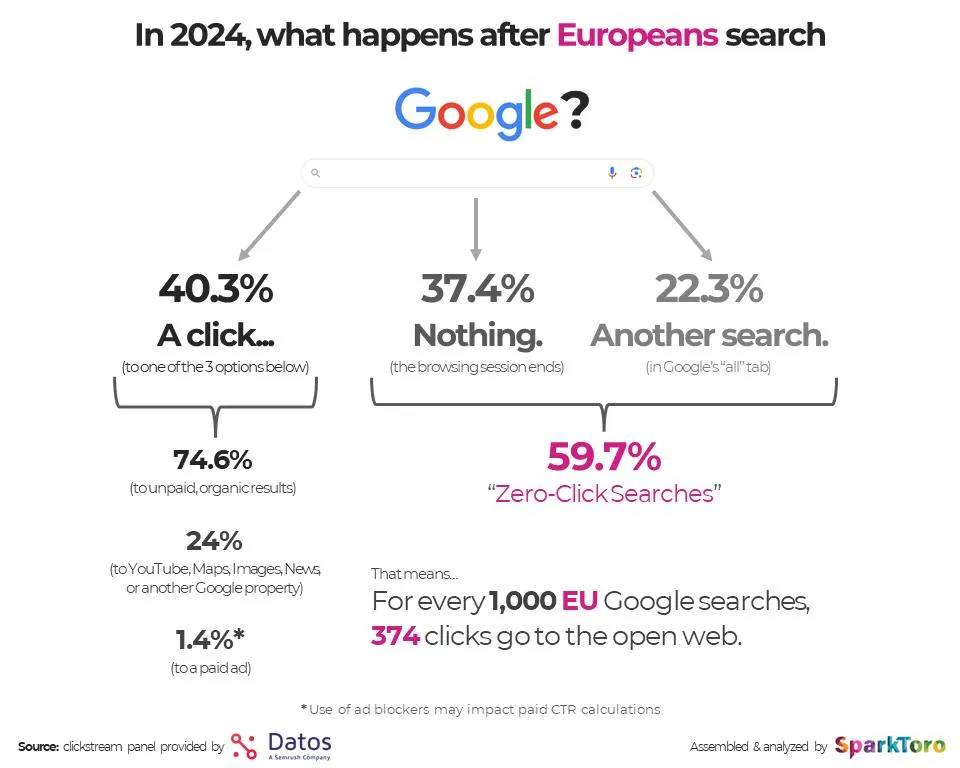
The rest ends right back at Google or is answered without a click. So the fight is no longer over 100% of the search volume, but only over the third of users who are really looking for more in-depth information.
And this number of clicks could fall even more sharply in the future, if Google serves AI Overviews even more often or introduces its AI Mode as the default search. There are already studies showing that when an AI summary (AI Overview) is displayed, the click rate on the regular search results drops from 15% to just 8% (source pewresearch.org).
What Does SEO Achieve and Why Is It Important?
Your own website right at the top of Google. That's the dream—pardon, the goal—of many website operators. No wonder, because Google processes every day according to a published study by Sparktoro & Datos over 14 billion (14,000,000,000) search queries.
People research, compare offers, and buy online – and they use Google Search intensively to do so. The Google search engine is a central entry point for many people looking for information, comparisons, and purchases.
“Companies that are visible in Google Search for relevant topics reach an enormous number of potential buyers and prospects.
Google Search is so powerful in part because, according to the study, most referrer traffic—63.41%—comes from Google. This makes the search engine by far the biggest driver of traffic on the web. In a distant second place with 7.21% is Bing (Source, graphic).

96.98% of all clicks happen on the FIRST page of Google (Source: ahrefs). Almost no user clicks through to the remaining pages (from page 2 onward). It is therefore essential for companies that want traffic and buyers to their website via Google to be on the first page.
But search engine optimization doesn't just deliver traffic; it also acts as digital reputation management. A high ranking is often subconsciously perceived by users as a seal of quality (“whoever ranks at the top of Google must be reputable”). A study by Botify shows that 51% of consumers trust a brand more when it ranks high organically, compared to purely paid ad placements.
SEO in Transition Through AI and Changing User Behavior
Search engine optimization is currently going through the biggest upheaval in its history. While Google held a monopoly on information searches for over two decades, artificial intelligence (AI) and large language models (LLMs) have fundamentally changed the rules of the game.
Already, 50 percent of users at least occasionally use AI chats instead of classic search engines (source Bitkom).

A paradigm shift is taking place: away from “search” (entering a keyword -> choosing from a list), toward the “answer” (a question to the AI -> receiving a synthesized solution).
New AI-Based Search Systems
Platforms like ChatGPT (OpenAI), Perplexity, Claude or Google Gemini are redefining how people access information on the internet. Anyone who used to search for in-depth information had to use Google to comb through a multitude of websites, open tabs, and gather information on their own until the answer was found.
Today, it's (almost) enough to just chat with the AI. The systems read, understand, and summarize the content from the web.
This convenience leads users to increasingly migrate from classic search to AI-based dialogue systems. Expectations have shifted: users no longer want to search for links, they want problems solved.
Google's AI Overviews and AI Mode – Why SEO Alone Is No Longer Enough
To avoid losing this stream of users to ChatGPT and the like, Google has already rebuilt its own search. With the introduction of AI Overviews (formerly SGE – Search Generative Experience) and the AI Mode Google integrates the AI answer directly into the search results page.

For SEO, this has two massive consequences:
- Loss of space: The AI answer pushes the classic organic results far down (“below the fold”).
- Needs coverage: Since the AI answers many questions directly (e.g., “How do I remove red wine stains?”), a click through to a further website is often no longer necessary.
Search engine optimization must therefore adapt: there is no longer simply one big Google search with 10 blue links. People now increasingly look for solutions and products—and for help—in AI-generated answers as well. Whether in the AI Overviews, Google AI Mode, or ChatGPT. Search will change even more, and SEO has to adapt accordingly…
GEO – A New Term
Is the term “SEO” still enough today? Since we no longer optimize only for classic search engines but increasingly for AI models (LLMs), the industry is debating a new term.
For some, AI optimization still remains SEO, because the basis is identical: excellent content and high authority are needed by both Google and AIs. For others, GEO is the more precise distinction.
But what does GEO mean?
GEO stands for Generative Engine Optimization. It refers to strategies specifically aimed at getting brands cited in the answers of chat AIs (such as ChatGPT, Claude, and Gemini).
Generative Engine Optimization Explained
For everyone who wants to learn more about optimizing for AI chats (generative engines):

Becoming Visible as a Service Provider in ChatGPT: What We Can Learn from the “Twerk Button” Incident Updated: November 6, 2025

What Is GEO? Generative Engine Optimization Explained (2026) Updated: May 28, 2026
How SEO Works and Its Subfields
Many beginners are overwhelmed by the complexity of search engine optimization. Yet the process can be broken down into a logical, recurring cycle. Whether it's a small blog or a large online shop, the basic framework stays the same.
Ranking Factors
Search engines like Google rank search results based on a multitude of signals. These signals are often referred to as ranking factors. These include, among other things, technical prerequisites, content relevance, authority, and user signals. Which factors are decisive in a given case and how heavily they are weighted is not publicly known.
SEO therefore doesn't mean optimizing individual factors in isolation, but aligning content and websites holistically.
An exciting leak in SEO history was the Google Leak of 2024, in which an accidentally published version of the internal Content Warehouse API documentation reached the public.
The leak brought to light numerous factors that had only been speculated to be important or not. In the following chapters, we take a closer look at some of these factors and optimizations.
You'll learn all about the Google Leak 2024 in this article:

The Google Leak: 14,000 Ranking Factors and Attributes Explained Updated: September 13, 2025
Phase 1: Keyword Research and Search Intent
“You are more honest with no one than with Google's search box.”
– Constanze Kurz, spokesperson for the Chaos Computer Club
The search box is the window into the true wishes, problems, and needs of the target audience. Before content is created, you have to analyze which terms (keywords) are actually being searched for.
In keyword research, there are several levels that must be taken into account:
What types of search queries are there?
In SEO, a general distinction is made between three categories based on length and specificity
- Short-tail keywords: These are very general search terms (usually 1 word), such as “shoes.” They have an extremely high search volume, are highly competitive, and convert poorly because the user's intent is unclear.
- Mid-tail keywords: Search queries of 2-3 words that are already more specific, e.g., “buy red sneakers.”
- Long-tail keywords: Very specific search phrases or entire sentences (often 4+ words), like “red Nike sneakers men's size 43.” The search volume is lower, but the conversion rate is higher because the user knows exactly what they want.
What intent does the searcher have?
Behind every keyword there is an intent (search intent). Google primarily distinguishes between:
- Informational: The user wants to know something (“What is SEO?”).
- Transactional: The user wants to do or buy something (“SEO tool download” or “buy”).
- Navigational: The user wants to go to a specific website (“Farbentour contact”).
Prompts – The New Kind of Keywords
With the shift to AI search, search behavior is changing too. Users no longer just enter static keywords, but formulate entire sentences and complex instructions (prompts). Since everyone “chats” differently, there are hardly any standardized keywords left. The solution: you derive the needs from classic SEO data, wh-questions, and FAQs. These questions serve as the basis for so-called “master prompts.”
Keyword research and search intent – from beginner to pro with our guides:

Keyword Research: A Complete Guide from A–Z – How to Find the Best Keywords! Updated: March 15, 2026

The SEO Competitor Analysis: 16 Points You Need to Check Updated: April 28, 2026
Phase 2: The SEO Audit (Taking Stock)
Before content is created, the technical foundation must be in place. An SEO audit is the technical inspection for your website. If the technology is blocking, even the best keywords won't help.
What is checked?
The goal is to ensure that search engines can read and understand the content without obstacles. Key points are:
- Indexability: Can Google reach all pages?
- Errors: Are there dead links (404) or incorrect redirects?
- Performance: Does the page load quickly and reliably?
For the check, standards such as Screaming Frog or the Google Search Console are used.
The result is a concrete “to-do list” for the technical cleanup.
Phase 3: The SEO Strategy (The Roadmap)
An SEO strategy defines which topics a website should be visible for and how that is achieved systematically. It subordinates technical, content, and authority measures to an overarching business goal.
Not a project, but a process.
SEO is not a one-time task. Since competition and search behavior change, the strategy must be continuously reviewed and adjusted.
In combination with GEO (Generative Engine Optimization), it forms the foundation today so that content is not only found but also correctly understood by AI systems and used as an answer.
From audit to strategy – our guides show you how it's done:

Developing an SEO Strategy: A Guide with Practical Examples Updated: May 7, 2026

SEO Audit Explained: A Guide with a Checklist Updated: June 5, 2026
Phase 4: On-Page
On-page optimization includes all measures that take place directly on your own website. It is the technical and content foundation that allows search engines to correctly read and classify your page.
1. Snippets (The First Impression)
Before a user sees your page, they see your snippet in the search results. The title tag and meta description determine whether it gets clicked or not.
- Title tag: A direct ranking factor. The main keyword must come at the beginning.
- Meta description: Not a direct ranking factor, but crucial for the click-through rate (CTR).
Here's how to create irresistible snippets that generate clicks:

Title Tag (Meta Title) – Definition and Explanation Updated: May 24, 2026

Meta Description – Definition and Explanation Updated: May 27, 2026
2. Structure and Architecture
A website without a clear structure is like a book without a table of contents.
- Headings (H-tags): Clear structures and a good hierarchy (H1 only once, then H2, H3 below) help Google and AI models scan the content of a website.
- URLs: Descriptive, short URLs (e.g., /polohemd/grün/) are better than cryptic IDs, which also create duplicate content and can prevent rankings.
3. Internal Linking
Internal links on a website are like nerve pathways in a body. They distribute link power (link juice) across a website, from strong pages to weaker subpages, and help the crawler discover new content.
Important: Always link internal links with hard keywords in the anchor text so that Google better understands the topic of the target page.
Building a site and information architecture explained:

Internal Linking and Internal Links Explained Updated: May 27, 2026

What Is a URL? (Uniform Resource Locator) Updated: May 24, 2026
Phase 4.1: Content Creation and Design
Since Google can process text more reliably than graphics, videos, or audio files, content forms the foundation for search engine optimization.
Search engines are full-text systems and need content to understand. However, good content is no guarantee of good rankings, but it is the basic prerequisite.
Note: There is no such thing as “SEO copy” – better forget that term right away. We create content exclusively for people, to answer their questions and fulfill the search intent. It's exactly this kind of content that Google rewards with good rankings.
Quality Criteria and User Signals
A text only ranks well if it is top quality and engages its readers. Google defines the quality of good content through various criteria:
- Solution orientation: Concrete answers and a solution-oriented approach instead of superficial descriptions and other blah blah.
- Depth of information: Real added value with a high information density (“unique information gain”) that goes far beyond the obvious.
- Trust: Technically correct, cleanly researched, and verifiable (more on this in the EEAT chapter)..
In this guide from Google itself, all the important quality criteria are listed.
Content Design (The “How”)
Content is judged not only by what it says, but by how quickly users find the information. The Google leaks of 2024 confirm: user signals decide the ranking.
How serious the search engine is about this is shown by surveys directly in the search results: “How quickly did you find the answer you were looking for?”.

📺 Video: Design Meets SEO – The Importance of Good Content Design for Search Engine Optimization
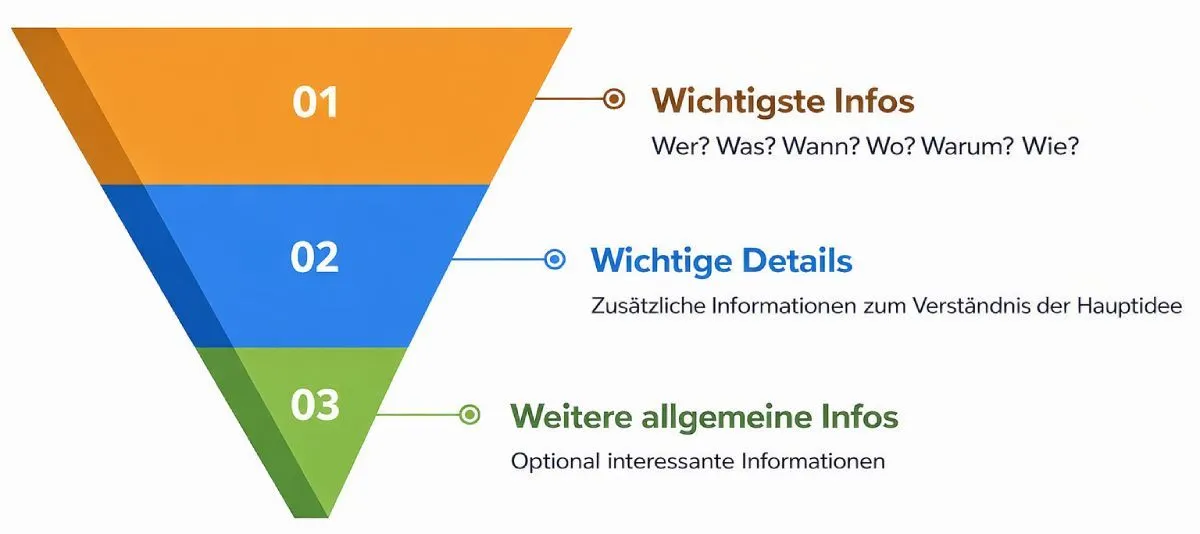
The Principle of the “Inverted Pyramid”
To engage users immediately, professionals use the principle of the Inverted Pyramid: the answer to the most important question comes first, with further details and answers to follow-up questions coming later.
Here's how to create texts that both Google and users love:

Forget SEO Copy and Start Thinking About Your Readers Updated: October 2, 2025
Creating Content with AI?
Can you have AI write texts that are also supposed to rank? A clear “yes and no.” According to Google's guidelines, quality is what counts, not the method of creation. AI can be an excellent assistant for outlines, first ideas, or even drafts, but:
Beware of Automation
Fully automated tools and AI agents mostly produce interchangeable, generic mush (“AI slop”) without any new insights. Such texts have hardly any chance of ranking and may under certain circumstances even be regarded as spam.
Case Study: Grokipedia vs. Wikipedia
A comparison shows how well Google recognizes quality. Despite its huge volume, the AI clone “Grokipedia” has hardly any visibility compared to the human-curated original.
- Wikipedia: Visibility 8,125
- Grokipedia: Visibility 0.08

AI does not replace editorial work. Without human expertise, “human in the loop” (HITL), you simply don't get content that can build good rankings in the long term.
There are indications that Google might use a so-called AI score to detect and penalize mass-produced spam AI content. More on this in this video:
Phase 4.2: Site Architecture and URL Structure
The architecture determines whether search engines correctly understand relationships. Each URL represents a distinct topic and fulfills a specific search need (One URL = One Intent).
Distinguish two levels:
- Site architecture: The technical and structural organization of the website, in particular the URL structure and hierarchy.
- Information architecture: The content-related and logical arrangement of the content for the user, i.e., navigation, structure, and user guidance in terms of UX.
Both must run in sync. If the technology (URLs) and the content (navigation) don't match, the ranking fails.
Site and information architecture explained with practical examples

Information Architecture – Definition and Explanation Updated: May 25, 2026
Best Practice: Static URLs (Example: Zalando)
Search engines love clarity. Zalando leads by example: instead of cryptic IDs, descriptive, static URLs are used.
Good: https://www.zalando.de/schuhe/adidas-terrex_schwarz/
Bad: https://www.xyz.de/produkte?category=schuhe&color=blau
URLs with dynamic parameters (e.g., ?id=123) often create many variants for the same content. The result: duplicate content and a waste of crawl budget.
Planning and Visualization
A clean structure is created not while building, but at the drawing board.
Planning: Use mind maps (e.g., XMind) to define topic clusters and silos in advance.
Analysis: Visualize your existing site with Screaming Frog. This instantly reveals orphaned pages or illogical click depths.
A good architecture is worthless without the right internal linking. Here's how to deliberately channel link power (link juice) through your structure:
Phase 4.3: Technical Optimization
The technology forms the foundation. If it is unstable, even outstanding content cannot rank.
Performance and Core Web Vitals
Loading speed is a confirmed ranking factor. Google measures the user experience using the Core Web Vitals (LCP, INP, CLS). These metrics assess how quickly the main content loads, how responsive the page is to clicks, and whether the layout stays stable. Measurement is done with tools such as PageSpeed Insights.
Large image files are the most common reason for slow pages. Use modern formats like .webp and consistently compress images before uploading.
Structured Data and Status Codes
Structured data (Schema.org) helps search engines interpret content such as products or FAQs automatically and display it as rich snippets.
Every server request returns a status code. A 200 (OK) is mandatory for all relevant content. Errors such as 404 (Not Found) or 500 (Server Error) must be cleaned up, since they block crawling. Using the robots.txt, you also control which areas are accessible to Google or AI bots.
Analysis Tools
For identifying technical errors, broken links, and indexing problems, professional crawlers are indispensable. In addition to the Google Search Console, the Screaming Frog, Sitebulb or Seobility are part of the standard repertoire.
Phase 5: Off-Page
Backlinks are digital recommendations and remain a central ranking factor. Links from strong, topically relevant pages transfer trust and authority to your own website. Google evaluates this trust positively and rewards it with better placements.
Digression: The Penguin Update Since link building was often abused through spam in the past, Google introduced the Penguin update. It penalizes unnatural link patterns and low-quality sources (e.g., purchased links from cheap platforms). Today the rule especially applies: quality beats quantity.
What makes a good backlink? A high-quality link comes from a website that itself has high topical authority, generates real traffic, and has a natural link profile. While backlinks are no longer the sole number 1 ranking factor today, they still form the backbone of a domain's credibility.
Link Building for SEO and Building Mentions for GEO
Backlinks and brand mentions are central signals of trust and authority. While backlinks are relevant primarily for classic SEO, mentions play an increasing role for GEO.
“LLMs can't technically do anything with backlinks, since they don't follow links the way search engine crawlers do. For visibility in AI answers (GEO), brand mentions are decisive instead
The ideal strategy combines both: Classic backlinks secure organic rankings, while the brand mentions they contain strengthen your presence in chatbot answers.
One effective approach is Digital PR. Through data-based or socially relevant content, you can deliberately build attention, mentions, and links.
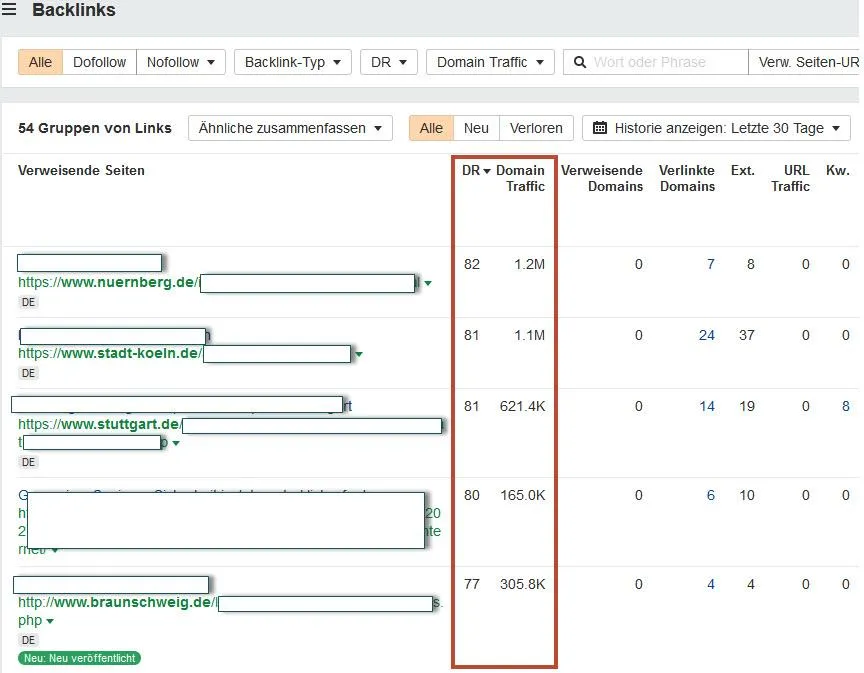
One example of this is this case of ours, in which, as part of Safer Internet Day, informative content on how older people can use the internet safely was published. The topical relevance led to numerous mentions and backlinks:
Alongside Digital PR, content marketing plays a central role. High-quality content creates mentions and links in the long term. This includes not only texts, but also podcasts, videos, or visual formats.

The principle of “publish and pray” is not a strategy! Anyone who wants to build reach has to deliberately reach out to others. This approach is also discussed in our specialist book on the topic of Content Distribution in detail:
Backlinks and mentions arise where content is discussed, shared, and reused. What counts is the ability to make relevant content visible and to anchor it sustainably within topic worlds.
📺How modern link building works without spam:
Link Building via Competitor Analysis
An efficient way to new backlinks is to look at the competition. Tools like Ahrefs or Majestic reveal which pages link to the competition. These sources serve as an ideal basis for your own outreach.
Important: Avoid Spam
Consistently avoid manipulative techniques. Private blog networks (PBNs), tiered link building, scrape links, Fiverr links, or satellite sites are detected by Google and lead to ranking losses or penalties in the long run. Clean link building is based on relevance, not on tricks.
Important resources for your link building: In these guides you'll learn how to develop a sustainable off-page strategy:

What Is a Backlink? Simply Explained + Definition Updated: May 7, 2026
Link Building Guide – Generating Backlinks for Your Website Updated: June 9, 2026

Link Building for Online Shops: What You Need to Consider When Building Links for Shops Updated: October 2, 2025
Phase 6: E-E-A-T and Trust
E-E-A-T is a central concept of Google's quality assessment. It helps the algorithm decide which content it can trust. This is especially critical for YMYL topics (Your Money, Your Life), which affect users' lives, finances, or health.
The four pillars of E-E-A-T:
- Experience: Does the author have practical first-hand experience?
- Expertise: Is the creator a recognized expert in their field?
- Authoritativeness: Is the website considered a leading source for this topic?
- Trustworthiness: Is the site secure, transparent, and honest?
Important: E-E-A-T is not a technical ranking factor in the sense of a metric, but a concept that bundles the quality signals together. The basis for this is the official Search Quality Evaluator Guidelines.
How to Optimize for E-E-A-T
To build trust with Google and users, the following measures are decisive:
- Focus instead of a mishmash of topics: Concentrate on one core area. A website that writes about everything is perceived as an authority nowhere.
- Expert content: Texts should be created or at least reviewed by real experts. Transparent author boxes with qualifications strengthen trust.
- Quality questions: Google provides a list of questions with which you can check the quality of your own content yourself: Google Search Central: Questions About Expertise and Trust
- Evidence and sources: Strong internal and external links to primary sources underline the subject-matter depth.
- Minimize the use of AI: Truly helpful content requires human expertise. Purely AI-generated texts without a “human in the loop” often do not meet the E-E-A-T requirements.
Everything about E-E-A-T: Here's how to implement E-E-A-T in practice and which signals Google really values:

Google's E-E-A-T: Meaning and Impact on SEO Explained Updated: June 9, 2026
Phase 7: Monitoring and Performance Tracking
SEO is a process, not a final state. Since algorithms, competition, and user behavior constantly change, continuous performance tracking is indispensable.
Since SEO / GEO is not an exact science, there are no ranking guarantees. Success cannot be forced; it can only be brought about through constant data analysis and adjustment.
A modern monitoring approach treats classic search results and AI answers as a single unit. You cannot separate SEO and GEO from each other: if you're not visible organically, you're rarely used as a source by AI systems. Optimization for generative answers is based on the solid foundation of technical and content SEO.
Tools for Tracking
To be able to react quickly to changes, a professional tool stack is needed:
- Google Search Console: Error detection and indexing status directly from Google.
- Serpwatcher: Daily tracking of specific keyword rankings.
- Seobility: Automated on-page monitoring (daily, weekly).
- Screaming Frog and Sitebulb: Gathering technical raw data for detailed audits.
- Sistrix and Ahrefs: Analysis of overall visibility and organic traffic (incl. GEO visibility).
Practical Example
Despite a highly competitive market, top-3 rankings were achieved for core keywords such as “Kartons,” “Maxibriefkarton,” and “Versandkarton kaufen.”

The results (period 06/2023 to 02/2026):
- Visibility (SI): Increase from 0.1 to 2.96 (+2,862%).
- Traffic (OT): Rise to 89,000 monthly visitors.
- Revenue: Growth of 327%.
- GEO presence: According to Sistrix, the brand is already mentioned in 5,194 AI prompts.
Strategic Implementation
The success is based on a radical optimization of all pillars of the SEO strategy:
- Structure and design: The website was completely cleaned up technically and given a modern, user-centered design. Clear navigation and the massive expansion of specific categories (e.g., Amazon shipping boxes) ensure perfect coverage of the search intent.
- Content quality (no AI): Building a glossary and blog by real experts – completely without AI-generated texts. Every category was supplemented with buying guides and FAQ sections.
- Technology: Significant improvement of loading times, comprehensive implementation of schema data, and the ongoing optimization of meta data through testing.
- Authority: Continuous link building and creative digital PR campaigns to strengthen domain authority and brand awareness.
You can find the complete case here:

Online Shop SEO Case: +327% More Revenue Updated: May 28, 2026
FAQ
How long does SEO take?
How long SEO takes cannot be predicted exactly. The first measurable effects often appear after six to twelve months. SEO is not a short-term project, but a continuous process. Search behavior, competition, and search systems change constantly.
Accordingly, content, technology, and strategy must be adjusted regularly. SEO is therefore a long-term investment and not a one-time set of measures with a fixed end point.
How much does SEO cost?
The cost of SEO depends heavily on the specific project. Decisive factors include the size of the website, the competition, the current state of optimization, and the scope of the desired services.
It also matters which tasks are handled internally and which are to be carried out externally by an SEO agency. Blanket pricing is therefore not possible in any reputable way.
How do you find a reputable SEO agency?
There is not one single “best” agency, only suitable or unsuitable partners. Caution is advised with long-term contracts that lack a clear definition of services, or with strong pressure to close a deal.
Reputable agencies can prove their expertise through references, case studies, or transparent ways of working. A sensible entry point is clearly defined, one-time services before a long-term collaboration is agreed upon.
Can you learn SEO yourself?
Yes. SEO can basically be learned on your own. However, it requires time, practice, and the willingness to continuously engage with new developments. Fundamental concepts in particular, such as search intent, content, and structure, are quite accessible.
As complexity grows, however, so does the effort involved. If you want to learn more about SEO, check out our big SEO tutorial on YouTube.
Can AI content rank?
The answer is: yes and no. AI content produced automatically and en masse generally does not achieve sustainable rankings. Such content often offers no real added value and in many cases violates the quality requirements of search engines.
AI can help with content creation, but it does not replace editorial work, research, or expert judgment. What remains decisive is the quality and relevance of the content for users. Google itself provides further guidance on this: https://developers.google.com/search/blog/2023/02/google-search-and-ai-content?hl=de
What about AI automations in SEO?
Fully automated AI processes currently mostly deliver mediocre results (if any at all). Even for basic tasks such as keyword research or meta tags, relevant aspects are frequently overlooked.
AI can be a useful support for SEO, for example in brainstorming ideas, structuring topics, initial analyses, or technical tasks. However, it does not replace strategic planning, expert understanding, or manual quality control. SEO remains largely manual work, complemented by intelligent tools.
Need a GEO check?
Get in touch for more visibility – in search engines and AI answers.
- More visibility and leads via Google and AI chats
- Sustainable SEO & GEO strategies
- Personal support


