
Link Building & Digital PR
Link building for online shops: What you have to keep in mind when building links for shops

Link building for online shops is often a particular challenge. Who voluntarily links to commerce-driven shops with standard categories and boring product pages without any special added value? Exactly: almost no one! How you can still build Backlinks for your shop and what you have to keep in mind while doing so, you'll learn in the following article:
Are links even still important for SEO?
There is a clear yes to this question! Google grandmaster, uh I mean mouthpiece, John Mueller explained in June 2019 in a Webmaster Hangout: “Links are really important for us to find content initially. So it’s like if nobody links to your website ever then we’re going to have a hard time recognizing that it even exists.”
Links are important for Google to find your content in the first place. If no one ever links to your website, your content probably isn't important and valuable either?
Another proof of the importance of links: Google introduced new link attributes. That wouldn't happen if backlinks were completely unimportant. Since 2005 there have been the attributes “Follow” and “NoFollow”. Links marked with NoFollow do not pass on any link power according to Google. In addition, the crawler does not follow these links – at least until now. Because according to Google, NoFollow links should now be followed after all, and by means of two new attributes it should additionally be possible to better label types of links:
- “Sponsored” for advertising and paid links and
- “UGC” (user generated content) for links that are created by users.
What does that mean specifically? Websites like Wikipedia have generally set all outgoing links to NoFollow, and as a result actually very good links were marked as “not important” for the crawlers. That is now changing, and this alone already proves that good backlinks simply are still important for SEO.
OnPage optimization before OffPage optimization: Why internal links are important for online shops
Many people fixate on building backlinks. We experience this again and again as a link building agency. Clients approach us with the goal of getting as many backlinks as possible in the shortest possible time. However, OnPage optimization should be tackled first. If the problems pile up there – loading times from hell, atrocious usability, too little content, missing internal links – even the best links do little.
Internal links
Internal links help Google to understand the content of a website and to recognize which pages are especially important. Internal links are an elementary component of any information architecture of a website and therefore important for search engine optimization.
In online shops, the same problem often occurs again and again: After a few years, no one knows exactly anymore what was actually linked to where. With dozens of different categories and thousands of products, there is a big danger of losing the overview in the tangle of internal links. There may be certain categories that should rank at the top for certain keywords. If these don't appear at all or not in the desired position, this may be due to missing or too weak links.
That is why optimizing the internal links is an effective lever in search engine optimization. A plus point here is the independence from other webmasters.
Internal link analysis with Screaming Frog and Gephi
Through internal links, the link power, or the link juice, of a website is passed on to specific subpages. Internal links convey to visitors and Google which pages contain especially valuable information. With Screaming Frog and Gephi, the internal links can be displayed vividly. Anyone who prefers a sober presentation can have the internal links shown in a clear Excel table.
Gephi is a powerful and, on top of that, free tool. It visualizes the information architecture of your own website. From this you can deduce whether URLs that should rank at the top for certain keywords are also often linked internally. An important URL doesn't rank, or at least not the way it should? That can be due to wrong or missing internal links.

With Gephi it is possible to calculate the internal and the external PageRank for each URL. For this, however, Screaming Frog is needed. Screaming Frog supplies the raw data that is needed to use Gephi. The tool is paid from 500 URLs per site. But the investment is worth it!
Seven rules for internal links
The focus of this blog post is not on internal links, but here are nevertheless very briefly seven rules that get straight to the point, short and snappy, on what to keep in mind with internal links:
- Never set internal links to “NoFollow”.
- Use clear anchor texts. Avoid generic terms such as “here”, “continue”, or “more info”. If a category in an online shop is called “women's shoes”, for example, it should be labeled the same way in the anchor text.
- Think of the users: Website visitors should quickly find the information they are looking for through internal links. Otherwise they are quickly gone again.
- To give an overview or category page more link power, it should be linked in the sidebar, in the menu, or in the body text.
- Too many internal links cost link power. So proceed with caution. There is no officially recommended number. As a rule of thumb, however, it has become established to place two links per 500 words in the body text.
- Do not link to the same target multiple times on one page. This does not strengthen the link power, but only weakens it, since with multiple links only the first link ever counts.
- Do not link different pages with the same keyword as the anchor text.
Link building for shops
Before we get to the tips on how to build strong backlinks, first a word of warning: There are statements from various Google employees that say that every kind of active link building is undesirable. No matter which strategies are used. Even writing to webmasters with the request for a backlink is, accordingly, not looked upon favorably. Supposedly it doesn't matter whether money changes hands or not.
Whether that's true or not: There is no way around active link building if the Google ranking of the online shop is to improve. We'll get to how that is possible without getting into trouble in a moment.
Dangers of link building
If Google detects unnatural link building, this can lead to a penalty (loss of the previous rankings). Thanks to Realtime Penguin, this happens in real time. In doing so, the number and the quality of the links, but also the anchor texts, are put to the test.

Link building strategies for the trash
Let's start with the bad link building strategies that can sooner or later lead to a penalty. Certain measures no longer make sense nowadays and practically invite a penalty.
These include:
- Manipulation and link exchange programs: Anyone who obviously tries to manipulate the search results and, for example, takes part in link exchange programs must expect a downgrade of their ranking. Google considers these activities a violation of the webmaster guidelines.
- Comments in forums and blogs: It's nice when users comment on the content of blog articles. Reactions like “Thanks for the post” or “Very helpful, thanks!” offer no added value whatsoever, though. That's spam.
- Link farms and networks: Link farms are websites that collect links to other websites. This is meant to improve their ranking. However, links from such sites do harm. If low-quality links lead to a certain website, Google classifies it as low-quality as well.
- Off-topic sites: The backlink you receive should reasonably match your own industry. Reasonably? Yes, topical relevance is also sometimes overrated. A newspaper, for example, can link almost any topic if it fits the corresponding article. A golf club that links to an ornamental fish zoo is rather implausible. It always comes down to the topic and the sensible connection.
- Different languages: Here it certainly also depends on your own offering. An internationally active translation agency comes across as credible with international backlinks. Other websites come across as implausible if they receive, for example, ten million backlinks from Russia or China.
Three safe tips for building backlinks
But how do online shops manage to build backlinks and improve their ranking without risking a penalty? We'll get to that now:
1. Write to partners
A simple method for obtaining the first five to six links is to write to your own business partners. Everyone has business and cooperation partners or suppliers who are not direct competition. With a good relationship, you can usually ask for a link without any problem. The easiest way to do this leads via a testimonial: The business partner can advertise with their customer review. At the same time, a link to your own website can be placed within it. Of course, you shouldn't overdo this either – 100 testimonials don't exactly come across as natural.
2. Publish guest articles
Guest articles offer several advantages: For one thing, they solidify the expert status of the online shop operator; for another, there is usually an author box in which a short introduction with a link to the shop is possible. Many webmasters and bloggers, however, demand money for publishing guest posts.
No worries: It also works without a budget. As an SEO agency we are ourselves a service provider with a promotional website. Nevertheless, we have already written numerous guest articles and published them on renowned websites such as Zielbar, Ryte, Chimpify (back then still Affenblog), and Seobility. And that without paying a cent for it! After all, guest articles – just like testimonials – represent a win-win situation: Every webmaster, blogger, or portal operator regularly needs fresh, carefully researched content for their target group. We offer our know-how and our work for free and increase our awareness (and get links through it).
A basic prerequisite for cooperation with high-authority sites is that the guest article is really good. It's not enough to buy some cheap text on a content platform. Quality is required here. And that both in terms of content and as far as the visual presentation is concerned. It may well be that the blog article ends up being not just 500 but 5,000 words long. So there is really work involved in it!
It's about reaching and inspiring the target group of the blog or the web portal with informative and entertaining content. It's important that the texts are not promotional. Above all, they should accomplish one thing: offer the readers really awesome content. Added value – everything else is pointless. The format also plays a role in this.
These formats appeal to users especially:
- Blog articles, e.g. with step-by-step guides or lists
- Infographics
- Scientific studies
- Exciting surveys
- Interviews with interesting personalities
- Videos
- Podcast
Placing guest articles: This is how it works
It's best to write to the responsible people directly. Webmasters are only human too! However, this email probably has more success if you don't get straight to the point. Above all, clumsy inquiries in bad German or with faulty grammar land in spam immediately. (At Farbentour we ourselves get countless inquiries of this kind. Anything that looks like a mass email or is riddled with errors has no chance.)
Even better than writing directly is to first build up contact with the responsible people. Keyword: networking. In doing so, mutual support should be the focus. Loosely following the motto: I help you, and in return I get the chance to place a guest article with you. One option for this is to first offer the other webmaster a platform yourself. Online shops often have magazines. There, for example, an expert roundup lends itself well. In it, a number of experts are invited to comment on a certain topic. Such an invitation is usually gratefully accepted.
By the way, the online shop benefits from it too: An expert roundup ensures reach. After all, high-quality content comes into the magazine this way, since exclusively experts write. The experts later share their contribution with their own networks of their own accord, which can generate plenty of additional traffic. Another bonus: Good content is reflected in the search engine ranking!
After that, it's much easier to place a guest article on the targeted website. Provided the content piece offers really added value for the target group and is outstandingly written and presented.
3. Creative content marketing
Content marketing is likewise an excellent opportunity to increase the awareness of your online shop and to ensure more reach and traffic. A good example of what something like this can look like is provided by the online fashion platform About You. On the website, a free e-book on the topic of “water sports safety” is offered for download.
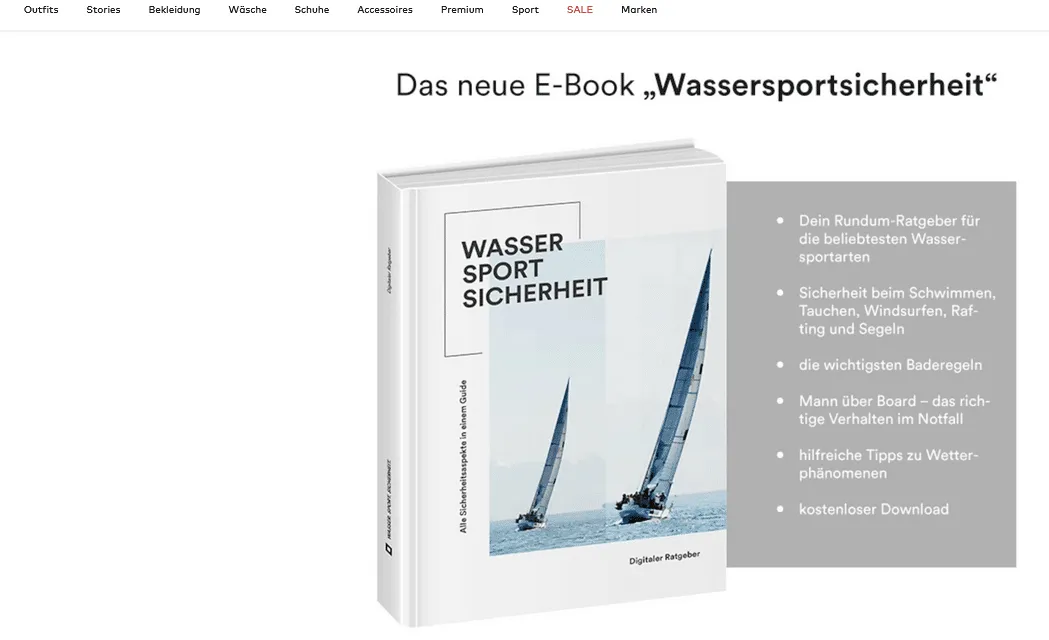
The emotional topic appeals to the majority of users. In Germany, the beach vacation is, after all, the most popular form of vacation of all. There is hardly anyone who doesn't spend their holidays by the sea at some point.
Thematically, the 22-page e-book revolves around safety while swimming, diving, windsurfing, rafting, and sailing. This covers the most important sports. At first glance a surprising topic: What does a fashion shop have to do with water sports safety?
The answer is found at the bottom of the landing page. There, ten important and thematically fitting shop categories such as “diving accessories for women”, “swimwear for women”, and “water shoes for men” are linked. As a result, the link power is passed on to the subpages. About You offers, among other things, an extensive selection of diving accessories as well as swimwear for women, men, and children. This is a vivid example of creative SEO: Very few users are willing to link to commercial offers. Online shops have it especially hard in this respect. A well-made e-book, however, ideally offers valuable content for the users.
The presentation of “water sports safety” may not be spectacular, but the e-book is nicely illustrated and easy to read. That's why it is gladly and frequently linked and shared by bloggers. In total, About You has raked in ten backlinks with it. These came, for example, from travel magazines, diving schools, and pages about school holidays.

What should likewise not be underestimated: Through the e-book, reach is generated. Water sports enthusiasts and vacationers who might never have come to the fashion platform on their own thus learn of its existence. Perhaps they even spread the e-book within their own network.
This example shows how effectively an e-book can be used for one's own purposes. With other topics, you can possibly get even more out of it. It's important to appeal to the emotions of the users.
But the content distribution also has to be right. Everyone talks about Content Marketing. But content needs marketing too. With a well-thought-out seeding campaign, content can be spread better. This includes working with bloggers and influencers, who should be deliberately brought on board.
Conclusion
The targeted building of backlinks for online shops is not without risk, since Google generally does not like active link building. But it is possible, with the measures shown, to optimize your online shop for SEO and to improve the ranking. One thing is certain: Without backlinks it will be damn difficult. Anyone who goes about it cleverly and circumvents the dangers has little to fear with link building. It's best to try out different strategies and find your own way.
Need a GEO check?
Get in touch for more visibility – in search engines and AI answers.
- More visibility and leads via Google and AI chats
- Sustainable SEO & GEO strategies
- Personal support


