
What Is Content Marketing? Definition and Examples
Whether content is now the king, the queen, or really just the butler is up for debate. One thing, however, is certain: the content marketing bandwagon has been rolling through the online world for years now, has been showered with plenty of buzzwords along the way, and yet apparently so few (it seems) still bet on content marketing.
What Is Content Marketing?
Informative, inspiring, and entertaining content is used to reach the relevant target audience without luring them in with intrusive or direct advertising promises.
This guide shows you the advantages of content marketing and, at the same time, why content marketing isn't everything.
The Advantages of Content Marketing
The saying “content is king” may be old, but it hasn't lost any of its relevance.
This form of marketing is meant solely and exclusively to address a specific target audience in order to answer their problems and questions or to entertain them. Direct advertising has no place in content marketing.
This approach has various advantages:
- You don't “annoy” the consumer, because you try to answer their questions and solve their problems.
- Through this form of marketing, the potential customer gains trust in the company.
- The company (individuals can do this too, of course) can establish itself as a true expert in the eyes of its target audience.
- You are found voluntarily by the target audience – the wastage is considerably lower than with classic outbound advertising (TV commercials, banner ads, etc.).
In times when hundreds of advertising messages riddle people's brains every hour, it becomes increasingly hard to stand out. Often the one with the largest advertising budget wins. With content marketing, you are found by your target audience and can thus minimize high wastage.
According to industry studies (e.g., Content Marketing Institute), many B2B and B2C companies use content marketing and invest a growing share of their marketing budget in it.
More on that later. Let's start with a quick look at the history:
History
Content marketing is really old! It's just that back then no one used the term “content marketing.” It was first put into circulation in 1996 by John F. Oppedahl (http://files.asne.org/kiosk/editor/june/doyle.htm).
But how old is content marketing?
Some sources give different dates for when content marketing was born. According to Dr. Oetker's official company history, August Oetker launched his baking powder “Backin” back in 1893, with recipes to cook along on the back (in 1891 he first took over the Aschoff pharmacy in Bielefeld).
For some sources, however, the famous “Guide Michelin” is the actual birth of content marketing (a recipe on a bag of baking powder just isn't that spectacular after all ;-)). The well-known tire manufacturer launched a hotel and restaurant guide in 1900 that is still world-famous today.
If you want to learn more about the history, drop by here or simply watch the video:
What Goals Does Content Marketing Pursue?
Content marketing can be used for many different goals. It can be used to …:
- … generate more traffic and new leads and position yourself as an expert
Content marketing is excellent for showcasing your own expertise and know-how and, with content that offers real added value, establishing yourself as an expert in your niche. - … build brand awareness and expand a position in the market.
“Those who write, stay?” That's roughly one way to put it. Anyone who manages to regularly deliver interesting, informative, and/or inspiring content stays in the minds of their target audience and can thus expand their brand awareness. - … win fans for the product/company (foster customer loyalty)
The number of fans or loyal customers of a product can be further increased with “awesome” content.
Of course, many other goals can be tackled with this marketing discipline. For example, detailed case studies, a popular format in content marketing, often earn backlinks, which in turn are very helpful for achieving better positions on Google.
Content marketing strategies can also be used to generate “social buzz” and thereby reach as many people as possible in a short time.
Or, put simply, the goals can be summarized as follows:
Attract attention to your own company with awesome content.
Today, one more is added to the classic goals:
Visibility in AI-powered search systems (ChatGPT, Perplexity, Google AI Overviews). Anyone who wants to be cited here needs clear answers to specific questions, unambiguous source references, and verifiable expertise (keyword E-E-A-T).
How Does Content Marketing Work and What Does Implementation Look Like?
If content marketing is implemented only half-heartedly, you can usually toss the whole undertaking straight into the trash.
No, this discipline requires a strategy and (lengthy) planning in advance. A quick shot can often remain ineffective. The following points should be considered during planning and implementation:
1. Creating a Strategy (Strategic Content Marketing)
In order to define the right strategy, we first have to put ourselves in the shoes of the relevant target audience:
- Which target audience should be reached with the content?
- What kind of content resonates well with the target audience?
- What information should the content provide?
- What content can be found at the competition?
For those who haven't yet given any thought to the target audience, I can highly recommend the article on defining your target audience at this point.
The depth of implementation of the content marketing strategy should also be determined, as there are various options here:
- holistic content
The website is designed entirely as a content platform, with the product in the background – example: coca-cola-deutschland.de. - integrated content
A content platform is built into the company website through which new content can be published regularly – e.g., via a blog, regular news, a forum, etc. - one-off content
Here content is created only once – e.g., white paper, infographic, interviews, etc.
Possible goals were already mentioned in the previous chapter. One important point that, in my experience, some companies still don't understand is acquiring new leads/customers through content marketing.
Finding a Strategy with the Content Radar and the FISH Model
The various possible goals in content marketing can sometimes cross each other and thereby lose their effect.
To recognize such obstacles and find a clear direction for the content strategy, there are various models that help with finding a strategy. Two very well-known models are the FISH model and the Content Radar by Mirko Lange.
FISH Model
The FISH model is about categorizing the types of content:
F stands for Follow Content and means producing content that people find interesting so that they always want more of it. Buzzfeed, with its endless top-10 list posts, pursues such a strategy with Follow Content. The content is relatively simple but creates a certain pull effect on many readers.
I stands for Inbound Content and means providing high-quality and useful content in order to obtain readers' email addresses (lead generation). Case studies are often excellent for this.
S means Search and Sales content. This is about content that is actively searched for by the target audience. This content should answer a specific question as well as possible. Especially texts that are meant to be optimized for Google and other search engines should always be able to answer users' questions.
H as in Highlight Content. As the name suggests, the aim here is to produce content that is meant to cause a certain “quake” in the company's industry – e.g., new studies with brand-new findings or the like.
Content Radar
The Content Radar divides content into functional/emotional and surface-level/deep. Using the radar, you can determine in advance whether the content should be functional (e.g., answering frequent questions from the target audience) or has an emotional function (should the content evoke “feelings” – e.g., entertain the reader humorously, etc.).
Surface-level/deep means whether the content is long-lasting or relevant only for a brief moment (e.g., a current news item).
This way, content can always be divided into four different areas in terms of its utility value and planned accordingly. A news item is usually something fast-paced and functional, since information is delivered briefly and crisply here. A complex guide, on the other hand, is usually deep and also functional, since extensive and problem-oriented knowledge should be passed on here.
The Content Radar can be combined with the FISH model in order to derive the right content marketing strategy.
Content marketing can be mapped to the stages of the customer journey or the marketing funnel:
In the awareness phase, blog and guide posts attract attention; in the consideration phase, whitepapers, case studies, and comparisons provide decision support; and in the decision phase, demos, testimonials, and concrete offers convince. This way, each content format fits a specific point of the customer journey.
2. Finding Topics
To do successful content marketing, the appropriate topics also have to be researched. A first important step in finding topics is to research the wishes, problems, and questions of the target audience!
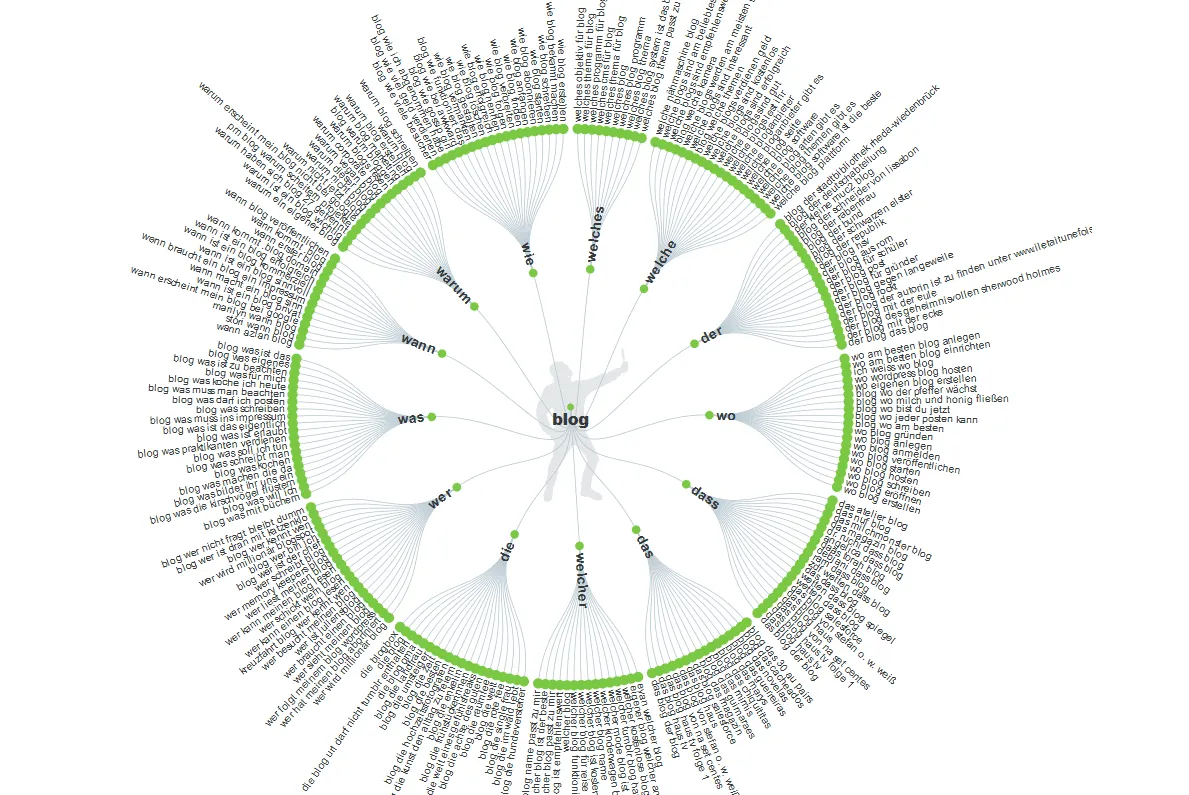
- As an old-school SEO, I of course recommend a keyword research using the Google Keyword Planner ;-). But other (free) tools on the internet can also be very helpful for topic research. Another recommendation is the website “Answer The Public”. The tool usually spits out a large number of questions and topic ideas for a given search term (see image – example for the keyword “blog”).
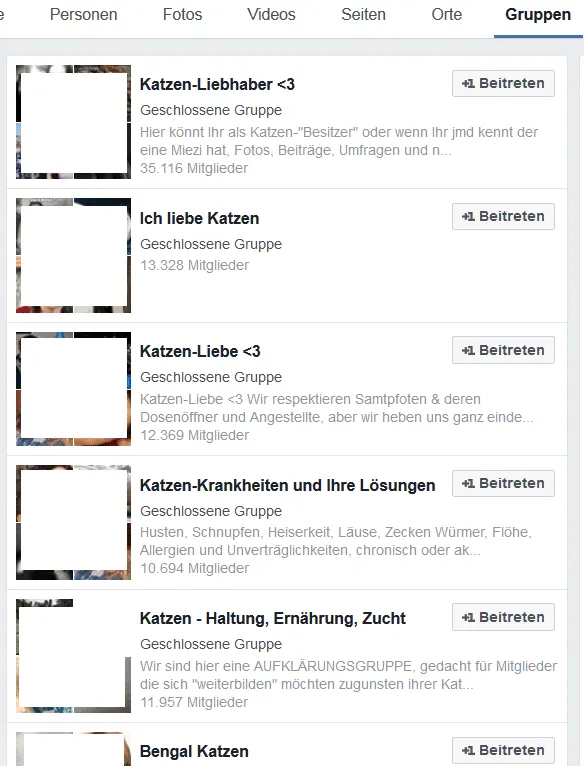
- Social media platforms such as Facebook are of course also very well suited for researching your target audience's questions. Once the target audience is defined, suitable Facebook communities can be researched and analyzed to see where the target audience's shoe famously pinches.
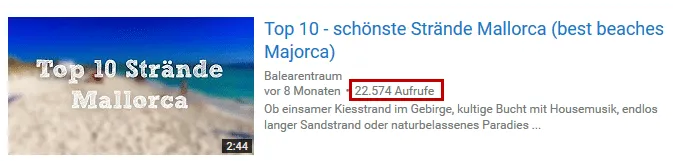
- Video platforms such as YouTube can also provide interesting topic ideas.
- A competitive analysis using analysis tools or the like is also very well suited for finding topics.
- The tool Buzzsumo.com can also be used to analyze which previous content formats have generated high “social buzz.” This tool is also very useful for finding topics.
- Reddit, Quora, and forums have become important again because Google displays these sources prominently in the search results. It's worth regularly checking there for questions from your niche.
Once enough topic ideas have been collected, it is advisable to record the ideas in an overview table or in a mind map, in order to filter out the most interesting topics. Mind maps can easily be created, for example, with the tools bubbl.us and Xmind (ChatGPT can do that too, of course ;-)).
3. Content Planning
Once the strategy and the topics are in place, we come to the content plan. When and in what form should the content appear? The strategy already defines which content formats should be created for the target audience.
A few examples of possible content formats:
- Blog posts
- Guides
- Tutorials
- FAQ
- Wiki
- Product reviews
- News, rumor mill, industry announcements, etc.
- Infographics
- Online game
- Self-tests
- List posts
- Survey evaluations
- Case study
- Images / graphics
- Whitepapers for download
- E-books
- Videos
- Podcasts
- Checklists
- Short videos (TikTok, YouTube Shorts, Instagram Reels)
- Newsletters (e.g., via Substack)
- Live streams and webinars
- and much more …
A content plan is extremely important for keeping an ongoing overview of which content has already been created, which is still to come, and which topics they cover. This is what a content plan or editorial calendar can look like in Excel:

With particularly large content plans involving very many employees, you can also quickly lose the overview in Excel. But there are already online tools that can make the work easier.
4. Implementation / Creating Content
As soon as it comes to implementation, it also becomes clear how realistically you planned. Beginners often misjudge the effort and then struggle with the implementation. The most important thing about implementing large content marketing plans is having a certain amount of manpower.
A brief aside on the topic of the hour: Yes, these days there is artificial intelligence. Tools like ChatGPT and co. are brilliant for overcoming writer's block, creating outlines, or brainstorming initial ideas. But – and this is a huge But: Please regard AI only as a tool and assistant, not as a cure-all.
An AI has no real experiences, doesn't understand your brand in depth, and tends to produce smoothed-over, generic mush. For truly outstanding content that stands out from the crowd, touches people emotionally, and builds genuine trust, you still need human writers. Anyone who just blindly hits the “generate” button here loses their uniqueness.
If the editorial team is too thinly staffed, even the best AI assistance won't help you – it leads to long waiting times in content production (e.g., of new blog posts). So you should always make sure to have enough real people (freelancers, permanent staff, etc.) to actually implement all ideas with heart and soul.
Only content that actually sees the light of the offline or online world can work :-).
Smaller projects can of course be implemented alone or in a small team.
By the way, I personally strongly advise against buying texts from larger content portals, because you proverbially get the rat in the shoebox… uh… the goat in the vending machine… the schnitzel at the kebab shop…. oh whatever, let's keep it short: you simply don't know what quality awaits you. That is often no better than a carelessly slapped-together AI draft.
Anyone who needs good writers (and is also willing to pay for them) can, with a bit of effort, find really good scribes here:
If you try to push down the price of content creation here (or replace the real writers entirely with cheap AI prompts), you always have to be aware that the quality will suffer massively as a result. If the content isn't valuable and deep enough, it quickly meets with rejection from your target audience.
So don't save in the wrong place. Good writers who write about a complex subject area and penetrate the topic more deeply than any AI often start at a word price of 12–15 cents, since they also have to research the content accordingly. Really good writers with the appropriate qualifications are also happy to charge 30–50 cents per word.
5. Content Seeding / Distribution
The content has been created, but the champagne corks can't pop yet because no one sees it? Then the content distribution should be reconsidered!
No matter how awesome your content is, if no one sees it, it will remain hidden in the dark forever and ever. So make sure you have a proper promotion strategy. Where do the target audiences spend their time? Through which channels can they best be reached? Are there influencers in the niche who might find your content interesting? Then you should think about blogger outreach.
And don't just rely on Google alone to win visitors or promote your content. Have at least one, or better several, traffic alternatives at hand – such as Facebook or other social media channels.
Content distribution can be structured according to the PESO or owned-earned-paid model:
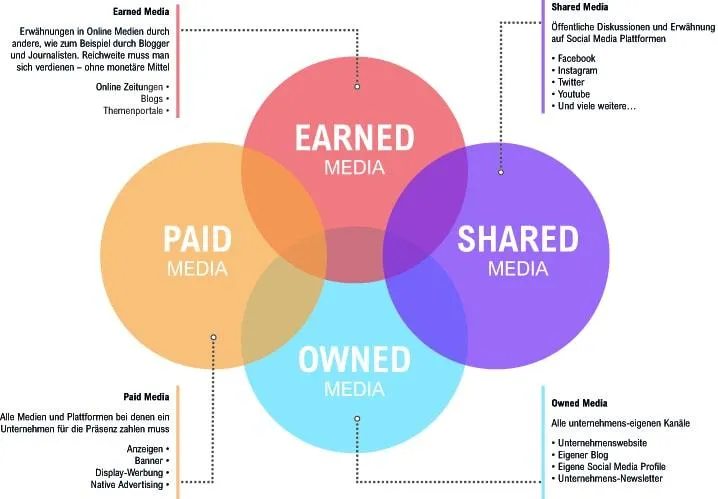
Owned media (your own blog, website, newsletter), earned media (blogger outreach, shared posts, links), shared media (mentions on Insta, TikTok, etc.), and paid media (paid social, ads). Concrete channels per area – such as newsletters, LinkedIn, or search engines – turn this into a plannable system.
6. Monitoring and Analysis
Of course, analyses should be carried out to measure the success of your strategy:
- How many visitors did it bring to the website (track visitors, for example, with Google Analytics)?
- How many likes and shares did the content get (Facebook – additional social signals often indicate positive approval)?
- How many people clicked on your ads or banners (how successful was your advertising campaign for the content)?
- How many people commented on the post?
- How many leads/customers could be won through the content marketing implementation?
There are many more ways to analyze. The fact is: anyone who doesn't track at all can't optimize their strategy and thus runs into the void and possibly misses out on success.
Measuring success becomes tangible with concrete metrics per funnel stage: awareness via organic traffic, reach, and engagement rate; consideration via time on page, returning visitors, and newsletter sign-ups; decision via conversion rate, lead cost, and ultimately ROI. This way, each metric can be assigned to a clear goal.
Examples of Great Content Marketing
I could now show you brilliant content marketing examples from large companies with a really fat advertising budget. But that wouldn't be helpful, since very few have such a large budget and resources (manpower).
That's why, instead of, for example, the content marketing example from Hornbach.de I'd rather show you examples that have a significantly smaller budget but illustrate very well how you can already achieve great things on a small budget.
Example: Whisky.de
Whisky.de is an online shop that successfully informs people on YouTube about the various types of whisky. The owner is truly no pro in front of the camera, but that is precisely what makes him seem so authentic. You immediately believe that he is a real expert in his field. The videos are pure advice videos without direct advertising.
Here's a cool example: anyone who still buys discount whisky after this video has only themselves to blame ;-)
Example: Blog Posts
Even simple blog posts can be successful and increase reach/awareness. List posts are often well suited for packaging a topic in an exciting way. Such posts are usually read and shared particularly often.
List posts are articles that write about a certain number of tips or claims. Such as, for example, the website Buzzfeed.comHere there are new list posts daily, such as “30 signs that you're almost 30” or “12 puppies experiencing snow for the first time.”
Even though such clickbait headlines are despised by more and more people, the success proves the operators of Buzzfeed.com right. Such tempting headlines simply get clicked more often, and everyone has to decide for themselves whether they can reach their target audience with them or even want to.
Common Mistakes
Beginners in particular stumble over the following mistakes. Anyone who has never viewed content as an information medium, but always only as a pure vehicle for advertising, will have to rethink a bit. Bloggers and journalists therefore find this form of marketing easier, since they (usually) already have experience creating informative/entertaining content.
Let's start with the top 6 popular mistakes in content marketing:
- You don't know your target audience
Who are you writing for? Whom do you want to reach with your content? Where does this target audience spend their time, and how do you even reach them?
If you don't meet your target audience where they are and address them accordingly, it will be hard to reach them. A buyer persona can also help you get to know your audience better. - You don't know your competition well enough
How does the competition behave in the market? On which topics are they particularly active? Through what do they get their traffic?
If there are already established competitors in your niche, a great deal can be derived from them. Do they, for example, actively rely on an online presence and count on Google for traffic? Then you can, for example, use the tool Sistrix.de to find out for which keywords they are found particularly well and through which they get these visitors. - Too few resources (time and money) for content planning, creation, and promotion
If the volunteer intern (volunteer = unpaid) churns out one 100-word news item per month, you really can't call that a sophisticated content marketing strategy.
If you skimp on content marketing, in my opinion you might as well not bother.
Only those who have enough resources available can achieve real success. For small projects, it's also enough to churn out 2–3 posts a month here and there. You don't always have to go all out. Even small campaigns can be successful and reach (realistic) goals such as higher visibility, more visitors, or the like. - You expect immediate results
Once the questions about resources are clarified, the expectations for possible results should also be clarified. Content marketing is often designed for a medium- to long-term timeframe. Just because a guide post and a short how-to video have been published doesn't mean the visitor numbers and leads will immediately go through the roof. No, content marketing needs one thing above all: plenty of time and patience until the first noteworthy goals are reached! - Selling is in the foreground
This is where beginners especially love to run their content marketing venture into the wall! “Oh come on, the post cost so much time, let's at least add a few links to our best products/services to explicitly point out once more how great we are!
Arrrrgggghhh! Unfortunately, that doesn't work.
The reader will completely lose trust if you feed them advertising copy. Many people will then see a guide text as clumsy advertising without any added value. The information or entertainment factor MUST be in the foreground. Advertising can, for example, be wonderfully brought to the reader on a website via the Service/My services section or the like. Keep your content clean and free of direct advertising. - The added value is too low – you don't pass on any noteworthy knowledge
Example: two simple tips for getting rid of your annoying mother-in-law are simply too little if you want to stand out from the crowd – it's best to always put out significantly more content and information than your competition – only that way can you set yourself apart and be noticed more quickly. - You blindly rely on AI-generated content
Especially since ChatGPT & co., a lot of AI text is simply slapped in 1:1. That gets noticed – by readers and by now also by Google. AI as a writing aid is okay. Anyone who uses it as a complete author without their own research and revision gets interchangeable content – and that is exactly what Google now penalizes. Keyword E-E-A-T: Google wants to see content that shows real experience and expertise.
21 Ideas for New Content on Your Website
But what to write about when the topic just feels too dull to you? Which text to compose when you're having writer's block or no ideas for a great post? With the following tips, you can succeed in creating great content that also interests your readers:
- Conduct interviews with people from your industry. Try to win people from your industry for an interview, e.g., well-known bloggers whose reach is particularly high. The better known the person for your interview is, the higher the attention for the interview will be!
- Podcasts: Reading makes you tired ;-)! To keep your visitors from falling asleep on your website, podcasts help. You could, for example, simply record an interview (see point 1) as a podcast instead of writing it down in a post. This makes every interview feel more lively and human. Don't forget that we are all just humans and not emotionless robots. …that reminds me, I should also start such a SEO podcast sometime… ;-)
- YouTube: Did you know that YouTube is now the second-largest search engine in the world? With a great, detailed video, you can convey your knowledge, news, or whatever to very many people.
- Interesting product information, e.g., the differences between various types of beer, spirits, etc., that not everyone knows, can become real crowd-pullers on your website.
- Always let other websites inspire you. Read, for example, English-language blogs and consider whether you can adapt the topics into German. Of course, you shouldn't translate everything 1:1 now, but rather consider which topics from other blogs might also be interesting as a post on your website.
- Can you tell an exciting story about yourself or your company? Something personal always goes down very well with many readers.
- Are there current news from the industry? Always try to report on new findings or current events from your niche as quickly as possible.
- Swimming against the current for once and holding a provocative opinion on a current topic; this tactic can generate quite a bit of attention. However, caution is advised here – provoking too much can also backfire ;-).
- Do questions from your readers reach you? Simply address these questions in your next posts. Analyze your target audience closely and check which topics are interesting for them. You can also work this out through surveys.
- Report from trade fairs or similar specialist conferences. Many bloggers even write so-called “recaps” of trade fair visits to keep their readers up to date on the latest trends (e.g., in the SEO field, the SEO CAMPIXX).
- Identify a problem and solve it: yes, the classic among content ideas. Search forums (e.g., GuteFrage.net) for the community's most frequent questions on a particular topic and answer these questions on your website.
- Write a complex guide that is considerably more detailed than a normal post.
- Write instructions on how to NOT proceed.
- Create a list post, with, for example, 50 tips and tricks for a higher income.
- Have you made a great discovery in your niche? Have you found out something that no one else knew before? Well then, go ahead and publish a case study about it and prove your discovery.
- Report on myths and reveal them to be true or false.
- Write an article about the most valuable resources, e.g., the best WordPress plugins.
- Report on what it looks like behind the scenes – how do you work? What do you do to motivate yourself? What does your daily routine look like?
- Report on and show upcoming trends from your niche. What will change? Are you able to make forecasts about it?
- Write a “HOW TO” list: Explain your exact approach step by step, e.g., how to subject a website to on-page optimization or how to install WordPress.
- Reviews of current, interesting products are always read gladly. It's even better if you create a video about an interesting product: on YouTube and other video portals there are heaps of “unboxing” videos for many different tech gadgets, such as TVs, phones, etc..
As you can see, there are many ways to create great and creative content. Always first consider what information your target audience is looking for and then create suitable content that satisfies your visitors.
FAQs
Why is content marketing in such demand, and what is the difference from stale old-fashioned marketing?
Every single day we are bombarded with more than 6,000 advertising messages. The conclusion: the consumer switches off faster and faster, recognizes advertising better and better, and becomes ever harder to reach.
Content marketing is the exact opposite – with this marketing discipline you are found by your customer because you answer the searcher's questions. The customer searches for you and will (hopefully) find you according to your content, which you have tailored to this target audience! Awesome, right?
What is the difference between content marketing and inbound marketing?
Advertising banners, TV ads, or the like are also often referred to as outbound marketing. Associated with this are a fat budget, high wastage, and a large number of people whom you annoy with it.
As described earlier, with a successful content marketing strategy you are found by customers without annoying them. So the customers come to you of their own accord.
Once the customer is with you and has gathered the information, what happens then?
There is no clear dividing line between content marketing and inbound marketing. But in my opinion, this is exactly where inbound marketing kicks in and specifically tries to turn new visitors into customers and later even into fans or loyal followers.
Methods such as active social media campaigns and newsletter actions are used to generate leads from as many visitors as possible.
More opinions on the differences can be found here:
- https://www.trialta.de/inbound-marketing-blog/content-marketing-inbound-marketing-unterschied
- http://www.sem-deutschland.de/was-inbound-marketing/#Was_ist_der_Unterschied_zwischen_Inbound-Marketing_und_Content-Marketing
Why do content marketing and SEO fit together so well?
As mentioned: content marketing is often used to answer the questions of a specific target audience as well as possible.
And what does Google want in the top (organic) positions?
Correct: the best answers to the questions and problems of the target audience.
If you manage to give the best possible (and most detailed) answer on a topic with, for example, a blog post, your chances aren't so bad of being rewarded by Google with good rankings for it. Of course, there are many more ranking factors – good content is nevertheless an important foundation for better rankings on Google
How does AI fit into content marketing?
Generative AI (ChatGPT, Claude, Gemini & co.) has by now become an integral part of many editorial teams – from the briefing through the outline to first drafts. What fundamentally hasn't changed since the beginning: texts without human expertise, research, and revision come across as interchangeable and rarely rank well on Google. AI takes the typing off your hands, but it doesn't replace your own knowledge and your own experiences.
A growing strategic field is the use of generative AI along with Generative Engine Optimization. In the workflow, AI can be usefully employed for briefing, outline, first draft, and fact-checking, without replacing human expertise. At the same time, visibility in AI search systems is gaining importance (GEO/AEO – such as ChatGPT, Perplexity, and Google AI Overviews), for which content should be specifically prepared.
What is E-E-A-T and why is it important?
E-E-A-T stands for Experience, Expertise, Authoritativeness, Trust. Among other things, Google evaluates content by whether the author really knows the topic from their own experience, is professionally competent, has a certain authority in their industry, and comes across as trustworthy. For content marketing, that means: personal experiences, clear source references, visible author profiles.
Who is content marketing suitable for?
Do you have an online shop, a website, or another kind of online presence and want more visitors?
Then content marketing is a very good fit in most cases, since people search for answers especially online and these can be answered with targeted content.
Creating content is also not hard, but often somewhat time-consuming and also involves costs. However, you don't need a budget like Hornbach or Coca-Cola to win new leads and customers with it (see the examples above).
Why Content Marketing Can't Be THE Cure-All in Online Marketing
Content marketing will always remain “only” one part of the overall online marketing concept. As before, other online marketing disciplines are interesting, such as social media marketing, paid ads, and many more, in order to get more traffic to your own site, for example.
Anyone who bets only on content marketing and neglects other disciplines such as SEO will always get only a small piece of the online marketing pie.
Besides, success in content marketing is never guaranteed. No strategy, wrong planning, poor content, and much more can lead to your campaign not being successful. If you bet only on content marketing, that is especially bitter.
That's why I strongly recommend using several online marketing channels!
Content marketing is of course still a damn cool thing, but above all it also requires resources and patience, since successes are not always to be expected quickly.
The most important steps summarized once more:
- Strategy (What is even to be achieved? Who is the target audience?)
- Topic research (Which topics interest the target audience?)
- Content planning (When does which content appear? Who creates the content?)
- Content creation (Implementation: creating content)
- Promotion (How is the content made known, or how is it brought closer to the target audience?)
- Monitoring & analysis (Measure successes and adjust the strategy if necessary)
Defining the target audience is especially important here – who should be addressed with the content, and where do they spend their time?
What kind of content best suits this target audience? Exactly these questions should always be clarified beforehand, since otherwise successes (such as more leads) will be pure chance.
SEO & GEO check
Want more visibility – in search engines and AI answers?
We analyse your potential and show concrete next steps. Free and non-binding.