
What is off-page optimization? Definition, explanation and tips for off-page SEO
Off-page optimization refers to all the measures that serve to optimize a website for the search engines and that take place off the website. In English, this optimization is referred to as off-page SEO (off the page = off the website).

Off-page SEO is about link building and building up reputation and mentions on the web in order to deliberately increase the authority and the trust (trustworthiness) of a website.
The counterpart to off-page optimization is on-page optimization. This is about all the optimizations on your own website.
Fundamentals of off-page optimization
For many people, off-page is only about backlinks. That falls short, since all activities off your own website are meant. First, the basics: A backlink is a reference (hyperlink) from one website to another. Backlinks are an important ranking factor – a backlink acts like a recommendation that Google takes into account positively. This is what a link looks like in HTML:
<a href="https://www.beispiel.de/ziel-url">Anchor text of the link</a>
Good vs. bad links
Google distinguishes very well between good and bad links in order to combat spam backlinks. Good links come from topically relevant websites with many visitors and a natural, strong link profile; they pass on a lot of link power. Bad links are, for example, off-topic or foreign-language backlinks – such as a Russian gambling site that links to a German ornamental-fish blog. Many such links can become dangerous and result in a Google penalty.
Note: The “Domain Authority” (DA) is a metric from Moz, not an official Google value. Google does not use any public domain authority metric as a ranking factor – DA should therefore not be presented as a Google signal
The beginnings of off-page optimization
In the beginning, every link was evaluated by Google and taken into account for ranking – regardless of whether social bookmarks, web directories, wikis or mass spam backlinks.
In the past, large directories or web directories like DMOZ or Mr. Wong were mandatory in off-page optimization. Both no longer exist today (the Open Directory Project/DMOZ was discontinued on 17.03.2017, Mr. Wong was already shut down in 2014) and are relevant neither as a backlink source nor as a “must”.
Spam backlinks were especially popular for deliberately pushing a domain forward; automated tools built cheap links (blog comments, forum links). Keyword stuffing was also carried out intensively. Google declared war on this web spam with numerous updates – the biggest was the Penguin update.
How the Google Penguin update changed off-page optimization
Since the first Penguin update on 24.04.2012, Google has increasingly declared war on shabby spam links. Websites that wanted to improve their rankings with artificial link building were penalized – especially those with many manipulated links.
A prominent example was Home24.de, whose visibility fell sharply. With Penguin 4.0 (2016), Google evaluates link profiles in real time as part of the core algorithm, so that a recovery after cleanup is possible more quickly. In off-page optimization, the greatest caution is therefore advised.
Link profile and link mix
These days, a correctly chosen link mix that lets a natural link profile emerge is indispensable for good rankings on Google and can protect against a penalty.
In this, “anchor texts” – the text with which the link points to a website – play a major role. Even when good links are built from topically relevant blogs and portals, this can still cause trouble with Google if you do not observe a few points.
In off-page optimization, the entire link profile of a website must always be considered. This includes:
Anchor texts
Anchor texts help the search engines better understand what the linked page is topically about. However, the manipulation of anchor texts has been so heavily overdone that an exaggeration of anchor texts should be avoided here.
Links that always show the same link texts can be discovered by Google very easily, recognized as manipulation and can therefore cause a page to be penalized. It is therefore important, when building links, to let a naturally appearing link structure emerge and to choose the anchor texts very carefully.
Anchor text formula?
Google now recognizes very well whether a link profile has grown naturally or whether it is a case of poor manipulation. You have to make sure not to always link with the same money keywords.
If anchor texts are used, such as the name of the brand URL or the name of the company, this can in turn bring advantages and strengthen a website as a brand in the rankings and push it further forward.
At most internal links should regularly be set with the same money keyword as the link text.
- You should therefore vary the link texts for the money keywords for which you want to be found well more often when building links manually. Instead of simply always using the link text “off-page optimization”, for example, rather use off-page optimization for SMEs, off-page optimization online shop, off-page optimization costs, etc.
- When using money keywords, it is even safer if whole sentences are linked, such as “Off-page SEO (links) are an important ranking factor…” or “Search engine optimization is only effective in combination with off-page SEO …”. However, you should make sure that your money keyword is contained in the sentence.
On the internet there are many rumors on the subject of anchor text ratio. Some sources claim that, for example, 50% of all links may safely have the same link text. With 1,000 links, that would be a whopping 500 backlinks with the same link text! You cannot show Google a bigger red flag to be hit with a penalty.
There is no such thing as THE perfect anchor text ratio that you should go by. Rather, try to strongly vary the anchor texts when building links manually and thereby keep a link profile as natural as possible!
The link mix should not only have anchor texts from money keywords – these should take up only a small part. As anchor text, brand names, the URL of the website and generic link texts should rather be used more frequently.
Important: Webmasters should never blindly rebuild the competition's link profile. You can never know which of the competitors' links in the link profile were devalued via the Google Disavow Tool. You can of course still get an overview of which anchor texts the competition has set on the front ranks (this can be analyzed with Majestic.com, for example).
Tips for a good anchor text ratio
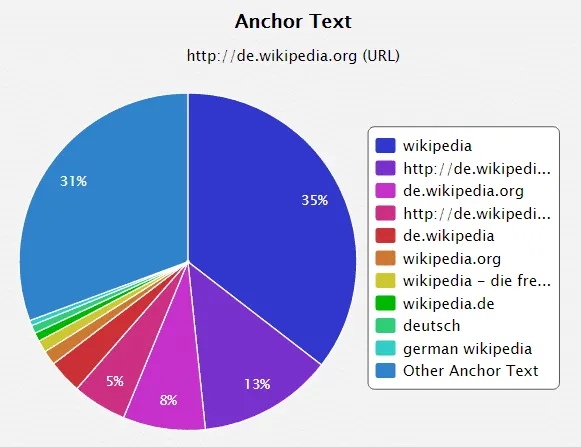
Wikipedia is one of the largest websites with the highest visibility on the web in Google. Here no active link building was carried out; instead, every link was built naturally. Here you can see very well which links and anchor texts have an effect.
It is interesting to see how often the exact money keyword is used. Some spot checks show that on average 5 – 30% of all link texts that point to a subpage on Wikipedia contain the exact keyword (examples further below).
With the Wikipedia homepage, this naturally looks different. Here there are no exact anchor texts that were repeated particularly often; instead, links are made with the URL and the brand name (Wikipedia).
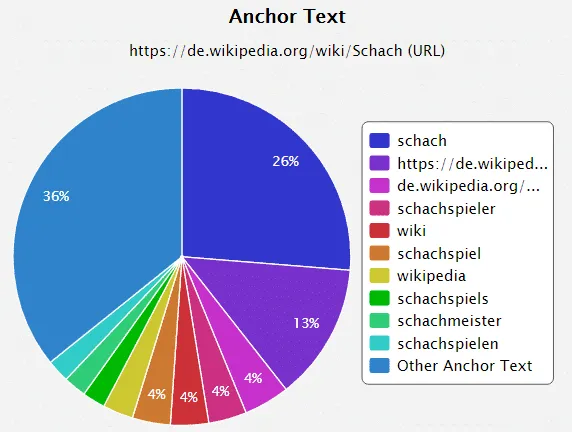
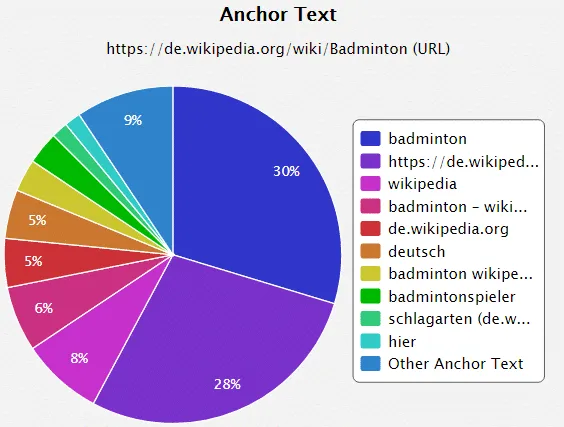
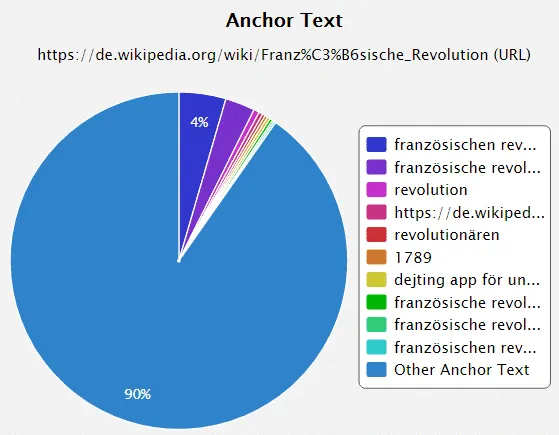
If now, on a new website without noteworthy content, 30% of all links contain the exact money keyword, this can be perceived by Google as very suspicious. Our advice is therefore to always vary the links to a subpage with the money keyword, and at most 5% of the links should repeat the exact money keyword.
If you want to be on the safe side, vary every link text and link whole or half sentences with the money keyword, and in addition build as many links as possible with generic anchor texts, brand names and the URL.
But what about link profiles that have almost exclusively brand names as link texts?
Many examples on the internet suggest, for off-page optimization, using the brand name (in my case the brand name would be “Farbentour” or “Farbentour.de”) as often as possible. Many large websites often have only the URL or the brand name as anchor text and rank very well with it.
Here, however, is the problem: Large websites have thousands of links and thereby extreme power. If now a small blog or small online shop starts to build 5-10 links with the brand name as anchor text, this does not have the same effect as with large websites that have thousands of backlinks with the brand name. That is why I recommend a healthy mix of brand names + money keywords (max. 5%) + URL + generic anchor texts.
NoFollow vs. DoFollow ratio
There is no such thing as the right number of NoFollow and DoFollow links. What is important is that every natural link profile also has NoFollow links.
A nofollow link is an HTML code that can be added to a link when you want to prevent Google from using this link when calculating the rankings.
Example:
<a href="Beispielseite.com" rel="nofollow">This is the link text</a>
Important: since September 2019, nofollow is only a hint and no longer a binding instruction; since March 1, 2020, this also applies to crawling and indexing. Google can therefore certainly use nofollow links for ranking. In addition, there are the newer attributes rel=“sponsored” (paid links/advertising) and rel=“ugc” (user-generated content such as forum posts and blog comments). Google treats all three attributes as a hint.
A NoFollow link is not worthless: A nofollow link from a very large website like Wikipedia can be a proof of trust for Google.
Deeplink ratio
Links should be set not only to the homepage but also to subpages. There is no perfect ratio; important subpages that are supposed to rank should receive deeplinks accordingly.
Origin of the backlinks / IP address
In order to be better able to declare war on private blog networks, Google now sees very well where the backlinks of a link profile actually come from. If the links come from always the same server IP, that is suspicious for Google. A natural link profile has backlinks from different IP addresses.
Time period
Also very important in off-page SEO:
- Were all the links built within a short period of time or over a longer period of time (several months/years)?
- Many people set their manual links within a few weeks, which can likewise seem suspicious to Google very quickly.
- It is better to build the links regularly over a longer period of time.
- Stopping link building overnight can likewise be problematic. If you build a large number of links every month, a sudden stop can likewise lead to a loss of trust (including ranking drops).
Checking the link profile regularly
Unfortunately, there are again and again competitors who like to “gift” their rivals a few harmful backlinks – in the hope that they drop in the ranking. This approach is also referred to as negative SEO. As an affected party, you can often only defend yourself against it with Google's Disavow Tool.
With this tool you can tell the search engine that certain links should not be taken into account in the ranking distribution.
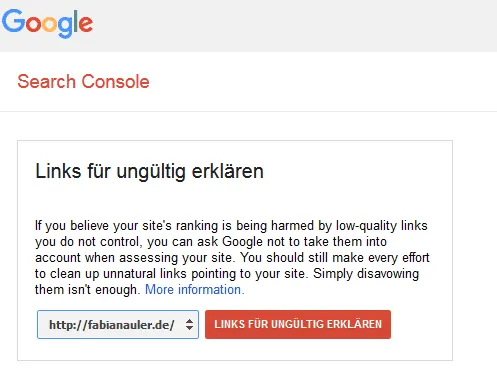
The Disavow Tool is usually not a standard tool and only intended for exceptional cases. Google (John Mueller) has made clear for years that negative SEO through external spam links hardly works and that most websites do not need the tool, because the algorithm (Penguin 4.0 in real time, SpamBrain) automatically devalues such links.
Five tips for better off-page optimization
1.) Topically relevant content links are strong
Backlinks out of the body text, which are surrounded by topically relevant content, are very strong links. Backlinks from the sidebar or from the footer, on the other hand, should be treated with great caution, since these can have a rather negative effect.
2.) Guest posts
Bloggers and freelancers in particular can make a name for themselves through guest posts on popular sites and thereby generate strong backlinks.
However, if you are still unknown in your niche, it is unfortunately not easy to be allowed to publish a guest article. There, first of all, it means going out to knock on doors and making yourself popular or creating attention. You can find more on this on our blog: Blogger outreach and seeding.
3.) Link building for online shops
Smaller online shops often have a hard time getting good backlinks. Why should a well-known site link to some random shop? On our blog we have summarized the best strategies: https://www.farbentour.de/linkbuilding-onlineshops/
4.) Traffic
Really strong links are links via which visitors also come – there are signs that Google recognizes this better and better and weights such links particularly strongly!
5.) Use tools!
Off-page optimization can only work sensibly with tools. There is a wide range of different tools with which you can analyze link profiles. Recommended are
- Majesctic.com
- Linkresearchtools.com
- Ahrefs.com
Off-page SEO in the future
Backlinks remain a central signal: with them, trust can be signaled that a linked website is really good and helps the user further. Webmasters should focus on building individual, strong backlinks that signal trust to Google, and on convincing other webmasters through high-quality content. This creates natural link profiles that Google rewards.
Instead of the “E-A-T formula”, today one should speak of E-E-A-T: Google expanded the Quality Rater Guidelines in December 2022 by a second E for “Experience”. E-E-A-T is an evaluation concept of the Quality Raters and not a direct algorithmic ranking factor.
Beyond links and reputation, off-page also encompasses unlinked brand mentions and the role of off-page signals for AI answers or Generative Engine Optimization (GEO). Both aspects are increasingly gaining in importance.
Three common questions about off-page optimization:
1.) Is it dangerous to build many links at once?
For link building, platforms like Fiverr, Ebay, etc. should be avoided, since the buyer only receives bad links that lead to a Google penalty.
2.) Does it make sense to do no off-page SEO at all?
Many webmasters are so unsettled that they no longer set any links at all and believe the myth that you can achieve very good rankings even without backlinks. In theory that is possible, but in practice it works only with great difficulty. That is why, for better ranking results, link building should always also be taken into account in SEO, in order to achieve optimal results. Anyone who neglects off-page optimization gives away a great deal of potential.
3.) Does it make sense to rebuild the competitor's link profile?
To believe that a competitor is right at the top only because it has set certain links is a big mistake. Many people try to rebuild the link profiles and then fall flat on their face, because the competitor built this profile years ago and they are now setting the same old links again. Google is not that stupid and detects the trick. Besides, you cannot know whether the competitor has cleaned up its link profile using Google's Disavow Tool and you are inadvertently building bad links to your site.
Quellen
- Google, Google's announcement of the first Google Penguin update: https://search.googleblog.com/2012/04/another-step-to-reward-high-quality.html
- Linkresearchtools, The Real Time Google Penguin Algorithm is LIVE: https://www.linkresearchtools.com/google/google-penguin-4-0/
- Google, Disavow Tool: https://search.google.com/search-console/disavow-links
SEO & GEO check
Want more visibility – in search engines and AI answers?
We analyse your potential and show concrete next steps. Free and non-binding.