
E-Commerce & Online Shops
SEO for shop categories: Better rankings and more traffic for online shops


SEO for online shops is, for many e-commerce professionals, the most important traffic lever of all. Yet at many shops, optimization already fails at the very important category pages.
Why shop categories are so important for SEO and how to optimize them correctly is what you will learn in this article.
Which search intent do shop categories match?
There are many optimization levers to pull in order to achieve the best possible rankings for the categories of an online shop. A first important step is determining the right keywords.
Category pages in online shops are perfect for transactional keywords (Do = the user wants to carry out an action, such as buying something). Search queries on Google, such as “solid wood table”, are strongly transactionally driven.
This means that the user is interested in this product but is still relatively at the beginning of their research. Perfect for a category page at a shop for solid wood tables.
In the category, a large number of tables are presented and the user can browse to their heart's content. The keyword “buy solid wood table” goes even further into transactional search intent – here the user already knows that they want to buy such a table and is now looking for the right shop for it. So this is also perfect for category pages in online shops.
Title tag + description
The SEO basic par excellence: this formula works very well for the title: main keyword + USP + (brand). So for example “buy solid wood table free shipping | AFictionalShop.com”. The keyword comes first, followed by a USP and the addition “buy” – this usually fits shop categories well. Here you naturally have to test. What really fits the search intent, and also what the competition is doing, always depends of course on the keyword.

The meta description is built up similarly. However, the description is not a direct ranking factor and keywords have no direct influence here. Here it is advisable to focus even more strongly on the USPs of the shop!
Structuring a shop category page that ranks as well as possible
When building shop categories, a certain scheme has proven itself over time. Here, not only SEO points are important, but UX and conversion are also highly relevant factors = the more satisfied the visitors are, the better that is, of course, for SEO as well.
Best-practice structure
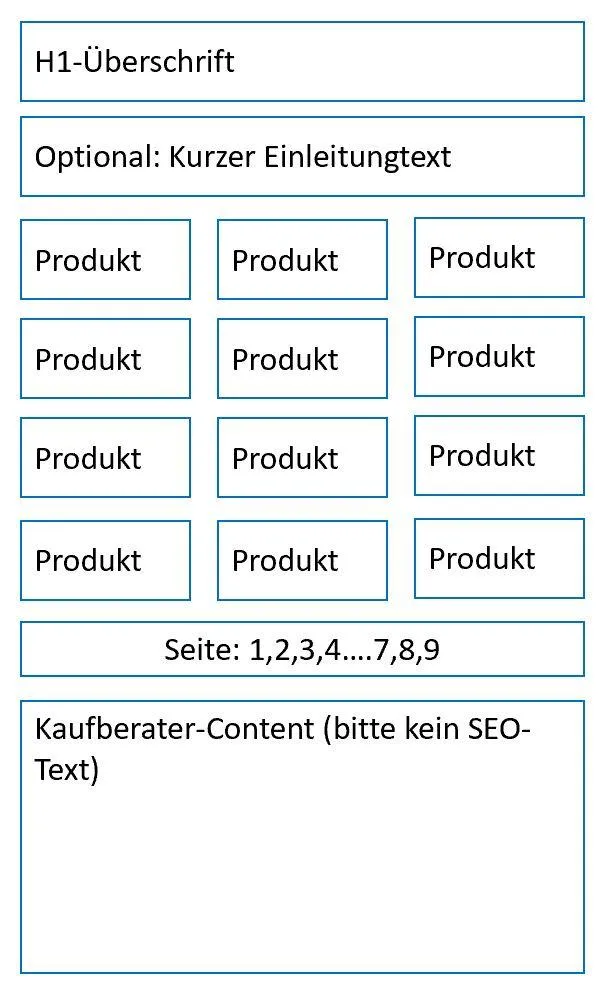
Following the best-practice principle, the structure of a shop category often starts with a short introductory text, followed by a large selection of products. Important: the text should by no means be too long. The products must be in the above-the-fold area so that the user gets to see the products directly, without having to scroll.
At the end of the products, then an area for a text – whether an SEO text is enough here will be answered shortly.
At the very top or in the sidebar, the filter elements should be placed so that the user can easily sort everything according to their needs. Remember: everything that is good for UX and for the conversion rate is also good for SEO. Satisfied users = the best SEO. Customer reviews, shop trust seals (e.g. TrustedShops) and much more can improve the conversion rate and thus also SEO.
Products
The number of products is enormously important. If, for example, you have far fewer products to choose from than the competition, you can forget about good rankings straight away. On category pages, the user often wants a large selection. With the term “solid wood table”, the user does not yet know exactly which table they want (how large, how wide, which color, etc.). Therefore, the category page must offer a large selection range in order to be able to provide something for every user.
Product photos are also enormously important and invite the user to browse. Often seen: shops with the largest selection and the most beautiful photos simply rank considerably better = user satisfaction is likewise enormously important here for SEO.
“SEO text” or buying advice at the end?
Do you even still need texts for the categories of a shop in order to rank well? Yes, definitely. Google is a full-text search engine and can classify documents accordingly on the basis of texts. That is why texts are so important for categories as well. A pure SEO text with keyword spam is no longer recommended today.
It is better to write really good buying advice, with answers to the customers' most frequent questions, and to provide as much assistance as possible here.
TF*IDF analysis and optimization are rather optional for transactional keywords. Look at how many words the competition has and which questions they answer. For TF*IDF analyses I can highly recommend Termlabs.io or surferseo.com Especially the integrated audit module of Surferseo is nicely laid out and helpful for optimization.

Ask yourself with which content you can create an even better buying guide than the competitors, and your visitors, but also Google, will thank you accordingly.
Pagination
Pagination is the page numbering used for shop categories. Especially shops with very many products per category cannot avoid proper pagination. However, category sub-pages that arise due to pagination can lead to duplicate content problems. The Google crawlers may then not know which category page should now rank. A simple solution is to set these sub-pages to noindex, follow. If need be, this can also be done to prevent duplicate content.
However, Google does not advise setting the noindex tag, because through noindex the linked products are no longer followed by Google (the internal links on noindex pages are rated as nofollow).
Therefore, the following step is recommended for pagination:
Only the first category page should have a category text. On the sub-pages that follow, this should no longer appear. It is better to keep the title tag and description of the sub-pages individual. This can be achieved by appending “page N” to the title and to the meta description.
NoteTip: Per category page you can display as many products as possible in order not to unnecessarily increase the number of category sub-pages – this saves crawler budget for large categories. So it is advisable to display 100 items per category page and to load the images later by means of lazy loading, in order to protect the loading times.
Caution with filters
In categories, duplicate content can quickly arise due to filters. Duplicate content does not directly lead to worse rankings, but it can confuse the search engines. Such filter pages have a sorting function, as for example in a category for men's shoes, in which you can select by color, size and much more. Each selection option can be a standalone URL However, this creates duplicate content in places, when the category text is always displayed along with it.
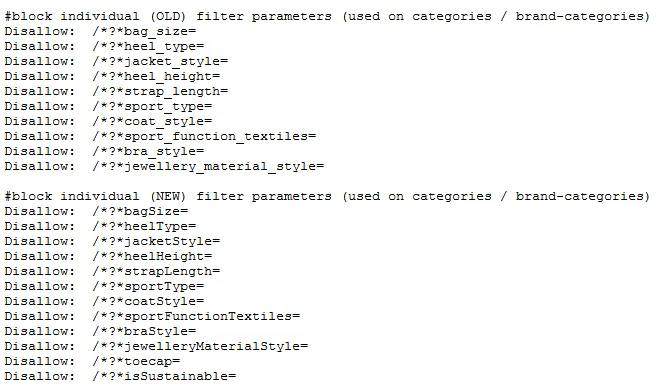
This can be prevented by setting the filter pages to noindex or, if need be, by placing a robots.txt file a disallow command as here in the example from Aboutyou.de:
Special case: infinite scroll on category pages
In categories with infinite scroll, the category sub-pages are loaded as soon as the user scrolls. Here the user does not first have to click on the respective sub-page links, as with normal pagination. What at first sounds quite user-friendly is often a problem for Google's crawler: the crawlers do not scroll and may not be able to capture the sub-pages at all: https://www.searchenginejournal.com/google-infinite-scroll-lazy-loading/363184/.
John Müller, spokesperson of Google, likewise does not recommend infinite scrolling, since this can also lead to duplicate content problems: https://www.seo-suedwest.de/5818-google-infinite-scrolling-zur-anzeige-mehrerer-artikel-kann-zu-duplicate-content-fuehren.html.
Testing
All of the recommendations mentioned so far are based on best-practice experience: in the end, practice has to show what works, and here every shop and every industry is unique. Therefore it is advisable not to implement changes on all pages of the shop at once, but selectively on a few sub-pages, in order to check the results.
For example, to build structured data into 10 of 20 categories and then see whether these rank better.

Conclusion
Shop categories are extremely valuable for many shops as far as SEO traffic and conversion are concerned. Through categories, transactional keywords can be targeted specifically. How to build the perfect category pages according to the best-practice principle is what you have now learned in this article.
If you have a shop yourself, you should always test all recommendations and check whether Google accepts them in your niche and industry.
-Fabian
Need a GEO check?
Get in touch for more visibility – in search engines and AI answers.
- More visibility and leads via Google and AI chats
- Sustainable SEO & GEO strategies
- Personal support


