
E-Commerce & Online Shops
Magento SEO tutorial: How to get your Magento shop fit for the search engines

Anyone who wants to build a successful e-commerce business cannot get around two things: the right online shop system and the corresponding search engine optimization.
A very good shop system, especially for large websites, is the Magento shop solution.
Magento SEO: How do you optimize Magento for the search engines?
Google makes no distinction between individual shop systems and lets the websites appear at the very top that present the best search results. Magento shop operators should therefore tidy up their shop and master all the SEO basics, such as optimizing meta tags, the URL structure, the content, and so on. Magento SEO plugins also help to achieve better rankings.
You can read more about this in the following SEO guide for Magento:
About Magento

The open source system Magento has been around since 2008 and is one of the most widely used shop systems. 1.2 percent of all websites use Magento – this makes it the most widely used online shop software in the world. Magento comes in various versions:
- Community Edition (free of charge, without support)
- Enterprise Edition (paid, various support levels)
Search engine optimization for online shops is in principle similar with every system – at least in theory. The SEO measures that you take with the individual systems should aim very specifically at using the respective strengths of the online shop system as well as knowing its weaknesses and compensating for them accordingly. In particular, the high prevalence in combination with the open source license increases the selection of Magento SEO measures. Magento itself, like many online shop systems, comes with some good SEO functions out of the box; in addition, you can draw on a large number of plugins and extensions from Magento or from the community.
Of course, you should not rely exclusively on the technology and pre-configured plugins – ideally you bring a certain understanding of your own. Our guide is therefore the ideal entry point into optimizing your e-commerce!
SEO for Magento: Here's how!
The first step of good search engine optimization in Magento, too, consists of fully exploiting the existing potential of the software. With very simple measures, it is possible for anyone to lay an optimal foundation. Step by step to the search-engine-optimized online shop – let's go!
1. Title and meta description
A meaningful title and a good meta description are indispensable. The title is displayed in the header of the website, the meta description (also “short description” or “meta description”) reflects a brief summary of the content. Both are shown in the Google search results. The more meaningful the title and description of the website are, the more likely users are to be encouraged to visit.
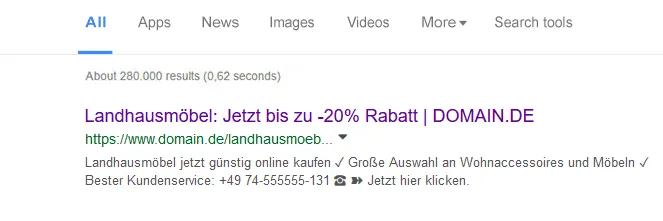
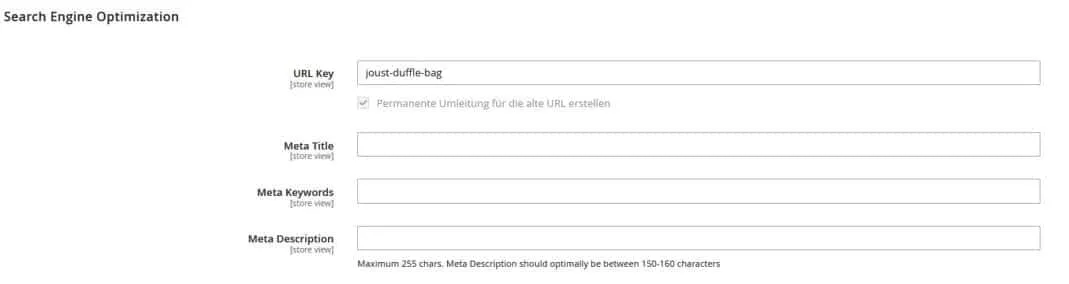
In Magento, the title and meta description can be created for each individual item as well as for each category page.
By the way, the “meta keywords” field is irrelevant for pure Google optimization, since Google ignores these keywords – so you can better put this effort into an appealing title and an exciting description.
The basic rules are:
- Every page (every product and category page) should have a title and a meta description. These should each be unique.
- The main keyword, i.e. the term for which the page is supposed to rank on Google, should appear both in the title and in the short description.
- The title and meta description should encourage the user to click; in the best case they highlight a USP (Unique Selling Point).
- The meta description should not exceed a length of approx. 230 characters (including spaces). Anything beyond that is abbreviated by Google on mobile devices with “…”.
Actually, the length of the meta description is not defined by Google in terms of a number of characters, but in pixels. The rule of thumb of 230 characters is, however, mostly reliable.
2. Search-engine-friendly URLs
Search-engine-friendly URLs are an important prerequisite for a successful online shop and can even increase the click-through rate.
To do this, in the configuration menu under the item “Search Engine Optimization” the item “URL Rewrite” is activated. The option “Add Store Code to URLs” is not particularly useful and should therefore be deselected.
A good URL looks, for example, like this:
www.myOnlineshop.com/mens-shoes/sneakers/
The user knows immediately what awaits them when they click on the link. The structure of the online shop is clear and easily recognizable.
This is how URLs should rather not look:
www.myOnlineshop.com/index.php?id=845333
This form is also referred to as a “dynamic URL” and should absolutely be avoided. Umlauts, special characters or keyword stuffing should also be avoided in URLs.
Well-structured URLs, as well as those that contain a keyword, make it easier for the user to recognize which content is on the page. This in turn can have a positive effect on the click-through rate and thus on the ranking of the page.
3. Content, content, content!
That high-quality and above all unique content plays an outstanding role in search engine optimization is by now generally known. This applies, of course, in e-commerce as well: good product and category texts with important keywords inform the users and can thereby contribute to generating traffic. With the texts, attention should above all be paid to the correct distribution of the headings. <H1> is in the hierarchy the highest and most valuable heading. It should appear only once and contain the main keyword. The <H1> heading is followed subordinately by <H2> to <H3> headings, which can be used for subheadings.
In Magento, under “Catalog”, a separate text can be entered for each category, each subcategory and each product under “Content -> Description”.
Good category texts are a must for every online shop. Therefore, texts of the highest possible quality should be created, with content that can generate traffic in a way suited to the target group. Good category texts contain well-founded knowledge about the respective product group, buying advice as well as, for example, care and application tips. You should rather avoid low-quality, cheap texts that cost 1 cent per word or even less. As a rule, a very low quality level prevails here, and a good ranking can hardly be achieved with that.

4. Don't forget the images!
An online shop without images is like an empty shop window. That is why it should be a matter of course to add high-resolution product photos. What is important here is the image optimization through the so-called “alt text” (alternative text). The alt text helps search engines to classify the product images, since search engines cannot “see”. Visitors who use a screen reader also get an impression this way of what can be seen in the image.
To enter the alt text, you go via the respective product page -> Images and Videos -> click the desired graphic.
5. Magento plugins – practical SEO helpers
Via extensions or plugins, a web shop can be optimized additionally for search engines. At marketplace.magento.com you will find numerous extensions in all price ranges for the search term “SEO”. Here it is worth taking a look at the features and the reviews of the other users in order to make a selection.
A good all-rounder is, among others, the SEO Suite Ultimate from Mageworx. In addition to a function for optimizing the metadata as well as checking for duplicate content, the extension offers numerous other functions that make search engine optimization of your own Magento online shop easier.

Before installing the extension, a backup of the online shop should definitely be created. This can be done quickly and easily via the item “System -> Import/Export”
Conclusion – SEO for Magento doesn't have to be hard…
Even without the help of experts or specialized SEO agencies, it is possible to subject your own online shop to an initial search engine optimization. Not least, this is due to the fact that Magento itself is designed to be quite search-engine-friendly. With the help of extensions, more far-reaching measures are possible – depending on budget and know-how.
What are your experiences with SEO for Magento shops? Have you carried out special measures yourself? Which SEO extension do you like best?
Need a GEO check?
Get in touch for more visibility – in search engines and AI answers.
- More visibility and leads via Google and AI chats
- Sustainable SEO & GEO strategies
- Personal support


