
B2B / Business-to-Business Explained
The term B2B stands for “business-to-business.” Translated, this abbreviation means something like “from company to company”: one firm sells services and products to another. This can involve machinery and equipment, software, or services in the online sector.
What Is the Difference Between B2B and B2C?
By definition, B2B means business relationships between at least two companies. In contrast to this is B2C sales, in which firms address private end consumers.
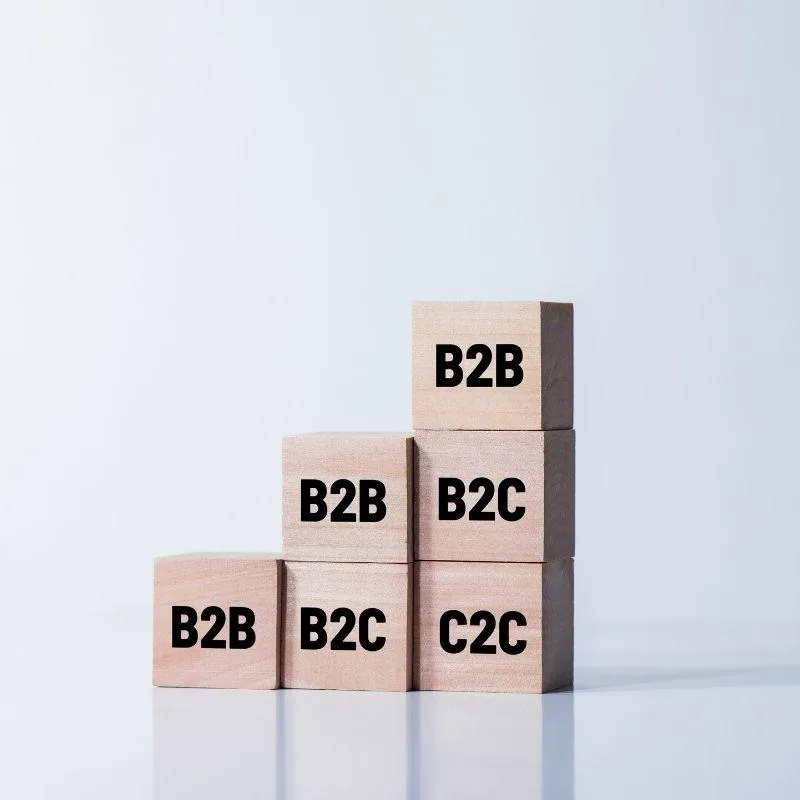
The abbreviation B2C stands for “business-to-consumer” (from the company to the customer). A typical example of this type of sales is retail.
There are also companies that target both audiences. These sell their products or services both to other firms and to private individuals. The hospitality and hotel industry is one example worth mentioning here.
There are differences between the two types of sales:
- In the B2C sector, a single person usually decides whether a purchase comes about. In the B2B sector, this process is more complex. Especially in larger companies, several departments are often involved in the purchasing decision.
- The number of potential customers is significantly larger in the B2C sector than in the B2B sector. However, the customer value in the B2B sector is higher.
- B2B customers deduct the VAT. B2C customers do not have this option. That is why small businesses that do not charge VAT and sell to private end consumers have a certain competitive advantage.
Typical B2B relationships are found in many industries:
A machine and plant manufacturer supplies production facilities to a manufacturing operation, a raw-material supplier delivers to a manufacturer, a wholesaler sells to a hardware store, and agencies or SaaS/cloud providers render services for other companies. Such examples show that B2B ranges from industrial goods through wholesale to digital services.
How Do Marketing and Sales Differ Between B2B and B2C?
There are certain differences between B2B and B2C: although in both cases it is about marketing offers, the segments differ in four points:
- Target audience,
- Messaging and channels,
- Products and services
- Service
Different Target Audiences
One of the biggest differences between marketing for B2B and B2C offers is the targeted audience: in the B2B sector, marketing addresses companies. In the B2C sector, end consumers or private individuals are the target audience.
In the B2C sector, marketing addresses a hard-to-grasp crowd of people. Accordingly, the offering concentrates on standardized services and products for the broad masses.
B2B customers, on the other hand, mostly need offers that are tailored to the customer's respective requirements. As business customers, they make money with the purchased products or services. B2B means that at least two companies do business with one another.
Different Messaging and Channels
In B2C marketing, emotional messaging through touching or amusing stories traditionally dominates. This is because consumers' purchasing decisions are primarily personally motivated. People identify with products and brands. In the B2C sector, that is often decisive for a purchase. Typical value propositions are adventure, fun, beauty, and happiness.
With B2B, the business relationship itself is the focus. So it is not necessarily about a specific product. Within marketing, the messaging is more factual. It is about how time, money, employees, or resources can be saved or business risks can be reduced.
This separation is increasingly blurring: in both the B2C and the B2B sector, emotional content and storytelling are used for marketing in combination with factual information.
Popular channels for B2C marketing are social media such as Facebook, X (formerly Twitter), and Instagram. In the B2B sector, marketing additionally – but not exclusively – concentrates on professional networks such as Xing and LinkedIn.
In addition to social networks, B2B e-commerce is gaining strongly in importance. Many companies sell via their own online shops, via B2B marketplaces and platforms, or bind their customers through electronic ordering processes (EDI) and e-procurement systems. Digital sales are a central B2B channel today.
Different Products and Services
In the B2C segment, the range of services and products offered is hardly manageable. After all, there is a large, heterogeneous group of potential customers that needs to be addressed. The offers are mass-produced products for an anonymous crowd.
B2B products are more complex. Companies often offer their business customers products that are tailored to the customer's respective requirements (such as individually configured machines or software). This leads to a long-standing personal business relationship between a company and its customers.
Nevertheless, many firms also offer standardized products and services in the business-to-business sector.
Different Service Requirements
Complaints in the B2B sector have more far-reaching effects than in the B2C sector. For this reason, B2B customer service is decisive for the customer relationship. Business customers place higher expectations on customer service regarding availability, speed of response, resolution time and competence, as well as empathy.
What Do B2C and B2B Marketing/Sales Have in Common?
There are indeed certain differences between B2C and B2B. Nevertheless, the commonalities predominate:
- Both marketing for B2B and marketing for B2C are about convincing potential customers of your own offering.
- In any case, a company needs a meaningful website. The website is a central point of contact for prospects and an essential part of marketing. Ultimately, it does not matter whether another company or an end customer informs themselves online about the offers and services.
- With advice articles, FAQs, and glossaries, companies underpin their expertise and answer the most important questions about the product offered.
- Social media is popular in both sectors for reaching your own target audience. In the B2B sector, LinkedIn does dominate. But Facebook and Instagram are also gladly and frequently used for marketing. After all, entrepreneurs and freelancers also surf in their private lives.
- In both sectors, good customer service ensures brand loyalty and positive reviews.
Besides B2B and B2C, there are further models: B2G (business-to-government) describes deals with authorities and the public sector, D2C (direct-to-consumer) refers to the direct sale from manufacturers to end customers without intermediaries, and C2C (consumer-to-consumer) stands for trade between private individuals.
Conclusion
Business relationships between companies are referred to as B2B. The marketing and sales of B2B companies concentrate on other firms. They develop offers that are tailored to the requirements of the respective business customer.
B2C stands for business-to-consumer. This definition already includes the end consumers as the target audience. Among the special features in the B2B sector are the intensive business relationships that often last for years. Relationships of this kind are rare between firms and end customers.
Therein lies precisely an essential difference between B2B and B2C. End customers usually make their purchasing decision quickly and impulsively. Business customers do so after consulting with all relevant departments. The decision paths until a sale comes about are correspondingly longer.
Quellen
- https://www.digital-sales.de/b2b-b2c-definition/
- https://www.business-on.de/definition-b2c-geschaeftsbeziehung-zwischen-unternehmen-und-konsumenten-_id38791.html
- https://10xstudio.co/blog/was-unterscheidet-b2c-von-b2b-marketing/
- https://gruenderplattform.de/unternehmen-gruenden/b2b-b2c
- https://www.phocus-direct.de/blog/die-9-groessten-unterschiede-zwischen-b2b-und-b2c-kundenservice
- https://de.wikipedia.org/wiki/Business-to-Business
SEO & GEO check
Want more visibility – in search engines and AI answers?
We analyse your potential and show concrete next steps. Free and non-binding.