
“People Also Search For…” – the Short-Click Box explained: pros and cons for SEO
A Google search always pursues a specific goal. The user has a result in mind. If the displayed websites match their search intent, everything is fine. If not, the user is quickly gone again: with one click, they jump back to the Google search results to select a different page. This is called a short click.
Below it, a box with the heading “People Also Search For…” with similar search terms often appears. This article examines what this short-click box means for SEO.
What Is a Short Click?
A short click refers to a click back to the search results page of Google (or other search engines). The selected result did not provide the answers being sought.
So the user does not stay on the page for long: they jump back and continue their research.
Common technical synonyms for the short click are “return-to-SERP” and “pogo-sticking.”
What Is the “People Also Search For…” Box on Google?
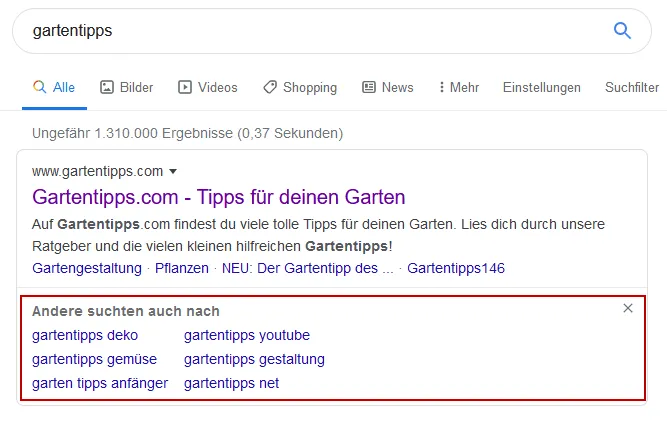
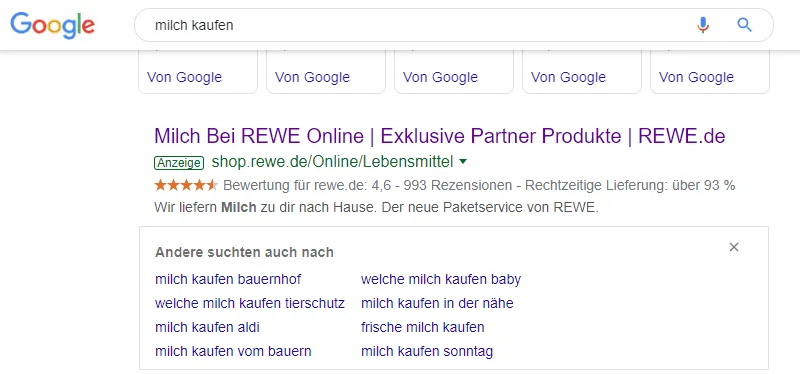
Since 2018, Google has offered a feature on the search results pages when searching via desktop PC: users who return to the search results via a short click see a box with the heading “People Also Search For…” below the result. There, a compilation of links with related search queries appears.
This box is referred to as the “short-click box.”
The “People Also Search For” box is now only rarely shown and has largely been replaced by the SERP features “People Also Ask” and “Related searches.”
When it does appear, it only appears on the first search results page (Top 10); in the source code of the SERP, it is already set up before the short click. Its links are result-specific and differ from the general “Related searches” at the bottom of the page.
What Do Short Clicks Mean for SEO?
Short clicks probably represent a negative user signal. Otherwise, Google would presumably not increasingly display the short-click box in the search results. The fact that this happens shows: Google registers the short dwell time.
That is why the search engine offers alternatives to the search terms in order to satisfy the user on their second attempt.
- Dwell time generally provides information about the quality of a website: those who stay on a page longer have apparently found what they were looking for.
- Users who immediately disappear again are apparently not satisfied with the content of the page.
- A short click means: the search intent was not met.
Disadvantages for Search Engine Optimization
Google pursues one goal above all: to satisfy users. Because only satisfied users will continue to use Google as a search engine. So Google has to provide users with the information that is optimal for them.
If a short click occurs, that is exactly what did not succeed: the user did not find what they were looking for. So the results did not match their search intent.
Google has a strong vested interest in keeping the number of short clicks as low as possible.
It stands to reason that frequent short clicks can be an indication of a poorer fit; however, they are not a direct ranking factor confirmed by Google.
According to Google (John Mueller), dwell time and pogo-sticking are not a direct ranking signal. The connection dwell time → quality → ranking is therefore a hypothesis and not a confirmed ranking factor. The short click is also to be distinguished from the bounce rate.
Reasons for a Short Click
If a website does not meet the search intent, there are various reasons for this:
- The content is no longer up to date.
- The content is not high-quality enough.
- There is too much advertising on the page.
- Long loading times and cumbersome operation cost users time and lead to frustration.
- Loading times and usability come straight from hell: endless waiting and complicated menu navigation cost time and nerves.
- The design no longer looks contemporary.
- The website does not match the user's expectations. (The content format may not be a good fit. The content is not up to date, not appealingly prepared, or not detailed enough.)
Important: Search intent and content should match. There is no point in optimizing a website for a keyword if the website does not meet users' expectations. Such misdirection practically invites negative user signals. At some point, an action like this may cost the spot in the Top 10 of the search results.
How Short Clicks Can Be Avoided
The most important lever against short clicks is to offer the user exactly the information they are looking for. Then there is no reason for them to bounce.
For this, website operators have the following options:
- Meet the users' search intent
- Offer suitable, high-quality content
- Reduce loading times
- Design in a modern and contemporary way
- Optimize usability
How Can the Users' Search Intent Be Determined?
The key to successful SEO is to understand the users' search intent and to offer the right results.
All of search engine optimization is built on search intent. For Google, the user comes first.
Only understanding the search intent makes it possible to
- select the essential keywords,
- create relevant, high-quality content, and
- offer users real added value.
Distinguishing Search Intents
Users pursue different intentions with their search query. This gives rise to certain keyword types:
- Information-oriented search queries: The user is looking for information.
- Navigation-oriented search queries: The user wants to head to a specific website or needs directions to a local business.
- Transaction-oriented search queries: The user plans to buy something.
Understanding Search Queries
At the beginning of their search, users often phrase their query generically and unspecifically. They refine the terms bit by bit. For example, they add a verb or an adjective that makes their intention clear.
Only a look at so-called intent modifiers reveals what is behind their search:
- Someone who writes the word “air conditioners” in the search field would presumably like more detailed information about this product.
- With “buy air conditioners in Oldenburg,” the user wants to find a shop in their city.
- A user who searches for “best air conditioner” wants to compare products and make a selection.
The user's goals differ, which becomes clear from the details of the search query and from the intent modifiers. Those who analyze the intent modifiers can tailor content more specifically to the respective intention.
Google's search results are useful because they provide insight into possible intentions that users pursue. Google sorts the search results by their relevance to users: the higher up the website, the more it matches the user's interest.
Determining Intentions Based on Organic Search Results
It matters whether search queries are phrased in the singular or the plural. The results can differ.
- SERP features make clear where the user is. If, for example, mainly shopping results appear, that reveals a commercial interest.
- “Answer the Public” is a free tool that shows what people are interested in around the keyword.
- Ads also reflect search intents. As a rule, they combine commercial and emotional components.
- Google Analytics, the Search Console, and Google Trends provide data on actual search behavior.
- Keyword research tools such as KWFinder support the research.
- Surveys of members of your own target audience also provide insight into their needs and intentions
Conclusion
Only when it is clear who the target audience is and what intentions they pursue when googling a certain keyword can you create precisely fitting, high-quality content and prepare it in a visually easy-to-read and engaging way. Is the website visually inviting? If there are no problems with usability and loading times, the probability of short clicks drops significantly.
Quellen
SEO & GEO check
Want more visibility – in search engines and AI answers?
We analyse your potential and show concrete next steps. Free and non-binding.