
What is SEM? (Search Engine Marketing)
SEM is the abbreviation for the term Search Engine Marketing and is also referred to as search engine marketing

SEM is the abbreviation for the English term Search Engine Marketing and is also referred to as search engine marketing. The most common definition is provided by the German Association for the Digital Economy (BVDW), according to which SEM encompasses all measures that improve visibility on the search results pages of common search engines.
SEM can be divided into the two subareas of search engine advertising (SEA = Search Engine Advertising) and search engine optimization (SEO = Search Engine Optimization).
Definition of SEM
Just 10-15 years ago, there was no such clear definition of SEM. Especially in Germany, SEM was often equated with search engine advertising and was considered a second discipline alongside search engine optimization. So anyone who spoke of SEM measures back then often meant placing paid advertisements on the results pages for matching search queries.
However, this view fell short because it equates marketing with advertising. A look at the sub-disciplines within marketing, though, clearly shows that the discipline encompasses considerably more subareas:
- Product policy (aligning the product with the target group, brand building, analysis)
- Pricing policy (an appropriate base price, discount campaigns and bonuses for new customers)
- Communication policy (classic media advertising, PR, direct marketing, sales promotion)
- Distribution policy (the product's path to the customer, direct sales vs. retailers, online selling)
These subareas of marketing, known as the 4 Ps (Product, Price, Promotion and Place), are today still flanked by many further areas. The online sphere in particular is what first made forms such as content marketing and performance marketing possible in their current shape.
SEM encompasses more than just advertising
Fundamentally, this digression is only meant to show that the equation “marketing = advertising” is too short-sighted. SEO measures in particular can be described more as PR and, with a lot of imagination, still as performance marketing, and therefore not as classic advertising.
For this reason, the formula: SEM = SEA + SEO can be described as considerably more fitting.
How is Google search structured?
A typical search results page from Google already reveals at first glance the various elements of Google search as well as the areas of application of SEO and SEA. The following example with the search term “securities account” demonstrates this very well.
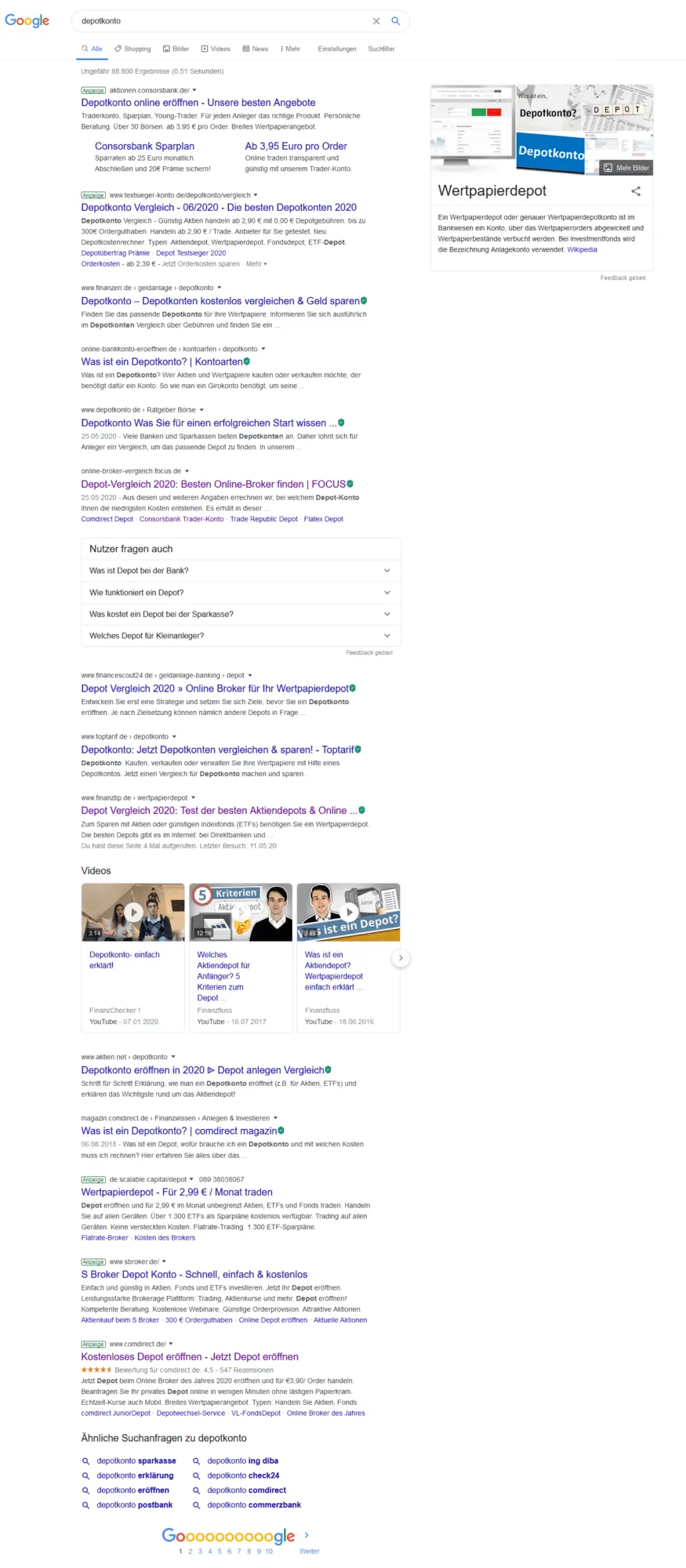
The search results page can be roughly divided into 3 subareas:
1. Google Ads
In this case, the first two search results are advertisements, for which the advertisers have to pay a corresponding amount per click. It looks similar at the end of the search results page: here, 3 more advertisements are listed. Google limits the number of advertisements as follows:
- Above the organic search results: a maximum of 4 ads
- Below the organic search results: a maximum of 3 ads
How many paid ads appear on a search results page depends on the respective search term and the prevailing competition for it. All measures related to search engine advertising focus on this area.
In addition to the advertisements in the search results, Google Ads (formerly Google AdWords) also offers the option of booking pay-per-click advertising (PPC) on other websites.
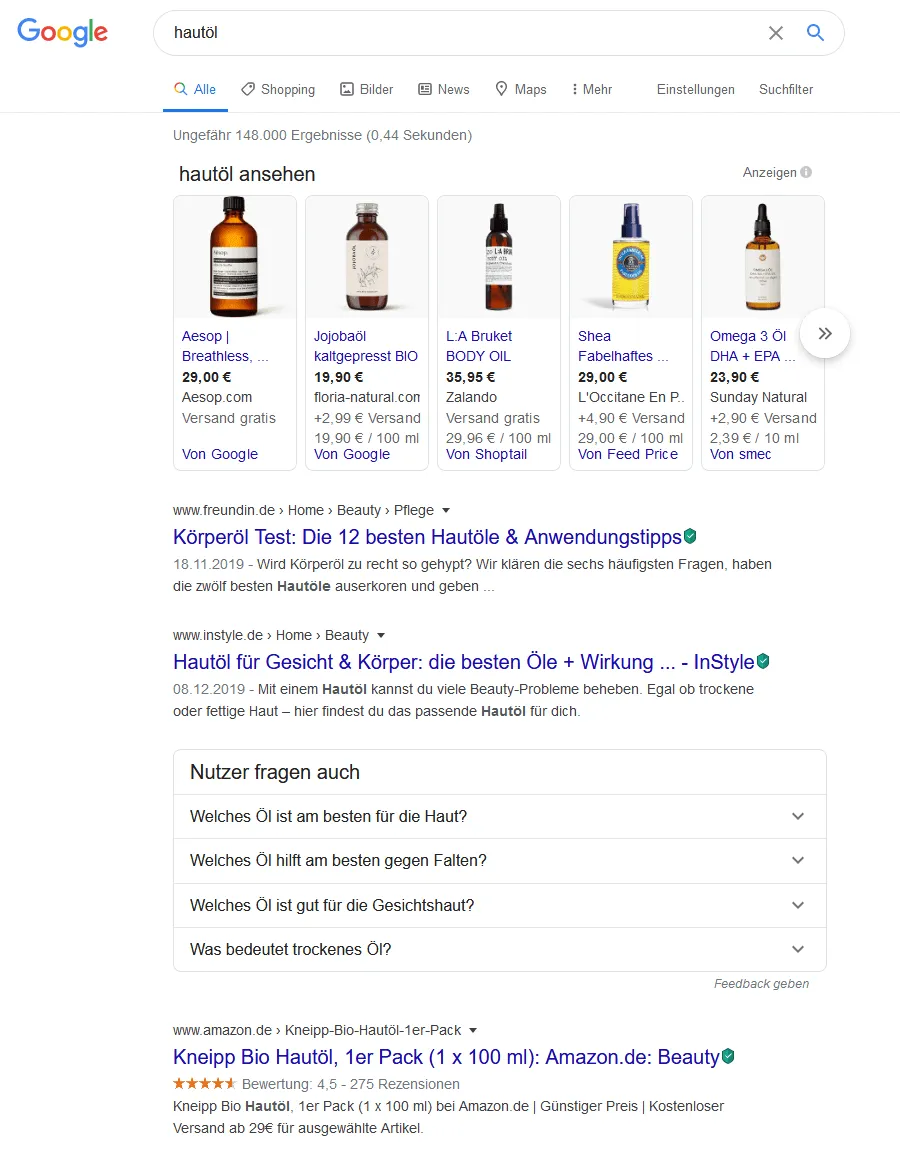
Note: Advertisements in Google search can, especially for search queries with a purchase intent for specific products, also come directly from Google Shopping. In this case, a selection of 4-5 products appears with images, prices, shipping costs and the respective provider.
2. Organic search results
The Google Ads are followed by the organic search results, which the search engine classifies as particularly relevant for the respective search term. In the past, people often spoke of the “10 blue links”. Normally, the 10 best search results are displayed on the first search results page (SERP = Search Engine Result Page).
The search results pages (SERPs = Search Engine Result Pages) show the field of work of search engine optimization. This encompasses all measures that improve visibility in the organic search results. These include, among others:
OnPage optimization (on your own website)
– Technical SEO
– Content creation and content design
– Site structure and usability
OffPage optimization (measures from outside)
– Building backlinks
– Content seeding
– Increasing your own reputation (building expert status)
Even though Google does not charge any money for placement in the organic search results, SEO measures certainly do incur financial effort.
How is a search result structured?
The individual organic search results are also called snippets and all follow a clear structure:
- URL: The URL is displayed in gray. Strictly speaking, it is no longer directly the URL that is also shown in the browser's address bar. Rather, only the website and the path through the directories to the respective content (breadcrumbs) appear.
- Title: The title is displayed in blue (visited links: violet) and in many cases corresponds to the title tag of the respective website. However, Google adjusts the title if necessary in order to improve relevance.
- Description: The description often corresponds to the stored meta description. Its length is limited to a width of approximately 500 pixels. Text that goes beyond this is cut off by Google with “…”. For this reason, it is often recommended to limit the meta description to a maximum of 160 characters including spaces. If the website outputs a publication date or a product listing, a limit of 139 characters for the meta description is even advisable.
Rich snippets: markups increase attention in the SERPs
The three elements above are contained in every snippet in Google search. Beyond that, further elements sometimes also appear, which are referred to as rich snippets. These are elements from the content of the website that become structured data through the placement of so-called markups.
Google recognizes various markups and displays them attractively in search. As a result, the corresponding search results attract considerably more attention.
Common rich snippets are:
- Ratings (the well-known star ratings for shops and providers)
- Videos (preview still image, star rating and further information about the video)
- Events (one line per event with the date, location and name of the event)
- Recipes (image plus rating of the recipe, preparation time and calorie count)
- Software apps (rating, possible operating systems and, on mobile, also a direct button for an installation)
- Products (ratings, information on price, stock level)
3. Universal Search
The third major area describes results from Universal Search. This includes results from the other Google services:
- Maps (especially for specific companies or destinations)
- News (in the case of particular current relevance)
- Video (when relevant and actually used videos exist on YouTube)
- Images (when the topic is more visually oriented)
In the example above, a few matching videos are displayed relatively far down. The placement here depends on how important certain elements such as videos, images or also news are for the respective search term.
Google Knowledge Graph as a direct source of information
In addition, for many search queries, data from the Google Knowledge Graph now appears on the right-hand edge. Here Google aggregates data from various sources such as Wikipedia, databases, and website information in order to answer certain questions directly in Google search. The information always appears with a link to the source.
The Knowledge Graph therefore comes into play above all with the following types of search queries:
- Specific questions about individual data (How old is…? What is the capital of…? Weather in xy)
- Definitions of individual terms (in the example above in Figure 1, a short definition from Wikipedia about the securities account appears)
For website operators, the introduction of the Knowledge Graph in 2012 initially brought declining click numbers. Many simple pieces of information were suddenly immediately visible to users without them having to click on a single website.
In the meantime, however, SEO measures in this context focus on carrying out so-called “in-SERP optimization”. This is about improving the content that appears through the Knowledge Graph directly in the SERPs. If the readers' curiosity is aroused here, the site operator can prompt them to click through to their website.
Note: SEM is not limited only to the large search engines such as Google or Bing. Other search systems such as Amazon (for shops), Jameda.de (for doctors), voice assistants (voice search) or many travel comparison sites can also be interesting for companies in the respective industries. Optimization measures can likewise be carried out there, which often only entail a fraction of the costs.
SEO vs. SEA – where do the differences lie?
The differences between the two disciplines within SEM can be shown on the basis of several factors:
- Speed
SEO measures are, in the best case, designed in such a way that they bring about changes in the OnPage or OffPage area based on certain targets. After implementation, however, it means: waiting for the reaction. Depending on the type of SEO measure, it can take between a few days and several weeks until the changes take full effect. Search engine optimization therefore takes effect with a time delay.
It looks different in the SEA area. As soon as ads are placed via Google Ads, they generate visitors for your own website. Search engine advertising therefore takes effect directly.
- Sustainability
SEO does need a certain start-up time, but in return it also works considerably more sustainably. In the best case, SEO measures still generate solid visitor streams for a website even years later.
The direct effect of SEA measures, on the other hand, only ignites for as long as the ads are actually placed. Apart from branding effects, search engine advertising therefore has a very limited duration of effect.
- Calculability of costs
Search engine optimization measures are considerably more difficult to calculate than ad placements in the SEA area. This is due above all to the fact that the possible SEO starting points are considerably more varied. Whether it is link building, content optimization or technical SEO – each area has many adjustment levers, and the effort also varies in magnitude depending on the project. One point, however, proves to be particularly important here:
SEO is not free! The measures require either a financial or a time investment.
Search engine advertising, by contrast, is limited to the placement of advertisements. Advertisers determine the exact budget beforehand and then have to deal with the areas of keyword research, ad design and optimization, and bidding strategy.
Note: The good calculability of SEA measures does not mean that advertising in search engines is easy. The whole thing follows more the principle of “easy to learn, but hard to master”. Anyone who wants to be successful here has to engage more or less intensively with the subject matter, depending on the market niche.
Why do the two channels nevertheless work together so well?
At first glance, a certain area of tension arises between the two subareas within SEM. That is why many beginners wonder whether they should rather invest in SEO or turn to search engine advertising. In many cases, the answer should be: both!
Many synergies between SEO and SEA
With successful search engine optimization, SEA initially appears superfluous, as good organic placements in the search results are already achieved for key keywords. Nevertheless, additionally placing advertisements is worthwhile here too, since in this way the advertising space is enlarged once again. The prominent placement of the ads above the SERPs in particular can boost the click numbers considerably once more.
In addition, however, there are further arguments for a coexistence of both disciplines within SEM:
Branding effect through SEA
If advertisements are placed prominently over a longer period of time through search engine advertising, the attention of the target group increases. Thus there is a chance that the company is perceived more and more as a brand in its core areas.
This “brand awareness” in turn facilitates the SEO measures, since search results from well-known brands are clicked on more frequently. A higher click rate in turn affects the placement in the SERPs. In addition, the queries for keywords that contain the brand name increase.
Keywords form the basis for all SEM measures
Whether SEO or SEA – keywords represent the extremely important basis for success in both disciplines. In this case, the synergy between the two subareas becomes very clear:
- Keyword Planner for keyword research: Google Ads provides the Keyword Planner for search engine advertising. In this way, matching search terms can be found together with the respective search volume and the competition in the SEA area. However, the search terms suggested there are also suitable for creating matching content in the SEO area.
- Google Search Console as a relevance barometer: The whole thing also works the other way around, though. Via the Google Search Console, website operators can read off through which search terms how many visitors reached the site. Keywords with a particularly good click rate (CTR = Click-Through-Rate) can also be used for search engine advertising in the process. In many cases, advertisers find search terms here that they did not think of at all beforehand in the SEA area.
Looking for split tests from SEA for SEO measures
Search engine advertising today offers webmasters the possibility of very easily carrying out split tests. In this way, an ad for a certain search term can be designed and played out in several variations. The variant with the best results remains the new standard after the test phase.
The results of such tests can also be used for the SEO area, especially with regard to the meta description. If the meta description is changed accordingly, the click rate in the organic search results also increases.
What significance does SEM have in online marketing and do companies need an SEM agency?
SEM continues to have very great significance for companies here. According to Deutsche Post's Dialogmarketing-Monitor, companies spent just under 4.2 billion euros on search engine marketing in 2018. SEM thus continues to occupy first place by a wide margin in online marketing.
Do companies need an SEM agency?
SEM has become considerably more complex in recent years. With the Mobile First Index, voice search and the constant changes in Google search, it is today almost impossible to become an expert in all subareas.
This almost automatically raises the question of whether companies need an SEM agency in order to be able to celebrate successes in this area. As always, it also depends here on the individual situation and the respective market niche. In markets with little competition, companies certainly also achieve successes on their own in the first steps.
However, when it comes to entering fiercely competitive markets, an SEM agency represents a great help. In addition, SEM consulting at the beginning ensures that expensive initial mistakes are avoided from the outset.
SEM as a fixed component in online marketing
SEM describes all measures that contribute to improving the placements on the search results pages of common search engines. While search engine advertising (SEA) focuses on the paid advertising slots in the SERPs, the core of search engine optimization (SEO) lies with the organic search results.
Like other search systems, Google search is subject to constant changes. In this way, the complexity constantly increases, so that companies and site operators always have to stay up to date.
Quellen
- https://www.bvdw.org/themen/digitales-marketing/search-seosea/
- https://wirtschaftslexikon.gabler.de/definition/marketing-39435
- https://support.google.com/google-ads/answer/1722087?hl=de&ref_topic=3121771
- https://developers.google.com/search/docs/guides/intro-structured-data?hl=de
- https://www.websiteboosting.com/magazin/35/alternative-suchsysteme-trafficquellen-abseits-von-google.html
- https://www.haufe-akademie.de/blog/themen/marketing/10-tipps-fuer-erfolgreiche-adwords-werbung-bei-google/
- https://onlinemarketing.de/news/branding-effekt-seo-marke-google-ranking
- https://www.deutschepost.de/de/d/dialog-marketing-monitor.html
SEO & GEO check
Want more visibility – in search engines and AI answers?
We analyse your potential and show concrete next steps. Free and non-binding.