
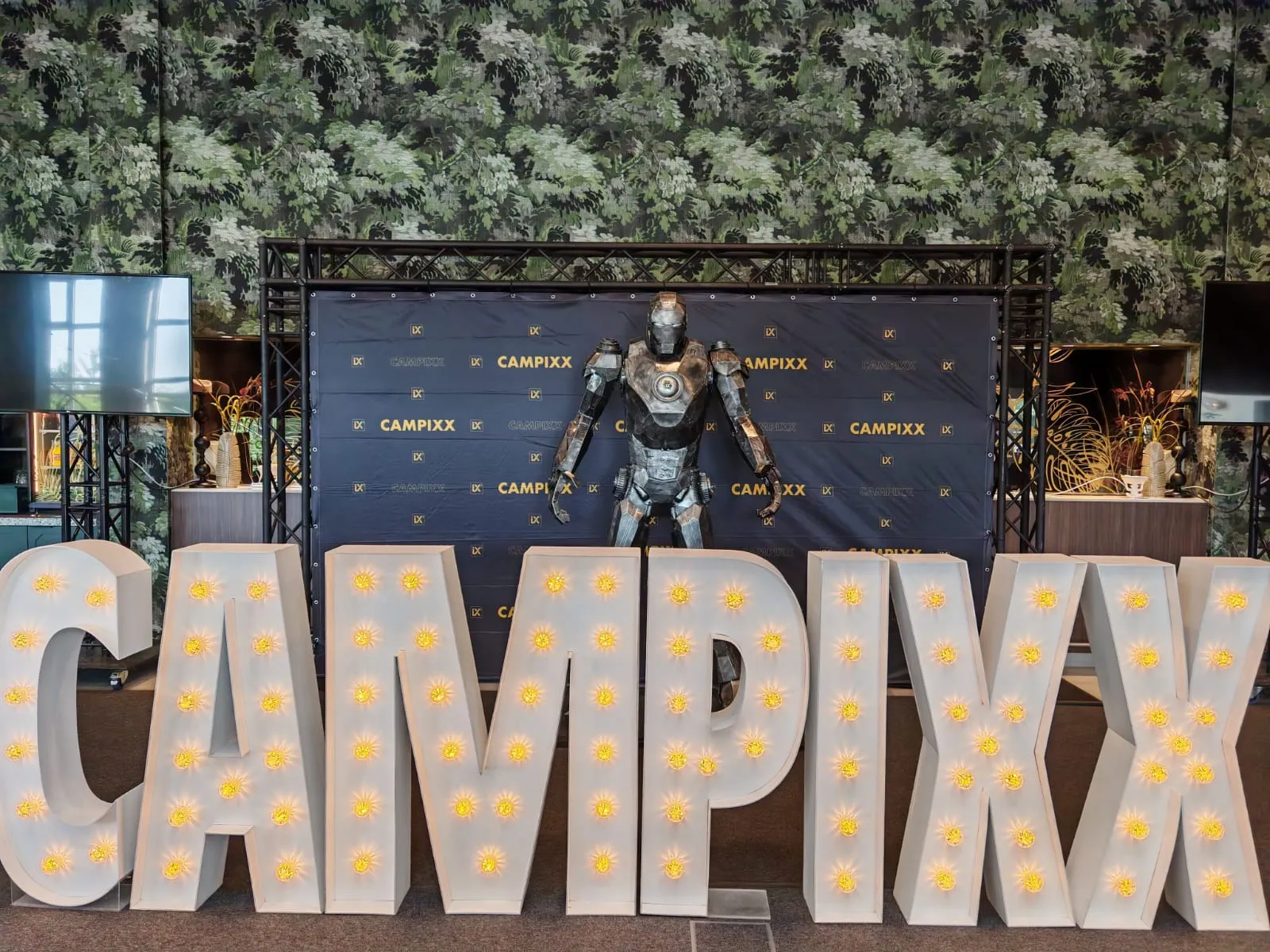
Our Recap of Campixx 2025: Quo vadis, SEO?

The title gives it away: The major upheaval of Google Search was the main topic at Campixx 2025. Among the attendees and in several talks, the focus was particularly on AI Overviews, Google's looming AI Mode, and the associated changes.
But of course there were also “normal” talks that didn't deal with the “downfall.” Let's get started with them step by step …
Generation Z – What's Coming Our Way in Online Marketing?
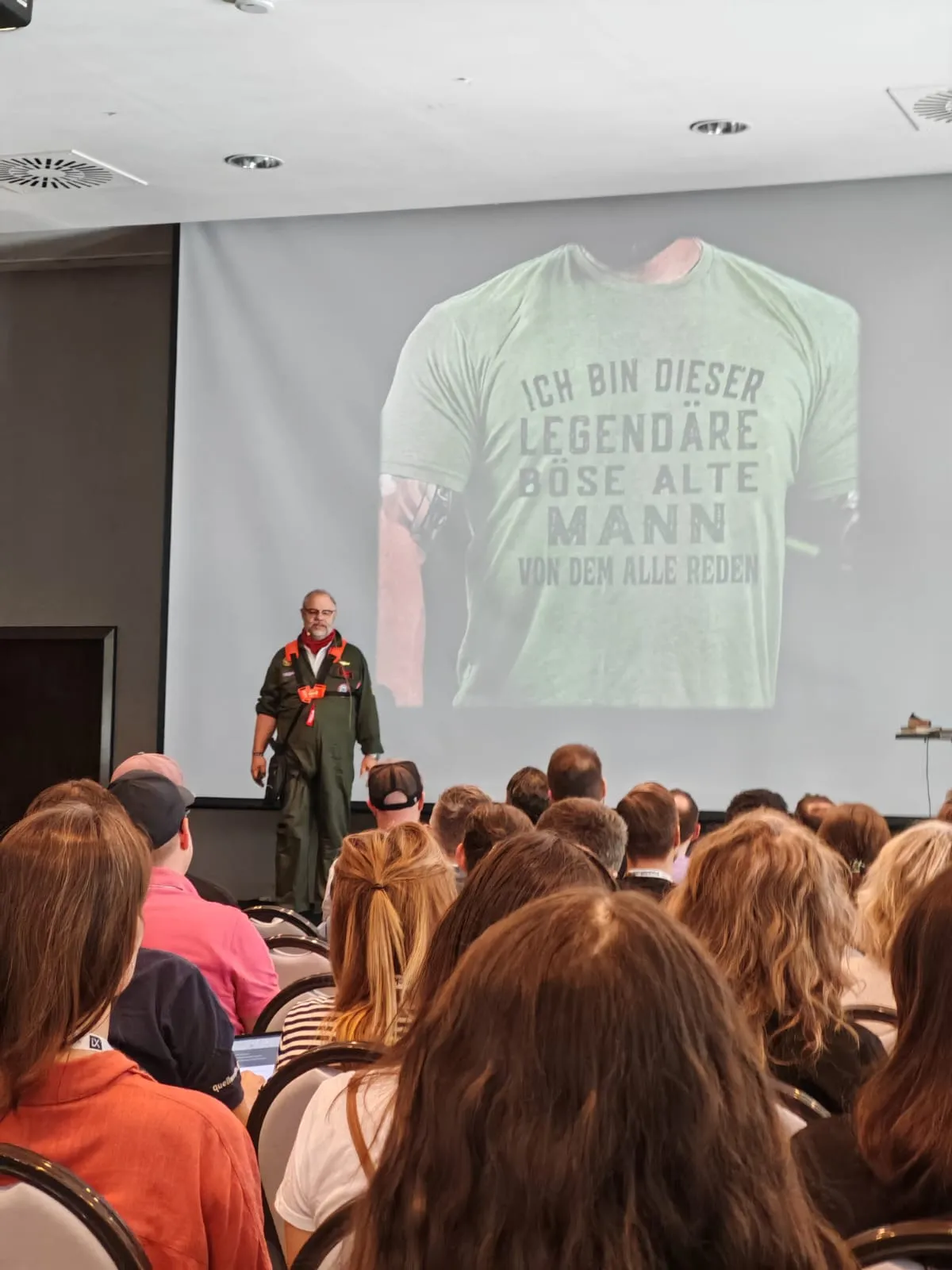
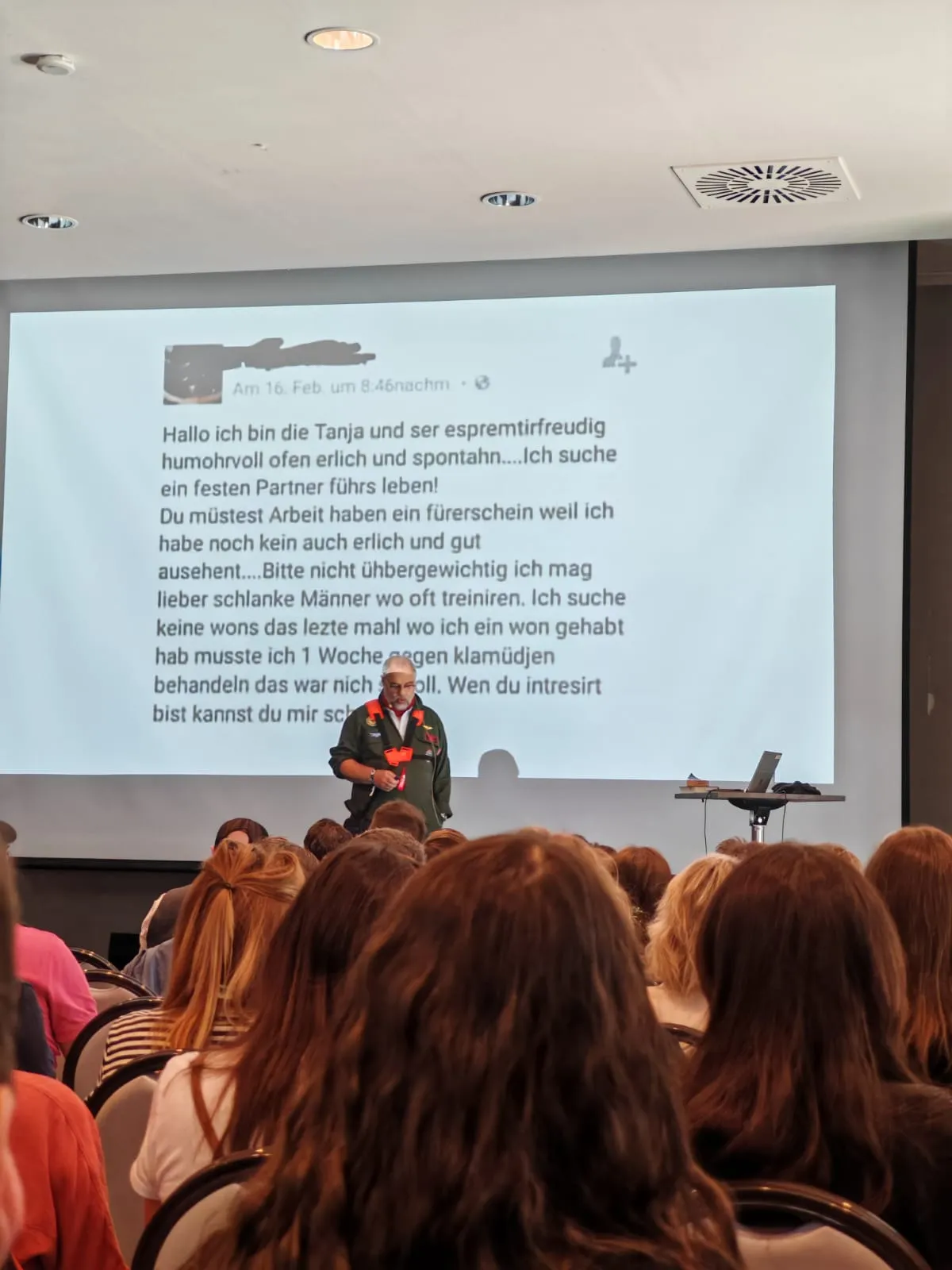
The first talk I saw was also the keynote and was given by Prof. Dr. Mario Fischer. Let me keep it short: his talk was about how the “new” generation called Gen Z behaves. Hardly a good word was said about them. During the talk, I had the feeling that this generation was being pummeled, even if a lot of it was wrapped in good humor. They're supposedly no longer capable of performing, hand-grenade parents, social media addiction, and much more.
Throughout the talk, a well-known quote kept running through my head: “The young put themselves on a level with their elders and stand up against them in word and deed” – Socrates. Even more than 2,000 years ago, the old complained about the young.
Mario Fischer attributed this behavior to two systems:
- Unity through difference: Young people always want to set themselves apart from the old and pull off their own “thing.” One example of this is certain groups in our society, such as Goth kids.
- Autopoietic system: The old don't want any changes. Everything should please stay just the way it is: the company should keep running as before, gas prices mustn't rise any higher, and so on.
A particularly big challenge between the different generations is the major and rapid changes in our society. Quote: “Fire was invented and then nothing happened for 1 million years.” When the internet was invented in 1990, it was still unimaginable that we would soon be developing chat AIs in the near future. Society keeps evolving faster and faster. Many older people simply can't keep up.
Toward the end, it was once again explicitly emphasized that Gen Z really isn't that bad after all. This generation is, ultimately, a product of the previous generations. So shouldn't we take a look at ourselves?


The 7 Biggest SEO and AI Mistakes You Should Avoid in 2025
Johanna and Timon Hartung from the agency Woxow gave a talk about major mistakes in the areas of SEO and AI.
Here, too, the message was clear: developments are advancing extremely fast. While one or two generations before us still had to rely on books from the library, then came the internet, then Google, and now AI. Anyone who doesn't react to these changes will run into trouble. Here are the mistakes mentioned in the talk:
SEO is supposedly obsolete and AI will solve every problem: of course that's not the case. SEO is the cornerstone of every website so that it also appears in AI answers.
Backlinks and social signals are ignored: backlinks and especially mentions, however, are used by AI search engines.
Not every website needs constant relaunches: with every relaunch, however, SEO should be taken into account.
Technical SEO shouldn't be neglected: a good technical foundation is the key to everything. Schema data is also relevant for many LLMs. Providing content chunking, meaning small, portioned bits of content in FAQ sections, can be read especially well by LLMs.
You shouldn't rely on ChatGPT alone, however: when using AIs, you should always draw on the help of various tools to achieve the best results. It was also mentioned that attempts are being made to build techniques like watermarks into AIs in order to better detect fake news (C2PA signatures).
Not accepting the new SEO reality: SEO is evolving heavily. Anyone who sleeps on it now may not be able to catch up.
FYI: By the way, Johanna Hartung and Timon Hartung have a cool podcast on YouTube :-).


How to Build High-Quality Backlinks Purely Organically Through Well-Thought-Out PR Campaigns
Kerstin van Haastrecht from the Fit Reisen Group shows in her fantastic talk how she and her team run digital PR campaigns that earn really strong backlinks.
Building backlinks organically with digital PR means that you naturally don't pay for the backlinks. The content has to be so good that journalists are happy to pick it up for a story and report on it.
That way, she and her team were able to build up some strong backlinks organically through great stories and news.
When researching topics, there are a few important points to keep in mind. These include, for example:
- It's about creating “something new” that journalists can't easily research, or only with great effort.
- The topic has to fit the brand.
- It should evoke emotions in the reader (nudity and eroticism reportedly work well).
- KISS principle: keep it simple and stupid.
She gave some interesting examples, such as determining the best public swimming pools in Germany based on an analysis of Google reviews.
Good ideas can also be derived from search volume and search trends, like “the most unromantic cities in Germany.”
A hashtag analysis can be used to draw comparisons and thereby tell a story, for example “the most popular nature parks on Instagram.”
Price-comparison rankings would be possible, e.g. “the most expensive taxis in Germany.”
In combination with the analysis of search volume and Google data, the idea “the city with the highest density of eroticism” would also be interesting.
Her ideas so far were then seeded directly to journalists via press releases, and this achieved good results:

What was interesting here was that a price was assigned to each earned link in order to make the success of a campaign measurable.


SEO in a Stranglehold – Caught Between TikTok and the LLMs!?
Stefan Fischerländer is, for me, one of the absolute SEO veterans. So I was correspondingly excited about his talk. The audience was in no way disappointed, but after the talk I did see a great many worried faces.
Stefan presented old slides from his Campixx talk ten years ago (2015). Back then he was already reporting on the major changes that would be coming to Google Search. At first these failed to materialize. For example the big announcement about Mobile First: a Mobilegeddon never came.
The major changes, however, crept in gradually. According to the study by mindsea.com, just 6.3% of mobile users use the web and search. By comparison, 34.7% use social media apps. So we SEOs pounce on the “measly” 6.3%.
Nobody wants to click through websites anymore today to find an answer. Pop-ups, annoying ads, and bad web design bother many internet users. The brain loves uniformity, which is why social media apps in particular, with their feeds and identical structure, are so popular.
As a result, websites increasingly lose out. He aptly called the whole thing “the creeping Mobilegeddon.”
In his view, platforms and APIs are the future of the internet. Shops and websites would make their products and information available, which could then be played out into users' feeds via API. The internet as we know it would gradually recede and take place across large platforms (social media).
While the use of ChatGPT is gradually rising, the use of Google Search is declining. Google has to counteract this. The AI Overviews are just the beginning here. The upcoming Google AI Mode is meant to eventually replace the main search (and no longer be just a simple search box with ten blue links as answers to a query).
He believes that search traffic will drop sharply. But there will still be a few years in which you can generate search traffic. For example shops with strongly transactional search queries.
Anyone who wants to optimize their content for AI Overviews and AI searches like Perplexity should above all focus on digital PR and mentions (brand mentions). In addition, you should build your content into the website in a citation-worthy way so that AI searches can read it out more easily. Important: the new search systems can't crawl as well as Google, since they lack Google's years of experience. That's why the technical side is even more important for appearing in such systems.
Yes, that really was the bleak picture Stefan painted here. In his opinion, in its fight for survival Google would have to become like Microsoft and offer many side products as well as countless subscription models in order to no longer be dependent on the revenue from Google Ads.


Since the talk was so exciting and there was a lot of discussion afterward, I'd like to share my opinion on the topic here.
- What about desktop users? These users are surely still relevant and search the internet for suitable providers, for example for a shop where they can buy shoes. Why should this target group die out and everyone only be active on social media?
- SEO has been declared dead for over 20 years, yet every time the discipline has emerged from the crisis stronger. The verb “to google” has even made it into the Duden and is the gateway to the internet world. We humans want to read content from other humans, so why should that disappear completely?
- In 2024, Google generated around 240 billion USD with its ads. With its subscription models, by contrast, it generated only 40 billion USD. Why would Google completely saw off the very branch it's sitting on?
- As long as people search for information, there will also be the option to do SEO. Whether for Google's AI Mode, for another AI search engine, or for TikTok. We SEOs have to adapt (as we always have).
- Still, we SEOs must not be blind. A client who bets only on SEO is living far too riskily – that has always been the case. We SEOs have to prepare our clients better and show them ways to keep generating relevant traffic across all online marketing channels (paid media, owned media, etc.).
- As was said in the two Hartungs' talk: SEO forms the basics, the foundation. If a website is optimally positioned in this area, it will also be found in novel search and answer systems.
Chatbot SEO Analyzed: What 150 Million Answers from ChatGPT & Co. Reveal About Visibility
Johannes Beus's talk was packed to the rafters, so I could only grab a standing spot off to the side. Accordingly, here's a quick photo as proof. I can't do any more to you, dear reader. ;-)
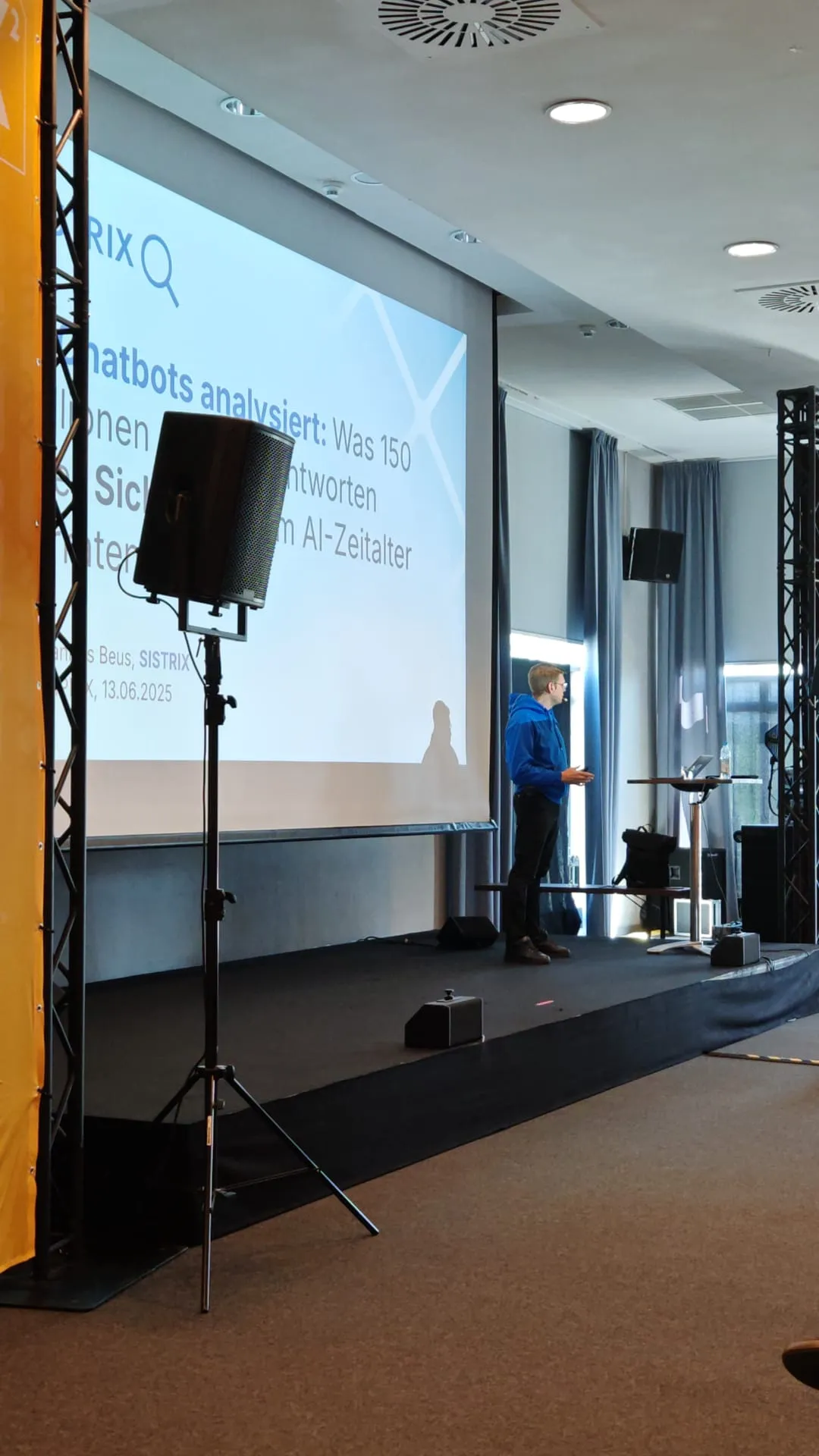
In his talk, Johannes said that Google Search will probably change a lot. The ten blue links will disappear and be replaced by AI answers. In five years, everything could be different.
He showed some exciting analyses. AI Overviews in Germany currently sit at around 9%. In the UK it's already 25%.
In the AI Overviews, other websites are often listed than in the SERPs. For many health topics, the AI Overviews are already being displayed. Healthcare SEO agencies should definitely stay on the ball here.
He held the same opinion as Stefan Fischländer: Google's new AI Mode is exactly what's coming and will fundamentally change search.
The data drawn from 10 million prompts was also interesting. The ideas for the prompts were derived from frequently asked questions from Google Search:
- The sources named in the AI answers differ depending on which system was used. The systems ChatGPT, Gemini, and DeepSeek were compared with one another.
- With optimizations like these, you therefore always have to take several systems into account.
- Chatbots place high demands on sources.
- About 30 percent of the named sources, however, are completely made up.
- With the help of log files, websites can be analyzed to discover made-up URLs on your own site.
- Reddit is only rarely mentioned in the sources.
- We have to think in terms of brand mentions.
- Answers with a brand mention, however, can be observed in only about 30 percent of cases with Gemini.
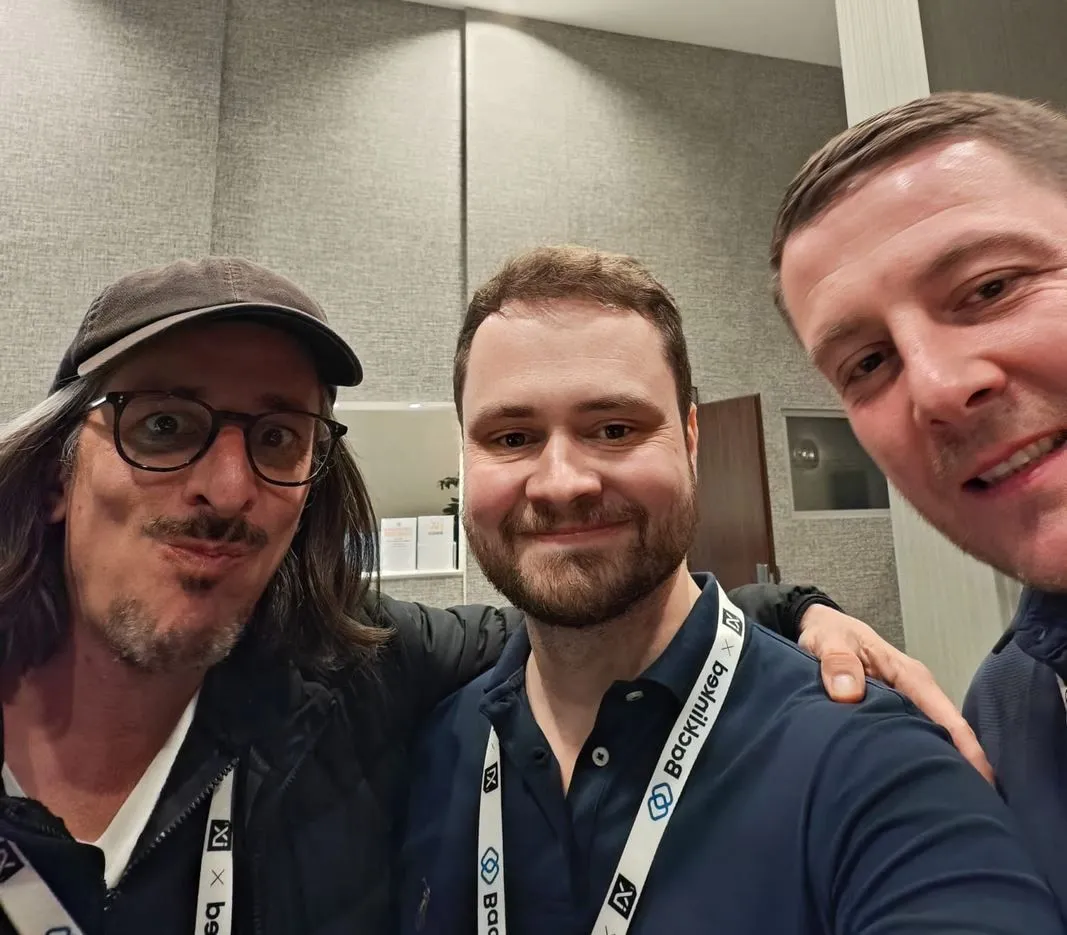
More impressions and selfies ;-)




This recap continues… on YouTube
More recaps from colleagues
- https://clicks.digital/blog/campixx-2025-recap
- https://www.eology.de/news/campixx-2025
- https://www.seo-trainee.de/campixx-2025-recap/
- Have you written a recap but aren't linked here yet? Then just write to us via the contact form, so that we can add you.


