

SEO for ChatGPT & Co. – A current status and overview (2025)

The AI hysteria never ends. Especially for search engines and thus for search engine optimization, new times are dawning. While the market shares of ChatGPT are still small compared to Google, you can't shake the impression that every wannabe SEO guru on LinkedIn, X, etc. spreads the next hype in such an exaggerated hysteria that it makes you sick.
In this blog article, I therefore want to take a factual, neutral look at the coming generation of search engine optimization through AI search engines and explain why classic SEO is far from dead and how you can achieve good rankings on ChatGPT, Perplexity and Co. Let´s go!

What is GEO, AIO, LLMO, GAIO & Co.?
Generative AI stands for artificial intelligence that can generate new content with the help of training data, such as texts, images, music or videos. Well-known applications are chatbots like ChatGPT, Claude.ai or image generators like DALL·E or ideogram.ai.
Exciting for SEO are Generative AI applications that can deliver search results and web pages as answers, such as SearchGPT or Perplexity.
Fig.: Example of the Generative AI “SearchGPT” and a search result with external links to further information and web pages

GEO (Generative Engine Optimization) refers to the optimization of content so that it is better understood and prioritized by generative AI models. Similar to SEO for search engines, GEO ensures that texts, images or other content are designed in such a way that they are preferentially used or reproduced by AI systems.

Fig.: Switching ChatGPT to SearchGPT
Since this field of optimization is still very young, there are currently many different terms for this type of optimization of Generative AI. So people don't just talk about “GEO,” but also use terms like
- AIO (AI Optimization),
- LLMO (Large Language Model Optimization),
- GAIO (Generative AI Optimization).
| Warum wir uns für den Begriff GEO entschieden haben: GEO ist die Abkürzung für Generative Engine Optimization. Da wir uns nach wie vor im Bereich der Suchmaschinenoptimierung, auf Englisch auch Search Engine Optimization genannt, bewegen, ist der Begriff GEO unserer Meinung nach besonders gut geeignet. Welcher Begriff sich durchsetzen wird, wird die Zeit zeigen. Bis dahin verwenden wir den Begriff “GEO” und hoffen, dass wir damit auf die richtige Bezeichnung gesetzt haben ;-). |
|---|
Market shares of ChatGPT & Co. compared to Google, or “Why the hysteria is (still) exaggerated”
Even though, according to a Semrush study (https://www.semrush.com/blog/chatgpt-search-insights/), some industries already receive decent traffic via Chat or SearchGPT, the actual market share is still very small.
According to another study by sparktoro.com (https://sparktoro.com/blog/new-research-google-search-grew-20-in-2024-receives-373x-more-searches-than-chatgpt/), the current worldwide market share of ChatGPT is only at 0.25%. Google is still the market leader with approx. 90%. Far behind comes Bing (incl. CoPilot) with approx. 4%.
Fig.: Current distribution of search engine market shares. Google still has enormous market dominance.

So no one needs to panic that classic Google search is no longer being used – on the contrary: According to a reportGoogle search will be used even more in 2024 than before.
How strongly AI models will be used as search engines is something the future will show. Informing yourself about it now can of course be an advantage. Especially since Google didn't keep us waiting long with its answer to ChatGPT…
AI Overviews: Google's answer to ChatGPT & Co.
The AI Overviews, formerly SGE, are already being rolled out in many countries and will gradually be found in the EU and the German-speaking world too. For this reason alone, every SEO should also engage with the optimization of the coming AI Overviews.
With the AI Overviews, AI-generated answers to search queries will be found directly in Google's search results. How search will develop further can of course only be guessed at. Google, for example, is introducing a new AI Mode in which the AI takes over the search for answers to complex questions for the user.

Which ranking factors (could) be important for GEO
First, it's important to consider which AI you want to optimize for. SearchGPT uses Bing as its search index, the AI Overviews naturally use Google's search index, etc. From this, some important ranking factors can be derived:
- Content: As with classic search engine optimization, the content and the website itself are at the center here too. It's important that the possible question to which the content provides a fitting answer is found as high up as possible. Similar to featured snippets, it has proven advantageous to place the question, for example as an H2 tag, as high up as possible in the content and to reproduce the corresponding answer as precisely as possible in a few sentences. That's exactly what will probably also help AI Overviews and AI search engines like Perplexity to classify the content better. Classic TF*IDF analyses can also help keep the relevance of the content high, so that other search engines also rate it as important.
- Technology: Loading times as well as Core Web Vitals should continue to be important for the crawlers of many search engines when evaluating sources for AI answers. Technical “errors” like broken links, canonical errors, etc. should also be avoided, since they make crawling unnecessarily difficult and are a sign of low page quality. With the help of schema data, search engines can also be shown what kind of content is involved.
| Anmerkung: Noch relativ neu sind sogenannte LLM-Textdateien, die das Auslesen von Inhalten durch KI erleichtern sollen. Ob das wirklich hilft, sei dahingestellt… Quelle: https://wordlift.io/generate-llms-txt/ |
|---|
- E-E-A-T: (Super important) If you establish your website as a trustworthy source, the search engines won't be able to avoid placing it as a link in their answers too. The classic E-E-A-T characteristics from Google come into play here:
- Is the content so good that others would voluntarily share it on social media?
- If the author is trustworthy and has proven their expertise through, e.g., speaker appearances, you can trust their content and statements more
- Is the content on the website backed up with sources, real experiences, statistics and more?
- If the website has been linked to by other trustworthy websites, this also increases the website's standing
- Backlinks: As already mentioned, backlinks are an important proof of a website's trustworthiness for search engines. If a website is naturally linked to by many (and relevant) sources, this speaks for a high quality of the content. In this context, many LLM models also read out how often a website is linked and in what context the linking occurs. High topical relevance and a natural build-up of backlinks are the key here.
- Mentions, branding, mentions: It's not just pure “dofollow” backlinks that LLMs could evaluate, but also the frequency with which a person, a product or a company is mentioned. With that, sponsored posts would gain in importance. Just like social media posts, podcasts, videos (YouTube) and more – the more often the AI search engines see a person/company in context, the more the relevance could rise.
Problem 1: Traffic
An important metric for many SEO measures, besides ranking, is website traffic. With many LLMs, however, the answer is displayed directly – and so thoroughly that many users no longer even need to click on the further source (web page). The consequence will be that many websites will noticeably lose traffic once AI searches catch on.
That's why it's already being discussed whether ‘traffic’ even remains an important metric at all or whether the customer journey will adapt to the new possibilities. So in the TOP funnel, at first it will only be important that the company or the product is mentioned by the AI searches at all. In the mid funnel, the actual traffic then comes to the website, where in the end (bottom of funnel) the conversion / sale arises.
Problem 2: Tracking
In the Search Console, clicks and impressions via the Google AI Overviews are not reported separately. Other AI searches like Perplexity or ChatGPT also don't (yet) offer their own evaluation options like the Google Search Console.
Of course, the traffic from such searches can be captured as referral traffic in Analytics, but there's currently no precise information on the search terms used, the CTR, the impressions, etc.
To enable better tracking, tool providers like Sistrix or Semrush are already working on solutions and offer new tracking tools here:
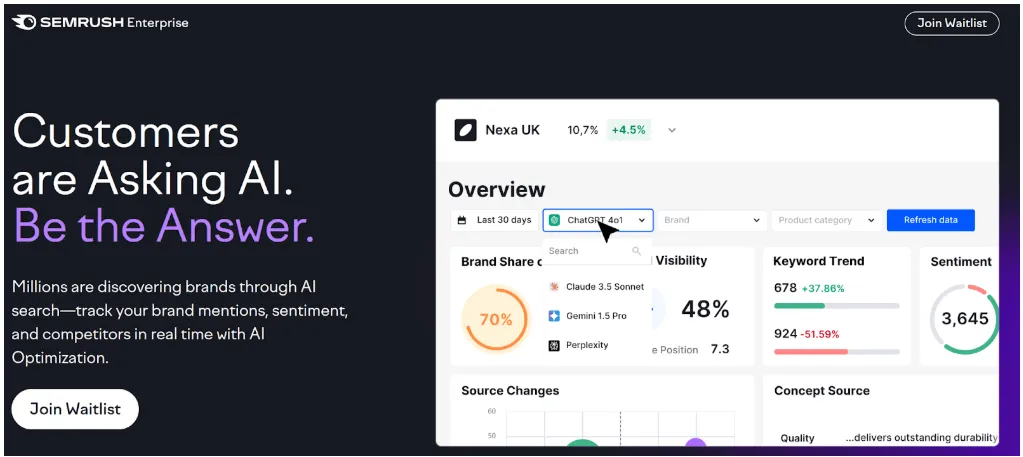
https://www.semrush.com/lp/enterprise-aio/en/

Conclusion & Video: Why SEO isn't dead and why we should still prepare for GEO
According to SistrixAI Overviews are shown for 15-20% of search queries on mobile (UK). ChatGPT has only a 0.25% market share among search engines. So there's no reason to panic.
Whether the market shares and the number of AI Overviews will change?
There will certainly be changes. Whether the entire search engine market will tip over, however, is not foreseeable at present. Rather, classic Google search will coexist alongside the “new” AI search. Similar to classic television and YouTube, there will be different target audiences that prefer one method of web search.
All you SEOs out there who already want to optimize now (GEO) should continue to address the wishes of the search engines and the users:
- Deliver really good content
- Clearly structured, directly visible answers
- Technically flawless, fast websites
- Keep EEAT in mind and be/become an authority in the field
- Use backlinks as an important means to show relevance
And now over to you, dear reader: What do you think about the coming AI searches? Do you like the term GEO or do you prefer another one?


