
What is e-commerce? (Definition & explanation)
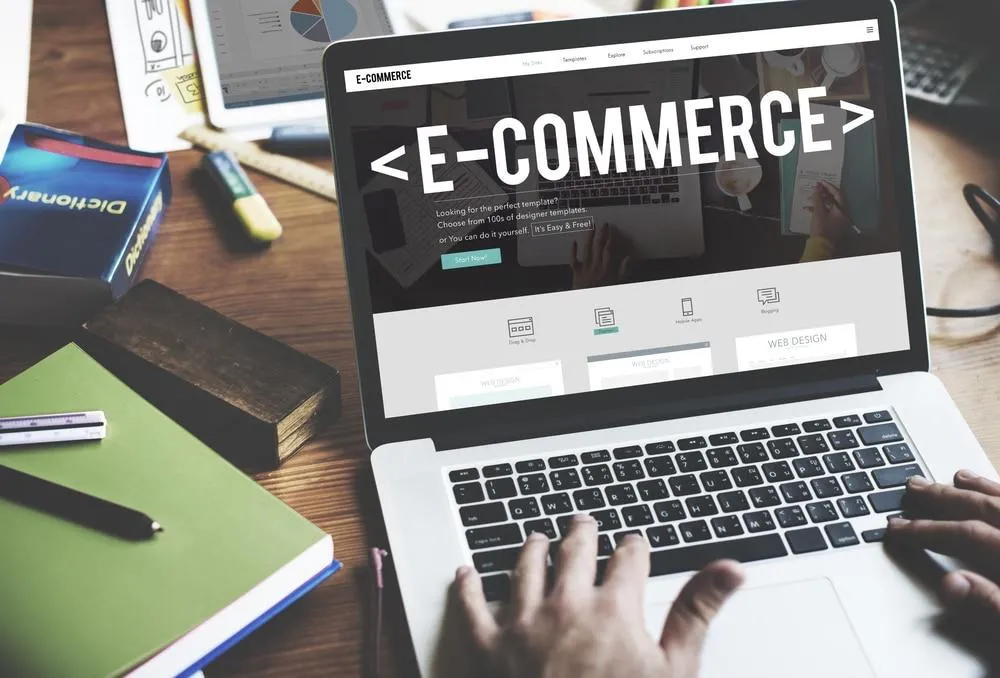
The term “e-commerce” stands for electronic commerce over the internet.
With e-commerce, in German elektronischer Handel, alongside the buying and selling process over the internet (or other means of data transmission), services such as customer service over the web or online banking are also included.
E-commerce is a part of e-business, and the focus here is on electronic business transactions (B2B and B2C), such as online shopping.
Advantages and disadvantages of e-commerce
Trends show that more and more consumers in Germany are shopping over the internet. Studies prove that music, video games, and books in particular are frequently bought over the internet. Groceries, by contrast, are still purchased through brick-and-mortar retail. Both retail systems (e-commerce and brick-and-mortar retail) have advantages and disadvantages.
Advantages of e-commerce
- Purchase processes are independent of place and time
- The customer is not tied to opening hours
- Potential customers can examine the retailer's entire assortment; there are no “spatial” restrictions
- Very low transaction costs with 24-hour availability
- No additional costs as with a brick-and-mortar retailer from costs for the store premises and on-site sales staff
- Shopping over the internet is more convenient for the customer = high customer satisfaction possible
- Fast updating of the inventory possible
- High reach at comparatively low costs versus brick-and-mortar retail.
- By adapting the language in the shop, it is also possible to gain new customers internationally
Disadvantages of e-commerce
- No direct, personal interaction between customers and sales staff
- Customers can quickly locate the competition over the internet and compare prices
- High competition in fiercely contested product areas
- Technical know-how and a certain skill in the implementation are required; otherwise this often has to be bought in at high cost
What is e-commerce SEO?
E-commerce SEO means the optimization of content that is accessible over the web for better findability via the organic (non-paid) search results in search engines. Such content can be websites of online shops that are meant to be found better via Google & Co., or individual products that are meant to become more visible for relevant search terms in a closed system such as Amazon or eBay.

The areas SEO and SEA are particularly relevant here for customer acquisition in e-commerce, since a large target group is reached in this way.
For sales, there are two fundamental paths to choose from: selling via marketplaces such as Amazon and eBay, or your own online shop. Marketplaces offer immediate reach and existing customer trust, but cost fees and commissions, mean strong competition on the same platform, and leave little room for your own brand and customer data.
Your own shop gives full control over brand presence, customer relationship, and margin, but requires building reach and trust yourself via SEO and marketing. In practice, many retailers combine both channels.
Search engine marketing: advantages and disadvantages of SEO and SEA
Unlike in brick-and-mortar retail, the customer journey in e-commerce proceeds differently: the customer on the web is shown a multitude of advertising messages on their screen every day. This leads to the expensively bought advertising being tuned out.
For advertising on the internet there are various forms – such as SEA, SEO, social ads, and affiliate marketing. One of them is search engine marketing. This form of marketing serves customer acquisition via search engines such as Google or Bing and is divided into two areas:
- Search engine advertising – SEA (Search Engine Advertising)
- Search engine optimization – SEO (Search Engine Optimization)
SEA means placing paid advertising in the search engine results. SEO is the optimization of content for the organic, non-paid search results.
Obtaining visitors and potential customers via the organic results in particular is lucrative, because in SEA the cost-per-click in fiercely contested markets is very high and can devour a lot of budget.
SEO has to be viewed in a more differentiated way: Here too there are fiercely contested markets, but the potential customer can be picked up very early on in their customer journey. If they are initially only interested in a product or need an answer to their question, then through clever SEO a good positioning in the search engines can also be obtained for such information-driven keywords. For so-called long-tail keywords in particular (search terms consisting of several words – such as “What to do with a broken shoe heel”), the competition is lower than for short-tail or mid-tail terms such as “buy shoes.”
Of course, SEA campaigns can also be set on such long-tail terms; purchases are more often completed much later at this stage of the customer journey.
- Advantages of SEO:
The visitors via the organic search results do not cost a single cent. In addition, a large proportion of users only click on the organic results and tune out the advertising completely. Anyone who does only SEA loses many potential customers through unused opportunities. The optimization for the right keywords via which visitors come can mean an enormous increase in revenue. - Disadvantages of SEO: Numerous ranking factors at Google, by far the most-used search engine in Germany, determine the positions in the search results: many invisible factors can prevent good rankings, and new updates to the search algorithms drastically change the placements in the results. Due to algorithm updates and competition, SEO successes fluctuate and cannot be guaranteed. Current market figures for Germany prove the size of the segment: B2C e-commerce revenue in 2025 was around 92.3 billion euros (continuously updated sources: Statista topic page, EHI, bevh). Two central current trends are social commerce and mobile commerce: selling via Instagram and TikTok shops as well as the now dominant share of mobile purchases.
Further information
- Statista: B2C e-commerce revenue in Germany (German)
- Smileypack: how to start a successful online shop, e-book (German)
Blog posts on e-commerce, online shops and SEO:
SEO & GEO check
Want more visibility – in search engines and AI answers?
We analyse your potential and show concrete next steps. Free and non-binding.