
SEO Day 2026 Recap

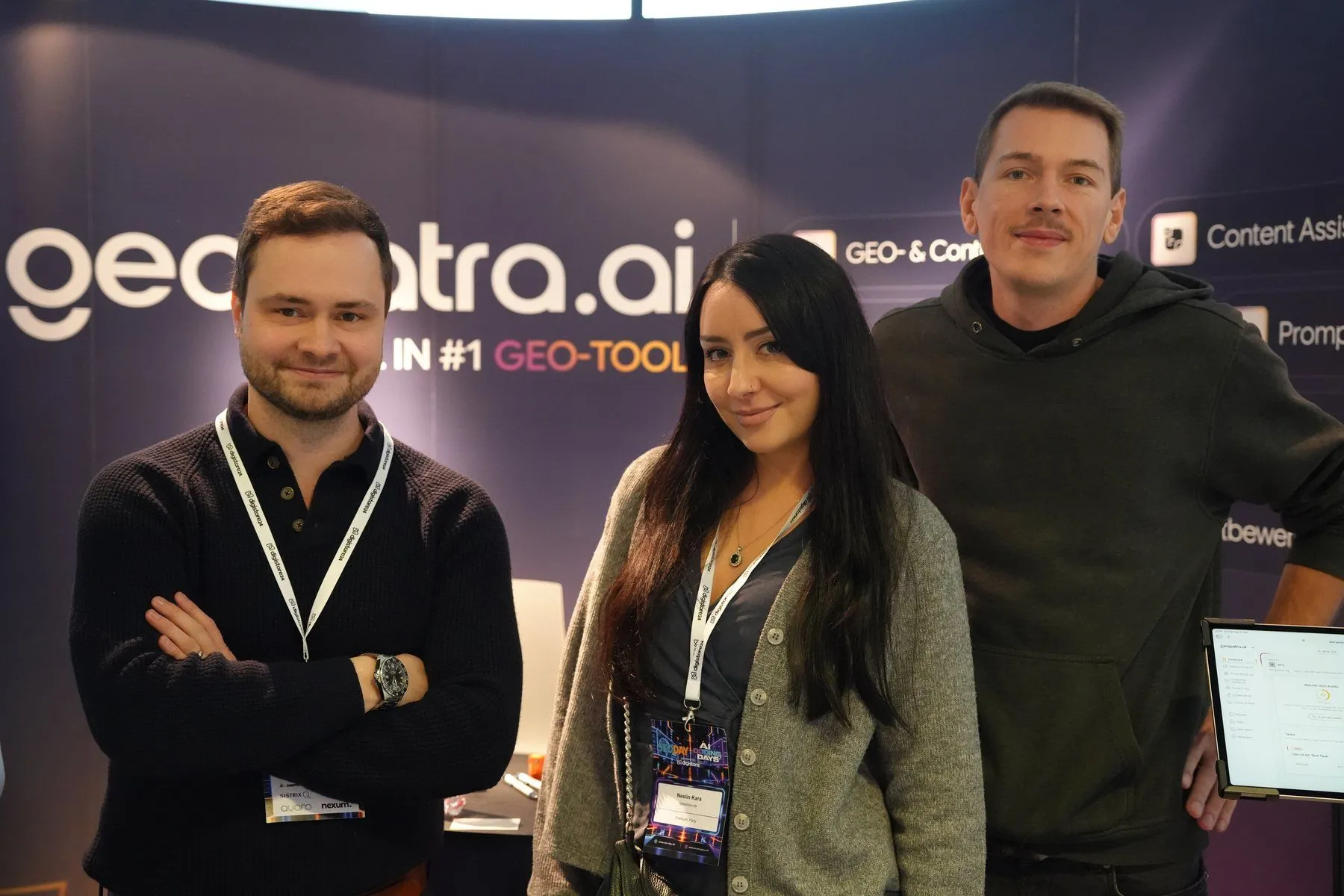
SEO Day 2026 took place on 19 November 2026 at the RheinEnergieStadion in Cologne, and once again it brought together a wide range of perspectives and strategies, above all around the continuing rise of AI. As search changes, so do the measures that lead to visibility. 2017 was the last time we attended SEO Day. Almost nine years later we came back for a great day of new experiences, new contacts and shared discussions about the future of search.
GEO myths and GEO truths
Julia Betinga, owner of SEOSOON, used her talk to take apart widespread myths around GEO. Drawing on practical examples, she showed which GEO measures actually have an effect. She started with the groundwork: how AI bots and AI crawlers access page content.
She then set five common assumptions against their real-world impact.
- YouTube is considered one of the most important sources for AI Search. It pays off more to embed video and audio content in blog posts together with a solid summary and metadata.
- LLMs are said to assess authority and trust. What actually counts is entity building, EEAT, strong offpage signals and a well-known brand.
- Schema markup is considered decisive for AI bots. It belongs to the technical basics, alongside crawling and indexing.
- Content supposedly has to be LLM readable. The difference comes from closed content gaps and unique material such as studies and background reports.
- LinkedIn posts are said to boost visibility in LLMs. What matters is being present where the community is, and a mix of platforms helps.
Fan-outs and sources in ChatGPT
After a short coffee break, David Konitzny, GEO researcher at the software start-up PeecAI, showed at 11 a.m. how AI systems are changing search and the selection of sources. ChatGPT 5.6 and 6.0 served as the examples.
Both versions break a query into several fan-outs, smaller sub-questions the model uses to gather information. They determine which pages enter the selection at all, and they differ from query to query. Alongside web search there are separate fan-outs for images, for local queries and for shopping.
What has changed most is where the data comes from. ChatGPT draws on around 70 engines and now crawls with its own index called Labrador, while Bing, Brave and Google only serve as a fallback in web search. At the same time the number of sources per answer is dropping, and so is the number of fan-outs. Reddit has disappeared as a fixed component, and listicles now appear in only 10 percent of cases. PDFs are used more often.
To select individual content the system works at chunk level. Every page is split into sections that are classified via embeddings and given their own chunk score, before a reranker qualifies the best matches. Keywords do not lose relevance in the process, because content still has to be findable for LLMs. ChatGPT additionally checks whether a source’s recency fits the question.
With version 6 the output itself changes. Under the name Intelligent UI, clearer structures arrive with more paragraphs, graphics, tables and external links. 47.8 percent of all answers now contain links.
Fixing indexing problems for GEO
Anke Probst, Head of SEO at 1337 UGC GmbH, followed with a talk on identifying and fixing indexing problems. Indexing is a key lever, particularly for visibility in LLMs. Using practical cases she showed how to spot such problems early. Her most important tool is Google Search Console. For important URLs she sets up dedicated properties there and gets notified as soon as one of them drops out of the index.
The properties can be segmented by template and by content quality, in extreme cases down to a single URL. Whether a page stays in the index at all comes down to two conditions for her. Without content of its own it never gets in, and without current demand it drops out again, even when it serves the search intent cleanly.
Weak internal linking pulls in the same direction. Linking a hundred pages evenly and without weighting signals to Google that none of them is particularly important. Important pages therefore need prominent links and content that matches current demand.
The current state of B2B SEO
Nele Hilgenstock, Team Lead SEO at wambo, then spoke about the current state of B2B SEO. Her talk addressed whether classic search is losing relevance due to zero-click searches and AI Overviews while LLMs are used more and more.
Her findings are twofold. AI systems mainly pick up magazine, blog and guide content, which is why traffic is falling. Leads stay constant all the same. The bulk of B2B traffic still comes through organic search. With GEO she sees a practical problem, because citations in AI answers are extremely unstable and every system works differently. In B2B there is the added fact that Copilot is the only approved AI in many companies.
Indexing remains the basic requirement, because what is not in the index does not show up in AI answers either. Beyond that she recommends deriving prompts from your own keywords and working with your own studies, since both pay into SEO and GEO. In terms of content, the focus belongs on the problems your product solves. Structurally, a table of contents, clearly separated sections and a summary of the essentials up front all help.
You can check your own position in incognito mode by asking the AI directly about the brand, for example with “Is brand X reputable?” or “Can you recommend brand X?”. It is also worth looking at which mentions and which URLs appear in the answers.
Rebuilding an agency around AI
Timon Hartung, founder and managing consultant at WOXOW, showed how he rebuilt his agency around AI. AI forms the roof over all processes there, but steering still happens by hand, because AI tends to invent things in order to please. He has built a second brain that listens in on meetings, reads emails and serves him as a knowledge base. He now produces audits with AI, because connectors make preparing the data considerably faster.
He thinks little of the loud part of the industry. Anyone claiming a tool like Sistrix can be rebuilt with three prompts is, in his view, mostly wasting compute. He draws a line on content too, since texts without a perspective of their own fail to feel authentic, and Google has to be able to tell that a human stands behind them.
In one to two years an audit will take only minutes, as he sees it. Pure execution then loses its value, which raises the question of what an agency still wins on. He draws the comparison to the industrial revolution. When the car replaced the horse, the need to travel remained, only the means was different. SEOs have to shift their role in the same way. What stays is consulting and ongoing management, and agencies have to use reporting to prove that their work delivers results.
SEO and GEO in 2026
Johannes Beus, managing director of the company behind the well-known SEO tool Sistrix, gave an insight into the state of SEO and GEO in 2026 and an outlook on possible developments in the coming year.
Data from the Sistrix index formed the basis. In Germany the share of keywords with an AI Overview has risen from 20 to 63 percent within a year. Measured by search volume, that now affects every second search. In France, the UK and the US the share is above 80 percent.
The click losses are distributed unevenly:
- AI Overviews currently cost 6.4 percent of all organic clicks. At the end of 2025 it was 1.9 percent.
- Almost the entire loss occurs in informational searches, where 12.9 percent of clicks are missing.
- Brand, local and shopping searches show no measurable loss so far.
- A link in the AI Overview is clicked in 2.3 percent of cases. Position 1 directly below reaches 13.5 percent.
Comparing channels, the ratio remains clear. A typical German website receives 100 visits from Google and 2.2 from ChatGPT. Of all chatbot visits, 96 percent come from ChatGPT. GEO therefore works mainly indirectly, because 97 percent of visits following an AI mention cannot be traced to any identifiable origin.
The effect becomes measurable through mentions in AI answers, through brand searches and through direct visits. Well-structured pages are cited 2.1 times as often as barely optimised ones. His core thesis: a brand gets searched for more often when AI systems name it.
SEO in the age of AI in 2026
Like Johannes Beus, Marcus Tober, SVP Enterprise Solutions at Semrush, gave an outlook on the SEO and GEO situation. Different rules apply in B2B than in B2C. In B2B, 49.0 percent of AI source references come from vendor or company websites. In B2C it is 24.5 percent. Leading formats in B2B are guides and how-tos at 12.1 percent and listicles and best-of lists at 10.3 percent, followed by videos and direct comparisons. In B2C those formats barely matter.
A large part of visibility comes through other providers’ lists. 80 percent of the brands mentioned sit in the top three positions there. Position 1 accounts for 48 percent, position 2 for 22 percent and position 3 for 10 percent. From position 4 onwards only single-digit values remain.
Top and mid of funnel now mostly happen off your own website, for instance through answers in search, through AI tools, through creator content, Reddit, TikTok, LinkedIn or YouTube. What remains on your own site is mainly the close. LLMs deliver hardly any traffic anyway, because they were never built for it. In ChatGPT your own domain is cited in 4.4 percent of answers and the brand is named in 9.2 percent. That works out at roughly two mentions for every link.
For him, measurement comes before optimisation. He recommends 30 to 50 tagged core prompts, three to five runs per prompt and a fixed window of 24 to 72 hours. The systems do not work deterministically. A single output is not yet a ranking.
From GEO to SEO: share of voice and sources
Thorsten Olscha, managing director of the online marketing agency morefire, presented share of voice as the central GEO metric, meaning the share with which a brand appears in AI answers. In his experience llms.txt has had no measurable influence so far. He sees no negative effect either. It could gain importance once AI agents start navigating websites on their own.
On sources he named several shifts. ChatGPT no longer reveals what it searches for in the background. In shopping the system draws on different data depending on the market. In the US and the UK it uses its own Labrador index, in Germany Google. Reddit has almost vanished as a source. Comparisons, tests, media coverage and guide content appear more often instead.
Conclusion: AI is driving SEO into a shift
SEO Day 2026 showed once again that search engine optimisation is going through a fundamental shift. Artificial intelligence is changing how users search, and with it how companies build and secure their visibility over the long term. It became clear that classic SEO measures such as technical optimisation, clean indexing and high-quality content still form the foundation, now complemented by approaches from GEO and AI Search. At the same time measurability is gaining weight, because visibility in AI answers can only be traced through mentions, brand searches and direct visits.
From our point of view the day was above all a confirmation. A large part of what currently runs under the GEO label is classic SEO work under a new name. Whoever is indexed cleanly, structures their content and delivers substance will also show up in AI answers. More interesting than new tactics, then, is the question of measurement: as long as 97 percent of visits after an AI mention cannot be attributed to a source, every measure of success stays an approximation.
Overall, long-term visibility grows out of the interplay of different strategies. That includes a solid data foundation and a willingness to actively pick up new developments. SEO Day 2026 offered plenty of food for thought, practical insights and valuable impulses that can be folded into your own SEO and marketing strategy. Search keeps developing, and with it the requirements for successful online marketing.


