Recap of SEO DAY 2017 in Cologne

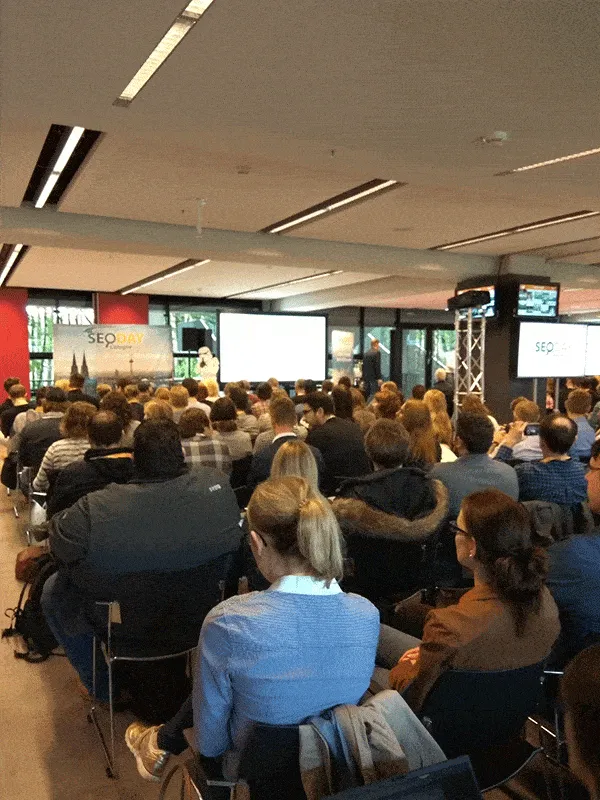
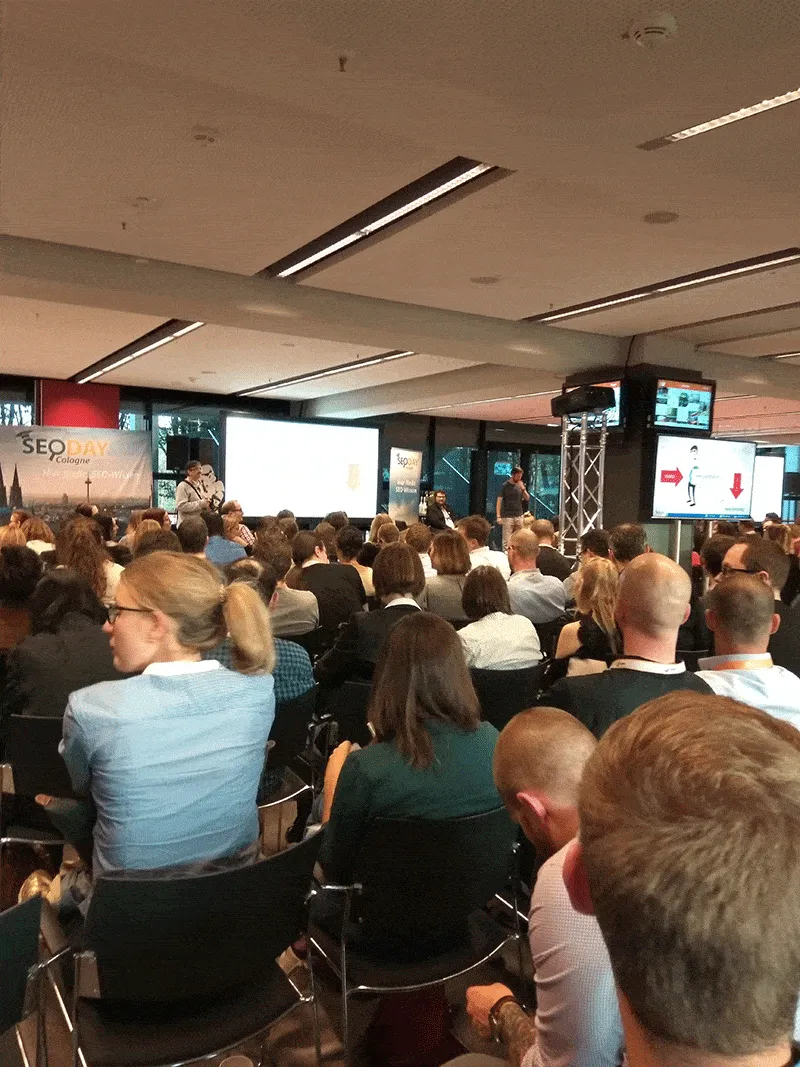
This year, too, numerous SEOs and online marketers came together to listen to the many talks by well-known names from the scene at SEO Day.
I have to admit that this SEO Day was my first. I'll summarize in this recap what I was able to take away and what positive as well as negative things there were.
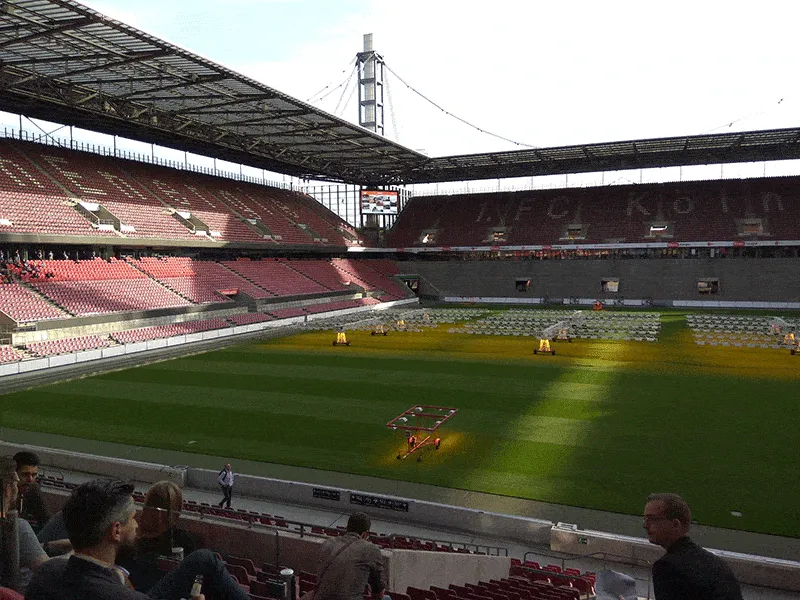
(Irony) First of all, I'd like to thank the state of NRW (or whoever else is responsible for road construction); thanks to you, the route from my front door to the stadium in Cologne took me not 40 minutes but more than double that. Thanks! (/Irony)
For this reason, I didn't arrive at SEO Day until shortly after 9 a.m. and was pleased to find that the start had been pushed back a bit for organizational reasons (in plain terms: I have no idea why everything started later, but it worked in my favor).
I was able to quickly grab a croissant and down a hot coffee – by the way: nobody definitely goes hungry at SEO Day! There were sweets and little treats on every corner – that's how it should be. Sugar shock, here I come!
How much does SEO actually differ these days on mobile, desktop, and other devices?
Speaker: Marcus Tober (Searchmetrics)
The first talk I attended was by Marcus Tober, the founder of the Searchmetrics tools.
He dedicated himself to a very interesting topic: in his talk, Marcus spoke about how different the search results can be in places across various devices.
Using the example of kicker.de, he showed that on the desktop it ranks 4th in Google's SERPs for “Leverkusen,” but on mobile search it can “only” be found in 14th place. From this you can logically conclude that the respective search intent of users differs depending on the device used.
Also interesting: different W-questions are asked on each device. On the phone, for example, especially many people search for help with heartburn and other illness topics, while on the desktop people search for W-questions like “What should I study?”
It's therefore important to question the search intent of users and to know whether they're looking for the information on mobile or on the desktop.
He also showed that on average only 8.8 organic search results are shown on the first page of Google (the rest are then images, news, or similar), while on mobile there are, after all, 9.2 organic search results on average in the TOP 10.
About AMP he was able to find out the following: many websites with AMP already rank very well and have numerous TOP placements. AMP does not, however, per se mean automatically achieving better rankings. In the USA, eBay switched to AMP and couldn't yet record any better rankings, which was possibly due to the fact that the previous site was already very well optimized for mobile. A super exciting analysis!
11 Concretely Actionable SEO Tips – Something for Everyone!
Speaker: Tobais Fox (verdure.de)
One thing you have to grant Tobias Fox: he really is a very good speaker and was able to win people over with a great deal of enthusiasm. Even though I already knew many tips in his talk, I was able to take two SEO tools away with me:
1.) https://uptimerobot.com/ : With UptimeRobot.com, users can (free up to a certain size) monitor their website for errors such as changes to the status code, loading times, and so on.
2.) mousflow.de: With the Mousflow tool, precise usability analyses can supposedly be carried out, such as live recordings of visitor behavior that show in video format how visitors behave. Not entirely harmless in terms of data protection law, but still a very hot tip, this tool.
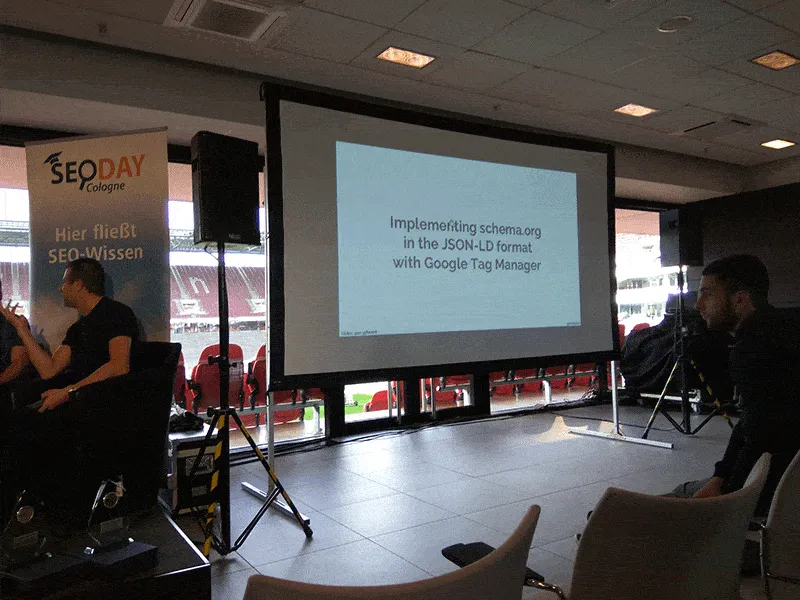
Implementing Structured Data (schema.org) Easily and Quickly – with the Google Tag Manager.
Speaker: Eoghan Henn (searchviu.com)
Up to now, I've been implementing Schema.org on WordPress websites via various plugins, such as the plugin “Markup (JSON-LD) structured in schema.org”. With Google's Tag Manager, this structured data can also be implemented.
Schema.org is a kind of dictionary for structured data with which you can transmit various information. Schema.org exists not only for websites but is also used in emails and in other areas.
For Schema.org to work, it needs a kind of language, such as JSON-LD, so that it can be read by Google, for example. Important: some search engines like Bing, for example, can't yet fully read JSON-LD and therefore don't display much of the information.
By the way: you can find an interesting blog post on the topic “How to implement hreflang with Google Tag Manager” here and the slides for the talk are available here:
Talk: Micro-processes in SEO – Step by Step to Success.
Speaker: Jens Fauldrath (get:traction)
I think everyone in the SEO scene knows Jens Fauldrath from his numerous talks as well as from his podcast. Jens really presents very well. On one of his first slides there was a picture of his daughter: “This here is my daughter, this will be the most beautiful thing you'll see in my presentation” – that was pretty cool. Now to the actual talk (in bullet points, I couldn't capture everything any faster):
– SEO becomes cheaper when the system allows settings: this was about well-known CMS systems (I don't want to name any names) on which you can't readily make important basic SEO settings such as noindex, canonical, title, and so on. If, during optimization, something like this first has to be programmed into the system, the entire optimization is logically significantly more expensive.
– Constant monitoring: on large websites with numerous employees, changes and errors can quickly creep in. Once the rankings are gone, it's too late. It's important to detect errors (such as mistakenly setting noindex) immediately and not only when the traffic figures collapse. (see tool from talk 2 “Uptimetobot.com”)
– SEO tools: according to Jens, it's always advisable to look at the Google Search Console. The tool is free and provides valuable data, for example also in the case of ranking losses: if you lose positions for a keyword, like from position 1 to position 4 or 5, that can be extremely painful. That's why rankings should also be constantly analyzed via the Search Console. (That the Search Console is an absolute must for every optimization is probably something I don't need to mention separately here ;-))
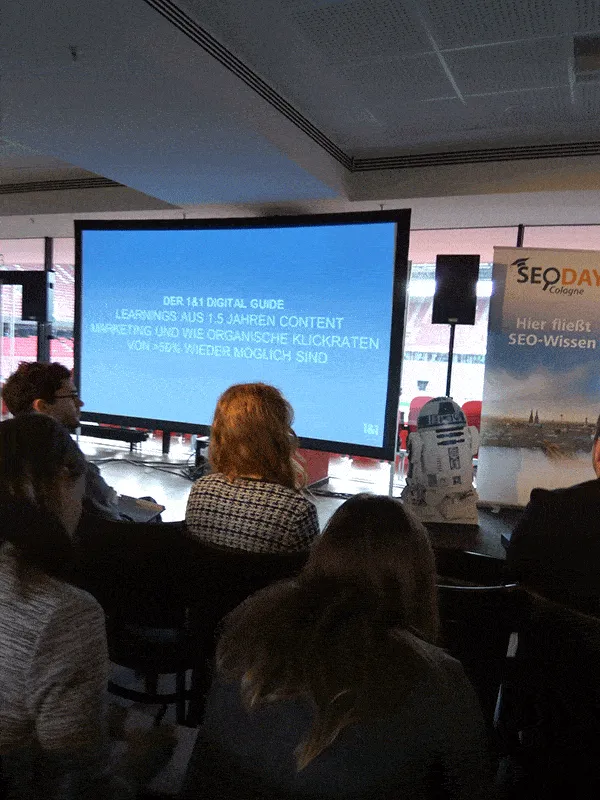
The 1&1 Digital Guide – Learnings from 1.5 Years of Content Marketing and How Organic Click Rates of >50% Are Possible Again.
Speakers: Maik Metzen and Nicolas Huber
The guys from Performics and 1&1 presented how they managed to generate an enormous traffic increase for the domain https://hosting.1und1.de/digitalguide/ through a large-scale content and SEO strategy.
Background: 1&1 wanted to reduce their spending on paid ads at Google and instead achieve equivalent traffic through the free organic search results. As a traffic source, they therefore decided on a mix of content marketing and SEO.
Over a full 18 months, 5,800 articles were written in five languages and published in 150 countries (all online via the domain). An editorial team of 28 people at Performics works exclusively on creating new content for 1&1. The editorial team writes on average 400,000 words per month.
Result: 5 million euros of SEA budget were saved through the content marketing and SEO strategy. Well, that really paid off, then.
It would have been interesting to hear how the editorial team comes up with ideas for new articles. How is the editorial plan managed, and many more questions that unfortunately remained open. Of course I can understand that such secret details aren't made known to a large crowd.
Out of the SEO Filter Bubble – Based on Surveys & Data, We Look at Google and SEO from the Outside. Speaker:
Johannes Beus (sistrix.com)
I probably took too much time over lunch, because unfortunately I arrived a little too late for Johannes Beus's talk.
Via Google Survey, he had directed a survey with certain questions at various target groups, e.g.: “Which Google products do you use regularly?” and so on. If you're interested in the results, you'll find a (unfortunately only small) excerpt here.
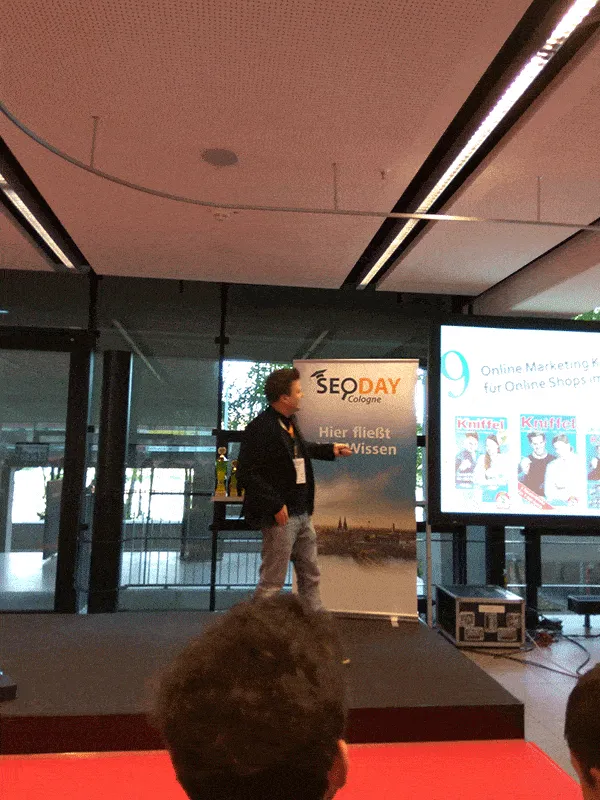
9 Online Marketing Tricks That Can Boost Your Revenue Immediately.
Speaker: Julian Dziki (seokratie.de)
If anyone suspects that this talk just throws out a few superficial tips, they're wrong. Julian had really made an effort and gave some nice tips, even if a few of them were already known to me.
– Don't plaster your title and meta description full of keywords: at most two keywords in the title and then build in a USP (unique selling point) or emotions in the title and in the description.
– Always avoid keyword cannibalization. Always optimize one URL for a specific keyword (set) and not several URLs for the same keywords.
– HTTPS, mobile, and loading times are enormously important. Example: 100 ms longer loading times cost Amazon 1% of revenue (1% of revenue at Amazon is a lot…)
– Trust seals: use trust seals for your shop as a trust element. According to statistics, two seals are more trustworthy than three or four seals. More on this at https://www.elaboratum.de/studie-guetesiegel-online-shops/
– A unique selling point for shops is NOT “cheap, TOP service, and best quality.” Everyone states these USPs. Be unique! What makes your shop special? E.g. largest shop within a region, a multitude of happy customers, award winner/distinctions, best-price guarantees, and much more.
– Use Pinterest: 87% of users on Pinterest stated that they had at some point come to a shop via Pinterest and also bought something there.
– Maintain your content on your website: delete old content and always optimize existing content in order to improve your ranking chances.
– If you use Google AdWords, you should look into the topic of RLSA (remarketing), since this form can bring you cheap traffic. Here is a good article on this topic.
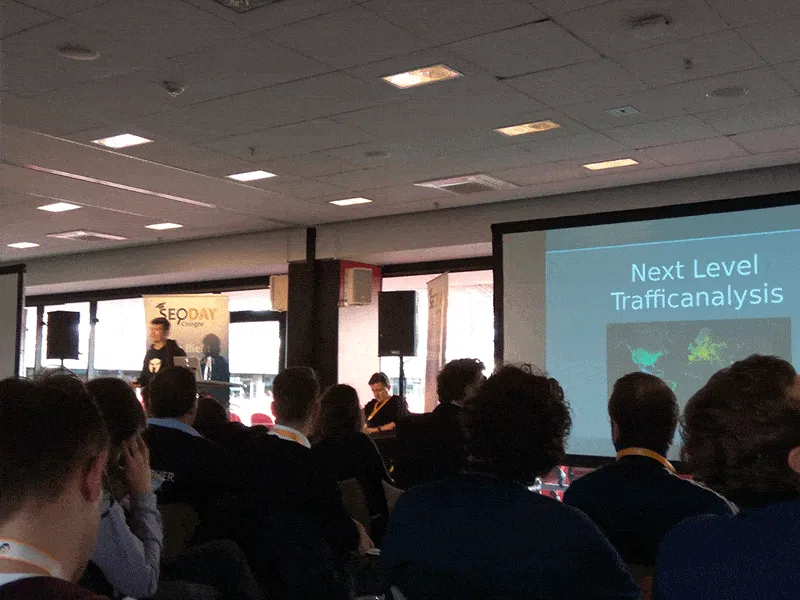
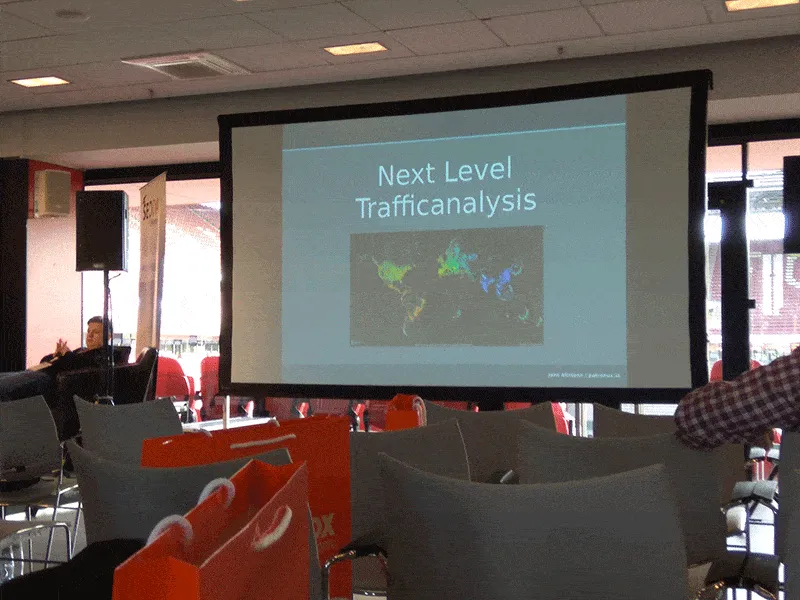
Next Level Traffic Analysis.
Speaker: Jens Altmann (gefruckelt.de)
Jens is a thoroughbred programmer! With my rather limited programmer skills, I unfortunately had some trouble keeping up so quickly toward the end.
Here's a small summary:
– The data of most traffic analysis tools is inaccurate
– Why? Bots and browser extensions prevent or manipulate your traffic data
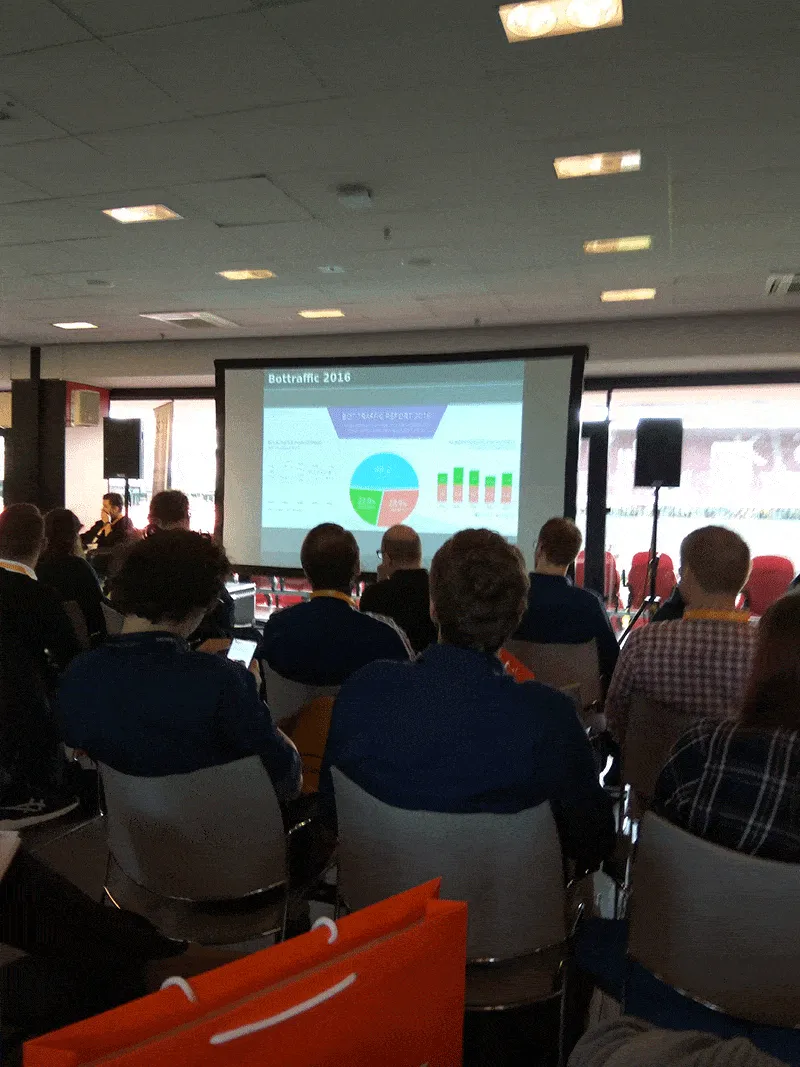
– Interesting statistic: according to https://www.incapsula.com/blog/bot-traffic-report-2016.html, over half of your visitors are actually just bots.
– By means of log analysis, you can see which bots visit your website
– ELK STACK is a log file management platform with which you can correctly analyze your log files (more on this is available here).
Easily Found. Nicer Google Rankings Through Outstanding Content.
Speaker: Rene Dhemant (rene-dhemant.de)
The best speaker that evening: with his humorous manner, Rene was able to really delight the audience and rightly received top marks for his talk.
His presentation was about why good, relevant texts are so important for rankings.
– Google is a text search engine
– The significance of texts for us humans:
- Power (power relationships are always recorded in writing, e.g. by means of a contract)
- Possession
- Organization (recording appointments in writing, and so on)
- Preservation (traditions, lore, languages, research, and much more are preserved and passed on through texts)
– The significance of texts for Google:
- Authority (power)
- Rankings (possession)
- Organization
- Preservation (Google updates, filters, and much more)
– The written word is extremely important for us humans as well as for Google.
– Don't write for Google, but always for humans (there's no such thing as SEO texts)
– Good texts for humans have rules, e.g. educate first, sell later!
– Google itself assesses the quality of a text based on 23 questions. If your text is of good quality, you also have good ranking chances
– Good texts are easy to read and structured: pay attention to contrast, font size >18px, paragraphs, subheadings, and so on.
SEO Battle – Two SEO Veterans Spill the Beans.
Speaker: Maximilian Muhr
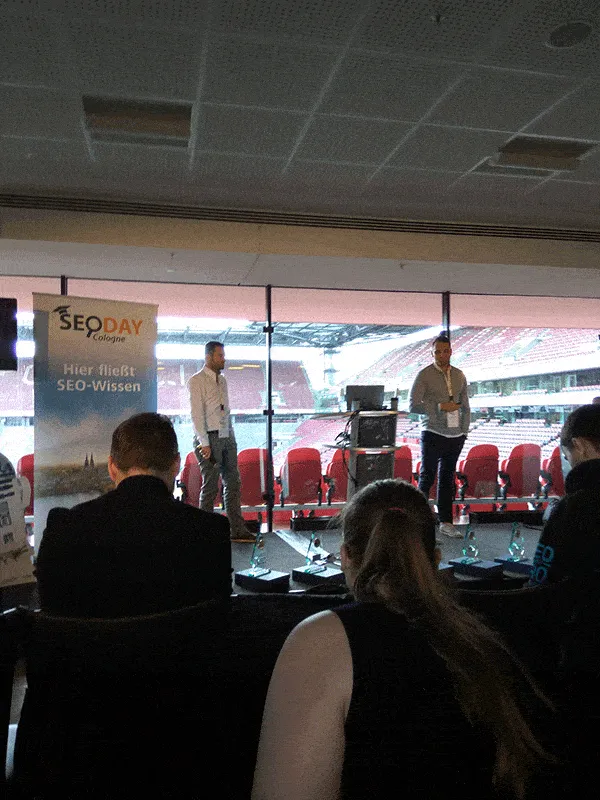
Ryanair isn't exactly the most popular airline at the moment, but now they've also made themselves unpopular with the SEO scene. The speaker Christian Tembrink was stranded in Spain. Since his flight was canceled the day before and a flight back didn't go until Saturday, Maximilian Muhr had to do the planned SEO battle alone.
This talk was about how, on various SEO theses, each of the two takes a different opinion and presents his theses on it. A really awesome idea.
The talk was great even “only” with Maximilian Muhr – I was able to note down the following small inputs:
– Optimize CTR by evoking emotions, direct address, or arousing curiosity OR optimize the CTR by testing beforehand via a Google AdWords campaign for the same keyword set.
– It's not the way you think: our attention span keeps decreasing more and more. Online, we have only between three and five seconds to convince the visitor of us before their attention is gone (goldfish have an attention span of nine seconds). Tip: use moving images (GIF) or cinemagraph images

– Make pages adaptable: not every user searches for the same information (find out the search intent)
– Be ready to fight: negative SEO is getting more and more intense – a trend from the USA might spill over to us. Be ready to defend your site against harmful links and hackers. Monitor the status code of your website and have the page source code checked regularly for changes.
Superpanel
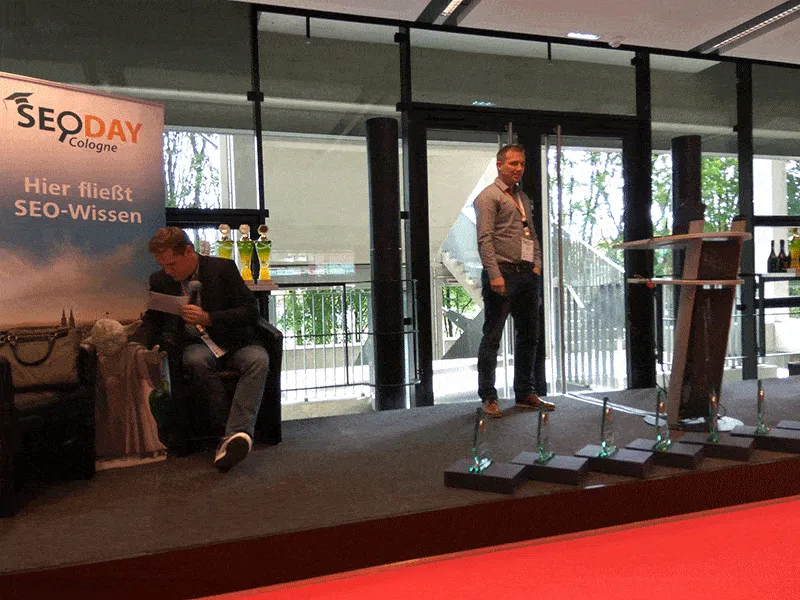
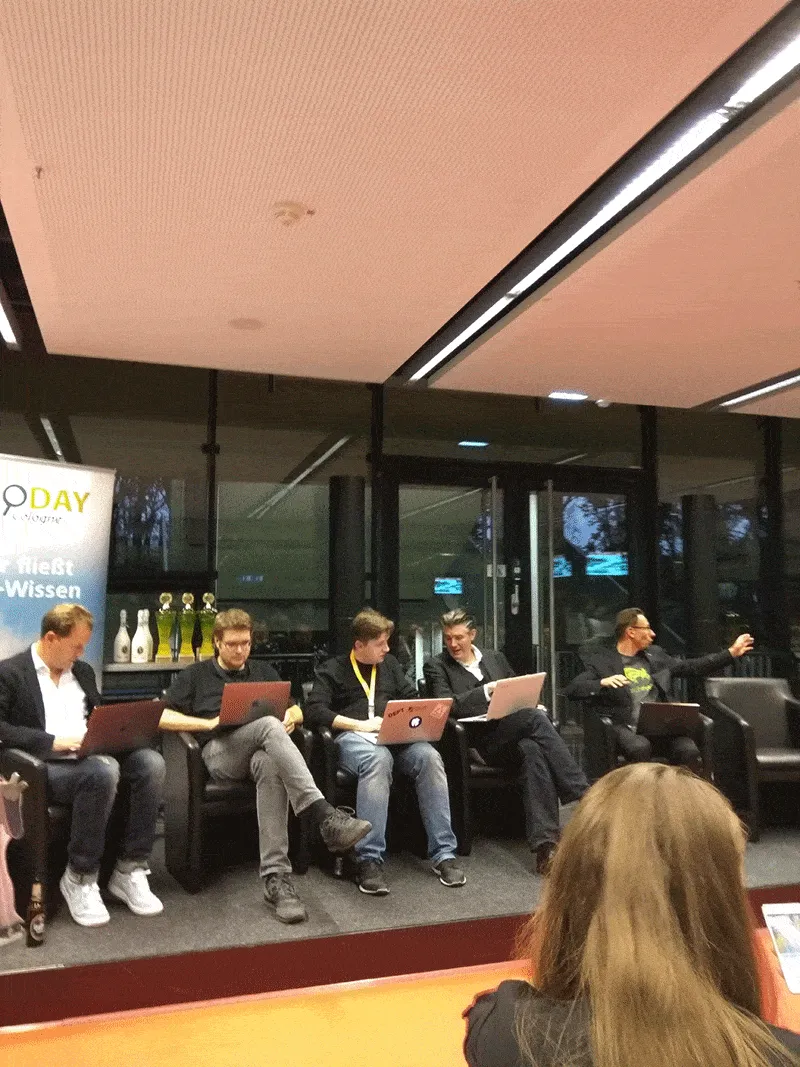
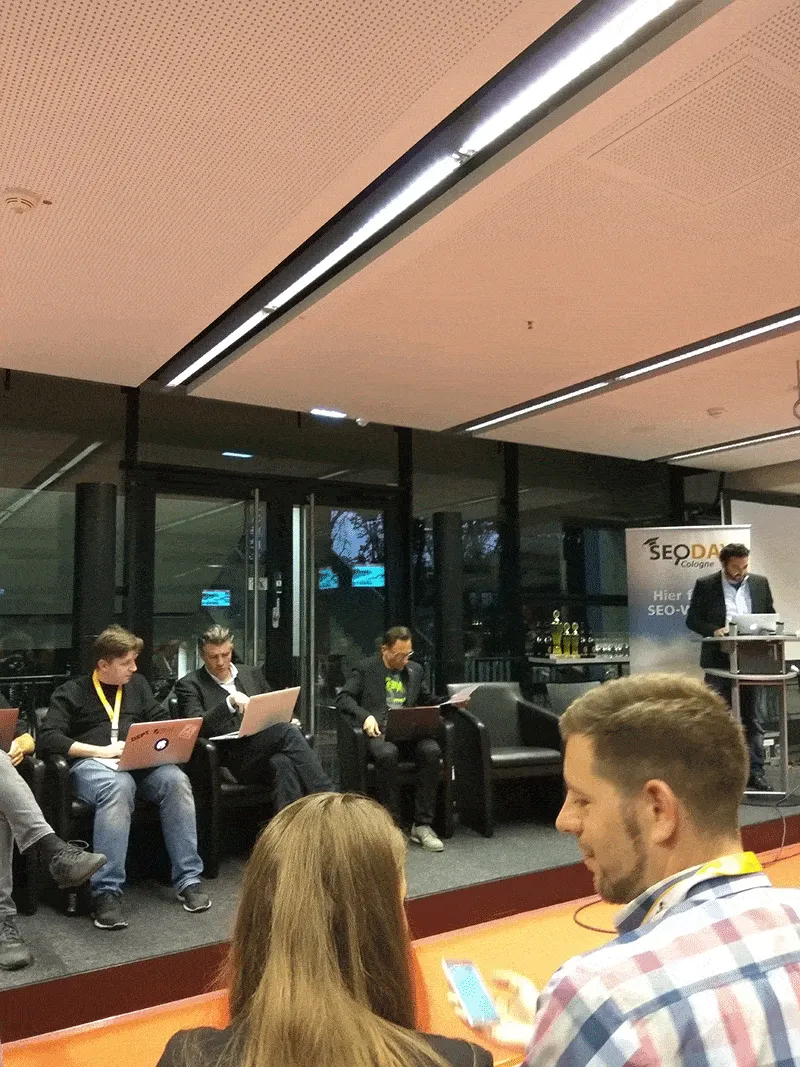
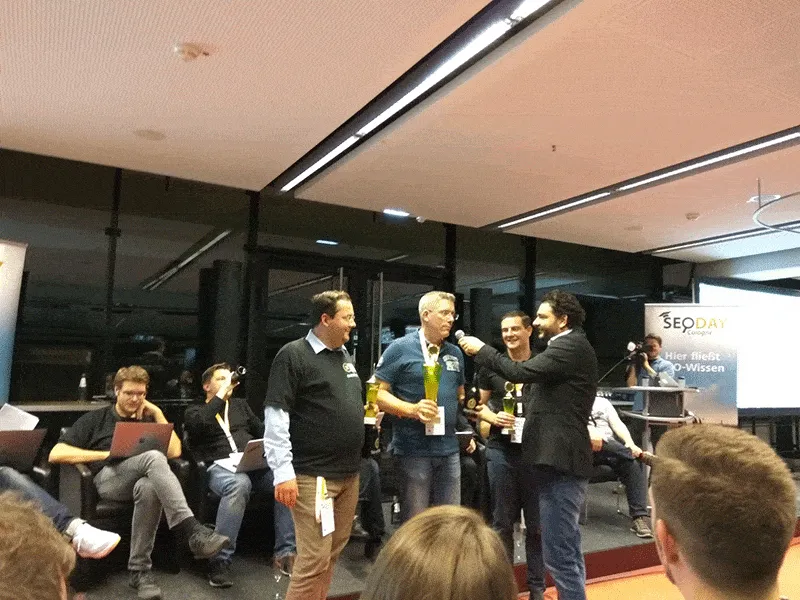
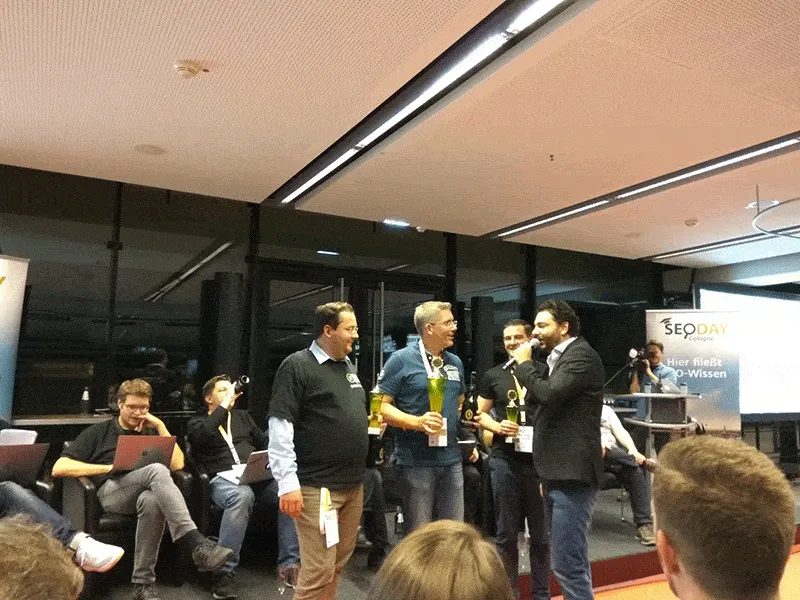
In the superpanel I no longer took notes and simply attended the “show,” such as the award ceremony. It was quite funny to hear how, with the SEO content “Siebtlingsgeburt,” the participants pushed themselves with spam backlinks until the Google penalty came. You could say that spam only works very short-term now, since it's detected by Google faster and faster.
There was also a site clinic based on the aspects of warning-notice risks and SEO quality. I'd rather not go into the points of the SEO clinic much, since nothing new was discussed here. The warning-notice risks part was more interesting for that reason. The lawyer Christian Solmecke gave the operator a tip: he had built numerous affiliate links into his website and marked them with a reference in the footer labeled “affiliate link.” This is not sufficient, since according to the legislator most people don't know what affiliate means, and the link should be labeled directly with “advertising” and not by means of a reference in the footer.
More recaps:
Conclusion
SEO Day was definitely worth it, and besides exciting talks, the networking is not to be scoffed at. The SEO scene, with few exceptions, can be seen as one big family in which everyone is fond of each other ;-).
What I liked less: even though some talks were good, the fact that something about page-title optimization came up in as many as four talks stood out to me somewhat negatively. I think that in the year 2017 this is surely known to everyone, and I really wondered why as many as four speakers went into it. There are so many other interesting possibilities you can talk about, like internal linking, tools that make your work easier, topic research for content, protection against hackers, and much more. I hope that next year there will be more varied tips with more depth.
I deliberately didn't listen to John Müller, since my business partner attended that talk. The next point of criticism: three speakers always talk at the same time. Which one do you decide on? Now and then I had the feeling of being in the wrong hall and that I'd now better switch rooms after all. A bit of a shame, but there's always some risk involved, or you go to SEO Day as a pair or a trio and can gather the information from the other attendees later.
I found the organization very good. The food during SEO Day was top-notch – as was the dinner at the restaurant Spencer & Hill in Cologne. Unfortunately, I didn't make it to the party (wife and child come first).
I'm looking forward to a new SEO Day next year!