
Is SEO dead? SEO will never die…

SEO – when will you finally die?
In one way or another, this seems to be what some desperate marketers have been thinking in recent years. Too great is the hatred for the online marketing discipline of SEO.
Why this aversion?
Since search engine optimization is not an exact science, takes a very long time, and there is now immense competitive pressure for many search terms, one or another marketer and online person has given up betting on SEO and wishes this online marketing channel the famously infamous death!
In this post I want to explain why SEO is currently so far from dead and why the chances aren't bad that SEO in the future will still play a role.
First reason of the SEO opponents: In the future, good content will be enough to be found without any problems
One of the most common arguments of SEO opponents is that search engines, especially Google, are getting better and better at distinguishing good content from bad content and evaluating it correctly accordingly.
In the near future, so they say, it will be enough to be found optimally via the organic search results solely through good or better content than that of the competition, which makes “SEO” obsolete.
Why “good content” cannot be everything in the future either
Technologies that pose new challenges are constantly being brought to market.
It is important for the search engines to be able to assess a website in terms of its quality. For example, structured data (Schema.org) helps Google & Co. understand your website better. Good content alone doesn't get you far. Decisive alongside the content are factors such as fast loading times, the indexability of the website, and many more.
The on-page optimization also enormously helps search engines understand content better. This includes giving the well-formulated meta title the appropriate keyword. Or showing the search engines the way to the most important subpages through internal links. All of this cannot be achieved through good content alone, and that is very unlikely to change in the future either!
Second reason of the SEO opponents: Search engine optimization has become too complex
The algorithms of the search engines have become sooooo complex that “manipulations” through SEO no longer make sense…
The SEO strategies change… constantly
Search engine optimization is and remains a constant challenge. The times when one or two strong links were enough to rank at position 1 for your desired keyword forever and ever are long gone. Big G is also getting better and better at recognizing SPAM measures such as keyword stuffing, manipulated link building, etc. In addition, the competition in the search results (SERPs) has become tougher.
According to Google, over 200 (!) ranking factors decide, at which position your website appears in the search results.
However, that doesn't mean you have to give up because of it, or that search engine optimization no longer has any effect. There are so many levers you can pull, which makes the entire optimization even much more interesting. Yes, harder too. But not impossible!
Continuously optimize your website, deliver the content your visitors want, do your on-page homework, bring time / patience, and you'll see how wonderfully SEO still works even today.
Is SEO still a relevant traffic channel?
Many opponents describe search engine optimization as a traffic channel that is losing more and more ground.
Is that really true? No!
According to Rand Fishkin's talk at the SMX in Munich in 2017, most Google users still click on organic search results: https://www.slideshare.net/randfish/the-search-landscape-in-2017.
The amount of clicks (CTR) on mobile devices and desktop PCs
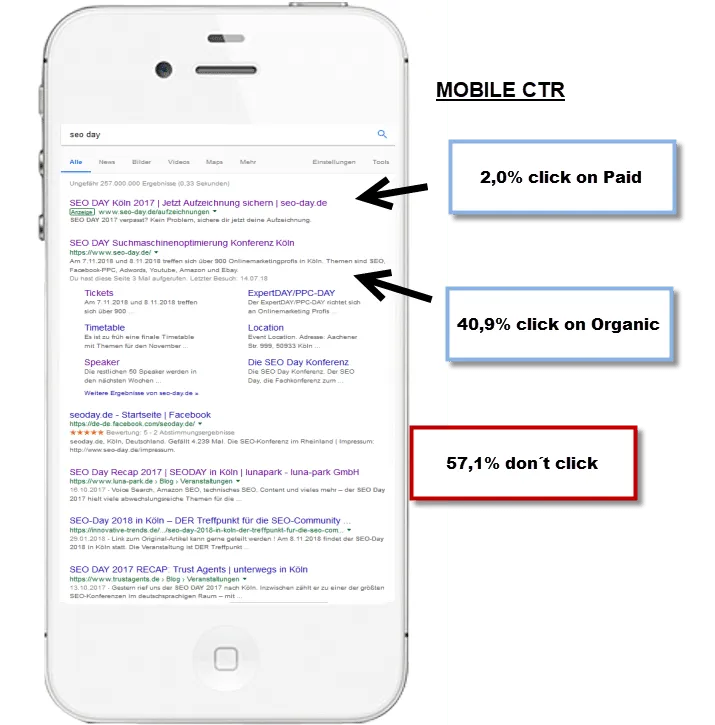
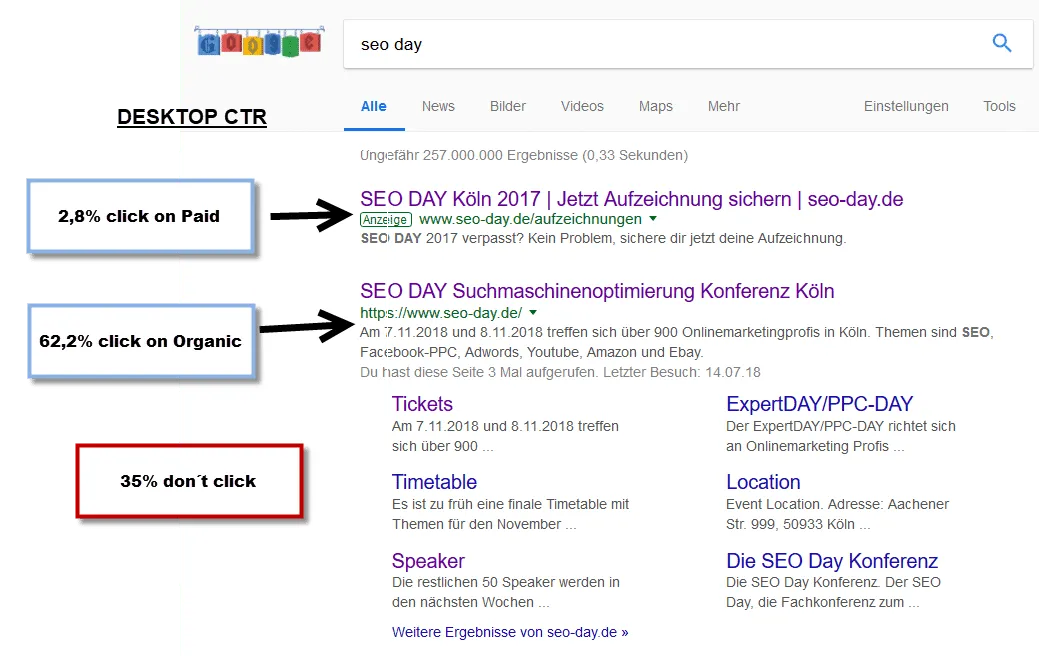
So optimizing the website for the organic search results still reaches the most Google users. But hold on a moment: 35% of desktop users and 57.1% of “mobile” users click on no search result at all!
Very likely many don't click because Google increasingly tries to deliver an answer to the search query itself right away (answer boxes). Google wants to become an answer machine and thus make its users even happier. Most search engines, however, live off their users clicking on the paid search results.
Therefore, Google & Co. will never deliver an answer to everything themselves, but will continue to try to get the user to click on the (paid) search results.
Soon only paid search results?
If only paid search results were still listed, SEO would of course be pretty dead! But would that make sense for Google?
It would at least be possible and could perhaps look like this:
In the post by Philipp Kloeckner you can see, for the keyword “hotels in rome”, no more organic / unpaid results. Only when you scroll far down do the first organic search results appear.
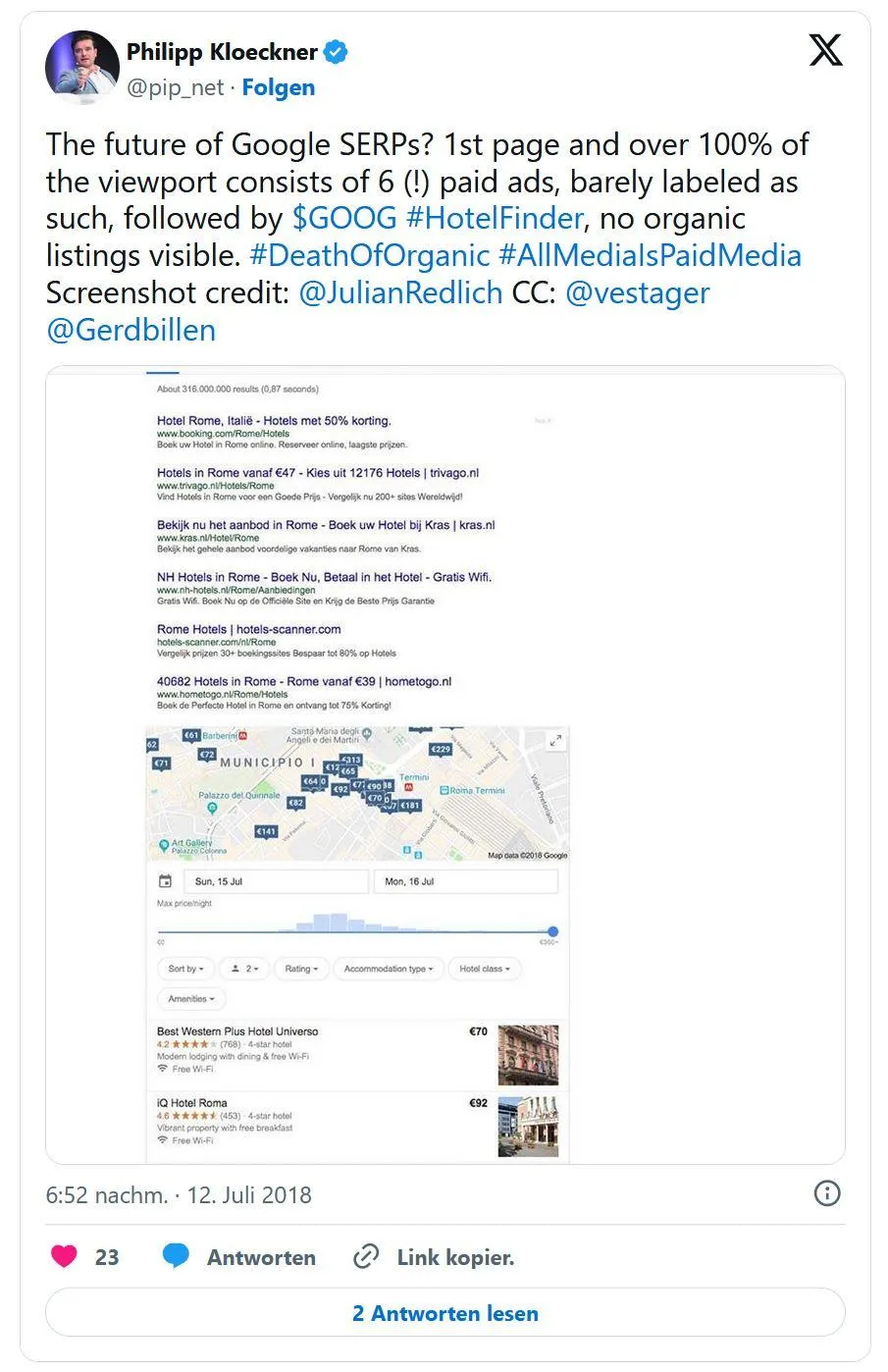
Is this what the future of Google looks like?
I think rather not: paid search results represent a problem. They appear right at the front for the search term but, under certain circumstances, don't deliver what the user was actually looking for.
The publishers of ads naturally want conversions, be it an inquiry, a newsletter sign-up, or something else. But not every search query is associated with a desire to buy.
When a user types “recipe for marble cake” into Google, they hardly want to land on a landing page where they are offered an ebook with 20 different recipes for marble cake at the great special price of only 9.90 €. No, they want to be suggested websites that show delicious recipes for free.
Only displaying paid search results would deter many users and encourage them to use a different search engine.
And that is exactly the biggest fear of Google: making its users unhappy so that they then choose a different search engine.
Thanks to organic search results, Google can always keep the quality of its search engine very high. To do so, Google “only” has to deliver the best answers to the search queries and continue to display free organic results – with informative content from websites that deliver to the user what they are looking for.
New search systems destroy SEO?
New search options for the consumer, such as voice search, could reduce the importance of SEO. But even with voice search systems there are certain criteria or ranking factors that decide which results are ‘read out.’ And as long as unpaid search results play a role in voice search, SEO will be of importance here.
Search by voice will also not destroy the entire market of desktop search and mobile search. Voice search will presumably remain a search channel that exists alongside desktop and mobile.
SEO opponents are right about one point: We make ourselves dependent
We SEOs, however, forget one thing too often: we make ourselves dependent. We are not dependent on the online marketing channel SEO; worse, we are dependent on a single company (Google).
And here a great danger is hidden: what if this monopolist now, after all, only lets paid ads appear on the first page.
What if no organic search results appear at all anymore, or Google no longer lists websites but only lets other technologies, such as web apps, appear?
A lot is possible, and trusting that Google will always continue exactly as it does now is simply naive. The search engine sets the beat and we jump to it! It is therefore immensely important not to make yourself dependent on a single channel, but to use alternative traffic channels.
Conclusion
As early as the 200Xs, the first “SEO is dead” articles could be read online. That is such a worn-out cliché that most people should know by now: SEO is not dead and it will stay alive for quite a while longer. Dangers could come from the search engines themselves, whose business model demands more capital, so that organic results, which we SEOs optimize, may increasingly slip into the background.

Whether it will really come to that may be doubted, since paid search results often don't bring the same quality as the pages in the organic results. Especially for informational keywords and question keywords like: “How do ebb & flow work,” “How to lose weight healthily,” organic search results are immensely important, because they deliver the answers the user is actually looking for, which makes them happy. And that is exactly what Google & Co. will need in the future, if they want to keep their market power: satisfied users who keep coming back to the search engine.
Conclusion: SEO is not dead, only the rules are changing!
-Fabian


