
SEO Basics & Strategy
B2B SEO: Win Customers Through Search Engines


Many B2B companies offer high-priced services and products to a very narrow target audience. Reaching them is not always easy. To make matters more difficult, the B2B sector has a very long buying cycle – it can take a long time before the target audience makes a purchase, and there are often several decision-makers on the potential customer's side.
B2B SEO can help you reach the right target audience and additionally generate customers or leads for your company.
In this article, you'll learn what matters in B2B SEO and which important hurdles you need to overcome.
What Is B2B SEO?
B2B SEO refers to search engine optimization for companies that sell their products or services to other companies. The goal is to be visible in search engines with relevant content and to address qualified decision-makers.
Difference From B2C SEO
In the B2B sector, it's often smaller groups of customers that you want to reach. As a result, the search volume of the relevant keywords is also smaller than for B2C keywords. On the other hand, the competition in B2B is usually weaker than in many B2C industries.
Typical characteristics of B2B SEO are:
- Low search volume for the many relevant search queries
- High demands on keyword research due to complex technical terms and different search intents
- Frequently comparatively weak SEO competition, since many competitors use search engine optimization only to a limited extent
In B2B, then, the goal is to reach a small target audience with (usually) high-priced products or services – and SEO can be exactly the right tool for that.
B2B SEO Video
You'll find more important fundamentals and tips here in the video:
B2B SEO Fundamentals
The most important B2B SEO fundamentals, sorted by the areas of keywords, on-page, technology, content, off-page, and monitoring:
Keywords
For which terms should the company be found? Which terms does the potential target audience enter? What does the buyer persona look like?
At the beginning of every SEO campaign is keyword research, to define the right keyword set for the website. Without suitable search terms for which the company wants to be found, optimization is like flying blind. In addition to researching suitable keywords, you should also check them for competition, monthly search volume, search intent (what does the user want for that keyword?), and ranking chances.
It's also useful to check the rankings and keywords of the competition with tools like Sistrix, Semrush, or Ahrefs – you might just find one or two keyword gold nuggets here!
On-Page
In on-page optimization, all potentials on the website are analyzed and optimized. These include, among other things, the site architecture (how are the users' questions answered and how is the information distributed across the website?) and the most important meta tags (title tag, meta description).
Further on-page basics:
Technology
Technology must not be neglected if the website is to be found well through search engines. Therefore, check the technical status of the website with regard to:
- loading times
- clean HTML code
- CMS adaptability for SEO
- up-to-date PHP version
- SSL encryption (https/2)
- mobile optimization
- indexing management
Also make sure that the Google crawler can read everything smoothly and that there are no blockages via the robots.txt. Setting canonical tags, hreflang tags, and much more correctly is also part of a technically flawless website.
Content
How high-quality is the website's content? Is there enough content for every important keyword on the website? Are keyword cannibalization and duplicate content avoided? Is there a content strategy according to which new content is created for the target audience, and is the current content continuously reviewed and, if necessary, revised?
Only when all of this is in place does a website have a chance of achieving good rankings.
Off-Page
In the area of off-page SEO, all ranking factors outside of a website are optimized. This includes, for example, building backlinks, but the devaluation or removal of toxic links that can worsen rankings is also very important here.
Monitoring
Monitoring ensures that the SEO strategy works and that rankings, traffic, and visibility develop positively accordingly. If monitoring detects that the site is losing rankings and traffic, you can intervene quickly. Tools for regular analysis are therefore very important (e.g. Google Search Console, Serpwatcher, Sistrix, and many more).
Examples of Successful B2B SEO
wlw.de (= Wer liefert was? / "Who supplies what?") is a well-known business directory for B2B companies. Wlw has definitely made the leap into the digital world. I still remember an internship during my business administration studies – even back then, wlw.de was always the first place to go when researching suitable suppliers.


One example from the SEO bubble is Ryte: The software provider has been able to generate enormous visibility and high traffic with its wiki and thus addresses a very large target audience.


Another example is Hubspot.de. The well-known CRM platform knows how to generate online visibility and traffic.


A lot of SEO traffic also goes to Metro.de. The company is searched for on Google especially in connection with locations, but also gains visibility and traffic through a blog and a directory of products (called Produktwelten / "product worlds").


Common Challenges in B2B SEO and Their Solutions
Here we've listed particularly "popular" challenges that occur in the area of B2B SEO for you – of course, there are many more.
Low Search Volume
B2B companies often serve only certain niches and therefore have keywords with a relatively low search volume. In some cases, "important" keywords have a search volume of less than 10 according to keyword analysis tools such as ahrefs or kwfinder.com. The art lies in finding the right keywords and not being put off by the low search volumes. Even if a keyword is only searched for 100 times, a big lead can still come to the website through it.
In this context, search intent should also be taken into account – many B2B companies rely exclusively on transactional keywords, such as "packaging manufacturer" (searched for 110 times according to kwfinder.com).
Often, however, there are still many other suitable keywords that go unnoticed. For the packaging manufacturer example, keywords with information-driven search intent would also fit, such as "packaging," "corrugated cardboard," "box packaging," and much more.
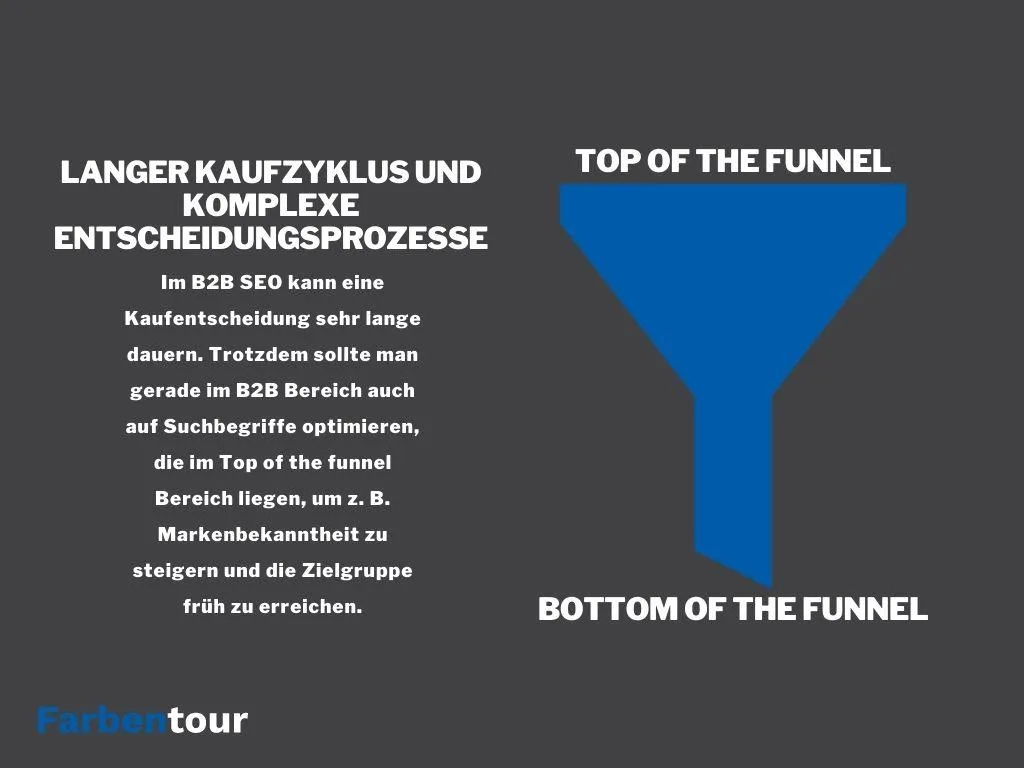
From a customer journey perspective, information-driven search terms are often referred to as keywords in the top-of-the-funnel area (the purchase decision still takes time) and transaction-driven search terms as keywords in the bottom-of-the-funnel area (shortly before the purchase decision).
Both types of keywords should be served, since Google considers websites with a high information value to be particularly valuable and attributes a high level of expertise to them.
Information-driven search terms can be covered well through a wiki or a blog / magazine. There, visitors can then find information about the products of, for example, a packaging manufacturer via Google. SEO traffic can also be used in the search for qualified staff.
Too Little Content
Many B2B companies only want to sell on their website. However, they forget that Google especially rewards websites that also offer relevant information with high added value. Companies should therefore invest a lot of time in creating such content.
Too Much Technical Focus
B2B websites usually get by with significantly less technology than, for example, online shops. Here, there are rarely millions of subpages, but usually only a few hundred pages on which the company presents itself and its services + blog or glossary entries.
Major technical tricks, such as a PRG pattern, are often not appropriate for small to medium-sized B2B sites and only waste resources and no longer have any effect on SEO.
For large corporations in the B2B sector, such as BASF, Thyssenkrupp, SAP, etc., things look quite different – here a technical focus is important! There are very many subpages and directories here due to a wide variety of products and services, as well as multilingualism and many other potential SEO danger sources. Especially when the B2B company wants to be found internationally across different countries in Google search, you always have to work with the correct hreflang tag, for example.
Companies should also avoid working with subdomains (which, for whatever reason, are often used) – each subdomain is regarded by Google as an independent website for which SEO has to be carried out anew and independently. It's better to concentrate all the SEO power on one domain and do without subdomains.
But none of this means that you should simply leave technology out of the picture. Of course, even with small to medium-sized B2B websites, you must not ignore important technical factors such as loading times, Web Vitals, status codes, etc.
Link Building for B2B – 6 Tips
Link building in B2B industries has the special challenge that there are rarely link sources that want to link to someone without a lot of effort. That's why here you get 6 best-practice tips for building backlinks anyway:
- Contact Partners (Clubs, Associations)
In many niches, there are associations and clubs that are happy to link to their members. Partners or suppliers also have websites from which you may be able to get a backlink. - Creative Content and Linkbait Ideas
Linkbaits can be used excellently for link building, especially in the B2B sector. Important: The content has to "appeal" to the webmasters, and outreach should be done over the phone – emails quickly end up in the spam folder. You should also always start a pre-outreach and present your linkbait idea to potential link givers – if many react positively, a linkbait can be launched. - Wiki and News Section
With a wiki, generic terms from the industry can be picked up well and corresponding rankings achieved. It often happens that webmasters link to such wiki entries as sources. In a news section, you can report on current topics and trends – here it always depends on the niche whether such a news section can even be worthwhile. - Guest Posts
The classic – even though Google advises against guest posts, we have had the opposite experience. With such guest publications, it's especially important to publish only absolutely high-quality content (>2,000 words) that has immensely high added value. - Interviews / Egobaits
Inviting other experts from the niche / industry to an interview (which is of course published on your own company website) can not only improve your own expert status. It can also help you obtain backlinks from other websites in the niche. - Analyze the Competition's Link Profile and Rebuild It If Necessary
Where does the competition get its backlinks? Using tools like Majestic or ahrefs, you can analyze the competition's link profile and filter out the best link sources in order to rebuild them if necessary.
Summary
In contrast to e-commerce websites (B2C), many B2B companies have only small websites that can cause fewer technical problems (large corporations excepted). Therefore, in B2B SEO the greatest focus should be placed on content, clean indexing, and strong links. These are the key factors in B2B SEO.
Need a GEO check?
Get in touch for more visibility – in search engines and AI answers.
- More visibility and leads via Google and AI chats
- Sustainable SEO & GEO strategies
- Personal support


