
Content Marketing
Create and Optimize Content – How Your Content Ranks for Hundreds of Keywords


Content, the material on your website, is one of the most important criteria for good placements in Google search.
However, it's not always easy to create content that resonates well with search engines as well as visitors and is found well not just for one keyword, but right away for hundreds of keywords. You'll learn how to do that in this blog post!
Define Main Keyword and Secondary Keywords
How you rank for hundreds of keywords….
Before you even start: For which (primary) search query should the article be found in the first place?
This is of course the first step, and before that you don't need to lift a finger when creating your text! Using keyword research (which we've already described in detail on our blog), you find suitable search queries and can sort them by search volume and competition.
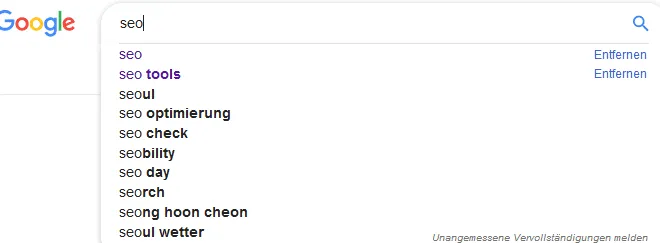
Via the Google Autocomplete function, you often get suitable secondary keywords for your main keyword. Other tools like Answerthepublic.com help you find more secondary keywords and gather them into a keyword set. This step is extremely important so that you even have a chance for the content to be found for a whole lot of (similar) search terms.
Take Search Intent Into Account
Before you now write an article, we have to become clear about what expectations the target audience has for the respective keyword set. Does the target audience want information or does it want, for example, to be shown products to shop for?
Based on the search intent, you can find out how your content should be. Check the top ten in the search results for your main keywords. What information do they provide? Are they more information-driven or rather transaction- or commercially-driven? Only once you've determined the search intent can you write the right article that is also found for many different search queries.
Write Good Content … no, wait … WRITE THE BEST CONTENT
What does it actually mean to have the best content? Good content answers the users'/visitors' search intent to their absolute satisfaction and additionally delivers the following:
- Shows (new) insights or solutions for the target audience
- Highly informative and offers real added value ("You won't read this anywhere else.")
- Added value = offers problem solutions and / or entertainment
- Authentic and true (don't tell fairy tales)
- Is emotional (only if it fits the topic)
- The text has to be better and more informative than the competition's texts (therefore always look closely at the competition – what information is missing and how can you stand out)
Note: The text should be so good that the target audience recommends the article to friends, relatives, etc. without hesitation, gladly shares it, and saves it as a bookmark. If you manage that, you've created excellent content that is also rewarded by the search engines.
Clear Structures and Content Design
Content that ranks well must also have clear structures and look appealing to the target audience. The text should be easy to read and not have overly convoluted sentences. The difficulty of the text of course depends on the target audience! The font type and font size should also be adapted to the target audience. Example: Older people want a large font, young people can also live with a smaller font.
Keep your texts simple and clear, without embellishment – following the motto "Don't make me think." The more clearly the information is prepared, the better.
Structure your text so that everyone can scan it immediately. That starts with the H headings. Every text should have only a single H1 heading right at the beginning. Further into the text, every subheading should be an H2, H3, or H4 (if you absolutely want to use H5, then just do it). Make sure that the order is correct. After an H2, an H3 correctly follows, not an H4 or H5. The headings must always appear correctly one after another, without skipping a number (stringent):
- H1 heading (What is search engine optimization?)
- H2 subheading (Definition)
- H2 subheading (Tasks)
- H3 further subheading (Audit)
- H3 further subheading (On-page & off-page)
- H2 subheading (Summary)
Make sure that every subheading is meaningful – many people scan a text first and then decide whether they want to read it or not. Your goal must be for the text to actually be read by most visitors.
You should build your main keyword into the H1, and you can build further secondary keywords into the subsequent subheadings, which is however not a must. It's better to have meaningful subheadings that make people curious for more than pointlessly spammed subheadings that no one is interested in.
To make a text further scannable, there are various options:
- Paragraphs: So simple and yet so important – a big wall of text scares off just about everyone. Paragraphs loosen up texts immensely, so a paragraph should follow every 4–6 lines
- Bold highlighting: Bolding important terms also helps to make the text more readable. Many readers use something like that as reference points to skim a text in advance. Make sure not to highlight entire paragraphs, but only important statements and terms.
- Definitely use further loosening-up elements such as images, tables, graphics, videos, podcasts, quotes, boxes, and much more. The more these elements are integrated into the text, the better, but of course don't overdo it. If an image, a table, a graphic, or similar appears every 300–400 words, that can already be enough loosening up. Images and graphics in particular are important, since you can generate even more traffic for your main keyword through Google image search. Make sure that the images all have a title with the keyword and a slightly modified ALT tag (also with the keyword).
- Make sure to highlight the key statements. Many people don't want to read 5,000 words when they want to solve a simple problem and pick out the solution. Make it as easy as possible for them to find this information in your text. Using a conclusion for a summary helps "reading-lazy" visitors to immediately deliver the information they were looking for.
- Build in links: Back up important statements with sources. Make sure to use reputable sources (not just Wikipedia).
- Table of contents with anchor links (like in this article here) help to make a text further scannable. A table of contents should be found as early as possible, or below the introduction, and every subheading should be reachable from the table of contents via anchor links with just one click/jump. A table of contents of course only makes sense if the text has a certain length. A 100-word article without subheadings of course doesn't need a table of contents.
How Long Should Content Be That Ranks Well on Google?
There's only one single right answer to this topic:
The text should be kept as long as necessary and as short as possible.
No one should write long texts anymore just in the hope that they will thereby be found better. Consider which information the target audience wants – which information is necessary if someone has no idea about the field. Deliver all the answers to all important questions without becoming completely rambling and straying from the topic.
Through keyword research, you should already have found all the important search terms and can accordingly write a good text that supplies the target audience with all the important information.
Use the Main Keyword Correctly in the Page Title and Description
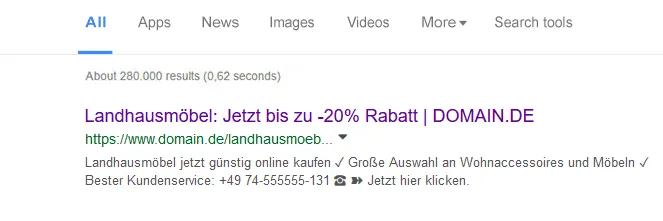
So that the content is found as well as possible via the search engines, it's important to create a good page title and a meaningful meta description. The main keyword should be as far to the front as possible in the title, followed by a call to action or a promise. If there's space at the end, the name of the website can also be built in.
The description presents further advantages and is meant to additionally encourage the user to click, such as "In this article you'll learn more about search engine optimization and get twelve tips on how to be found better."
The title for the keyword "search engine optimization" could then read as follows: "Search Engine Optimization Explained: Definition, Examples, and Practical Tips."
Good page titles and descriptions should always encourage clicking and make people curious accordingly. Never use the pointless stringing together of keywords (keyword spam), since such snippets rarely have a good chance of getting ahead.
Keyword Density and WDF*IDF
The keyword density, i.e. how often the keyword appears in the text, is by far no longer as important as it was a few years ago. Much more important is to deliver all relevant information and to hit the target audience's search intent. Whether the keyword now appears in the text once or twice or ten times is no longer important.
Be careful with keywords that recur too often in the body text: If you overdo the keyword density, you'll even get penalized due to keyword stuffing. Therefore, don't pay attention to any keyword density and write the text for the target audience.
Also use synonyms to additionally show the search engine and your users that you've really engaged with the topic. Tools like SEMAGER help to find related terms: semager.de
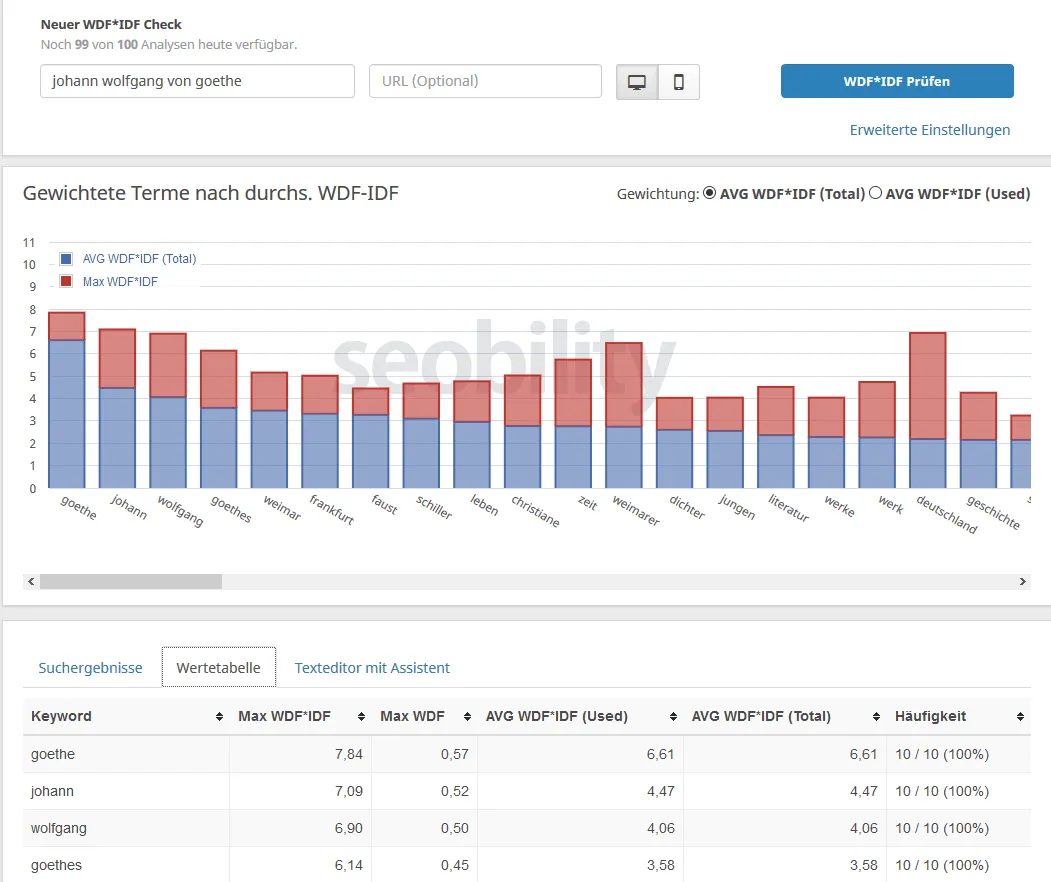
The holy grail of the SEO community used to be WDF*IDF term weighting. Simply put, this analysis was used to find out which terms besides the keyword the competition also uses in the SERPs. Many then blindly built in the exact number of suggested terms that the analysis showed them. That is absolutely no longer necessary.
More important is to check whether a topic is completely covered in your text or whether the competition discusses further topics that you may have overlooked -> That's exactly what the WDF*IDF analysis is perfect for.
Example: A WDF*IDF analysis for the search term "johann wolfgang von goethe" shows you terms like "Leipzig, Weimar, Frankfurt" – so all the cities where Goethe stayed should be mentioned in your text. His works like "Faust" are also displayed in the analysis -> So the text should also write about his works.
Note: Google considers keyword clusters and no longer individual keywords. Therefore, a keyword density for a single keyword is not important. So always try to work through the topic as holistically as possible.
Internal Linking & Site Architecture
Make sure that your content is not hidden too deep in the site structure of your website. This means that all content (no matter how big the site is) should be reachable from the homepage with a maximum of three clicks. The deeper the content is hidden, or the more clicks are needed, the less relevant it is for the search engines and the less often they come to the content and crawl it.
The fewer clicks are needed from the homepage, the more important and relevant the text becomes.
Also, internal links in the body texts to further content on your website strengthen the site structure and help to ensure that no article "disappears." Through internal links, you strengthen it for the search engines in order to additionally gain relevance.
Tools for Analysis
Various online tools support you in creating the perfect text for your website. Keep in mind that no tool in the world is perfect and merely gives suggestions for improvement that you should not blindly follow when optimizing.
- Analysis Tool by Wortliga
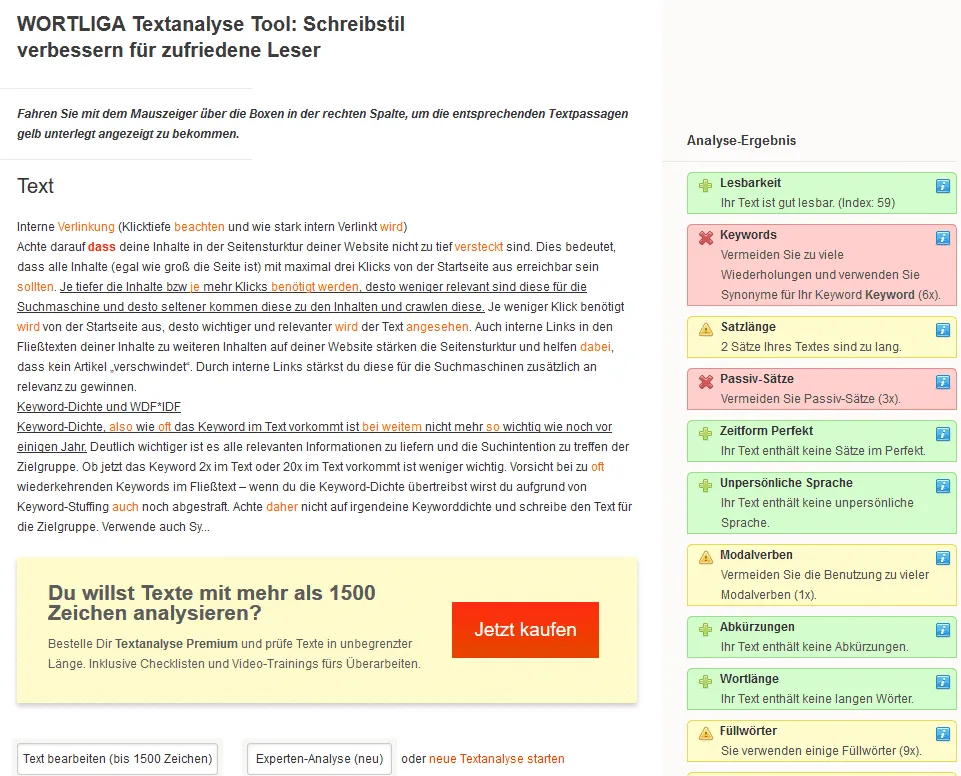
Wortliga is an analysis tool from Wortliga.de. It examines your text for various points such as readability, sentence length, passive sentences, phrases, and much more. The tool can be used for free up to 1,500 characters.
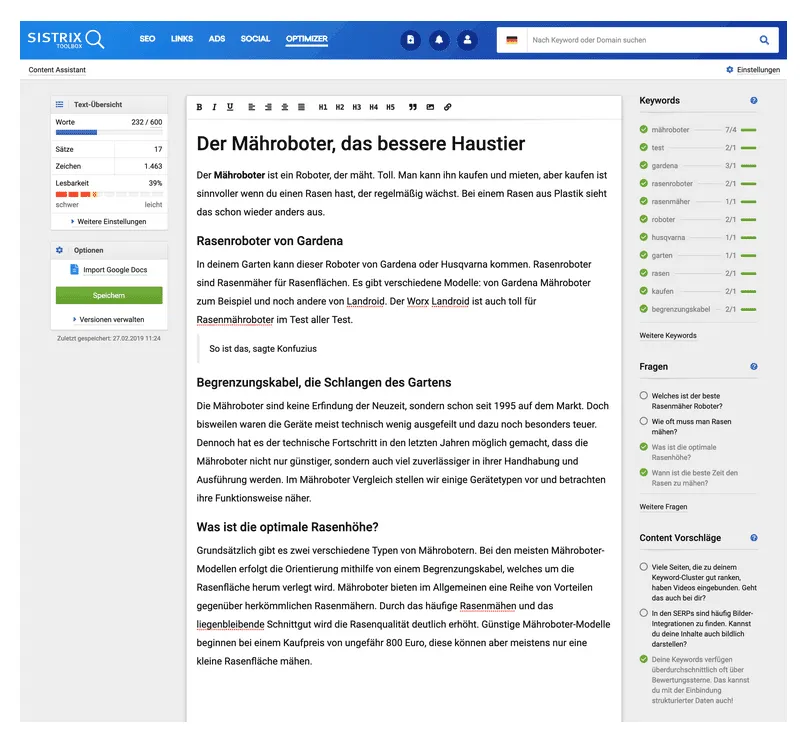
- Content Assistant by Sistrix
Customers of the SEO tool Sistrix can use the integrated content assistant of the toolbox: Similar to Wortliga, various points are checked here. The difference here is that the content assistant checks whether the text covers all the important keywords that you discovered through your keyword research and for which the text is supposed to be found well. Here, besides keyword and question suggestions, further content suggestions such as videos and images are also offered.
The Salt in the …
What salt is to soup, the following options are to your content. With them you give your content an extra boost on the way to good placements, and you can (hopefully) be found well for hundreds of keywords with just a few articles.
- Use structured data: With structured data, you can quickly and easily give Google & Co. information about your website and your content. This also lets star ratings, preview thumbnails for recipes, anchor links, and more be displayed in the search results.
- The content should load quickly: Quite clearly! Who in the internet high-speed country of Germany wants to wait long [/irony]. By means of image compression, caching, and a fast host, the loading times can usually be optimized considerably. You'll get your current loading times and optimization suggestions here: https://tools.pingdom.com/.
- Backlinks: Good content is usually also gladly linked to by others. If your articles also have backlinks, this can be a positive signal to Google and additionally bring better rankings.
- Content distribution: How is your content supposed to be linked to if no one knows about it? Right: The content has to be promoted: Whether via ads, blogger outreach, or simple networking. Make your content known everywhere in your niche.
- Try to get into the answer box on Google (Google's Featured Snippet Box). Through it, you can generate additional traffic once again. Place a frequent question directly in the introduction of your text and place the answer compactly below it. The question should be an H2 heading, and the answer should be about 40–60 words long (but this also depends on the topic).
Summary
Individual keywords are more or less irrelevant when creating a text. Google considers topics holistically. Therefore, always work with a keyword set, a list with many keywords that fit together thematically and can be worked on in one article. See to it that you answer all questions and wishes. The user intent is always to be taken into account: What does the target audience want?
Write texts for people and not for machines. In doing so, forget the term "SEO copy" – there's simply no such thing. Only once you take that into account can you write perfect texts that will also achieve good positions in the search engines for a whole lot of keywords.
What is the perfect content for you that gets found well via Google & Co.? What do you pay attention to when creating a text?
-Fabian
Rate text
Average rating: 4.9 / 5. | Number of ratings: 34
Need a GEO check?
Get in touch for more visibility – in search engines and AI answers.
- More visibility and leads via Google and AI chats
- Sustainable SEO & GEO strategies
- Personal support


