
SEO Basics & Strategy
SEO Analysis – How to Sensibly Analyze a Website from an SEO Perspective

A detailed SEO analysis of your website is an important cornerstone of every successful optimization for search engines. That is why in this article I will show you how to properly analyze your website. Questions and constructive criticism are very welcome in the comment area below this article.
Which points must be considered in an SEO analysis?
Before you carry out a detailed SEO analysis, it must be clarified what stage your online project is in. Is it a still-virgin website on which nothing has ever been optimized with an SEO motive, or is it a project that you, a freelancer or an SEO agency has already “optimized” several times?
Depending on the optimization state your site is in, individual points in the following article can be skipped. However, I usually recommend running a complete and detailed analysis. Even if, for example, a keyword analysis was done ages ago, it can never hurt to carry out a current analysis again to be safe. Needs and search queries change again and again, and something may have been overlooked in the first analysis.
Let's get started:
Keyword analysis, target audience definition and defining the search intent
By means of a keyword analysis you can find out which search terms could be interesting and which could not. Find out what your target audience enters, what needs they have and which search queries have an appealing search volume and a feasible level of competition. How you can define your target audience you can find here.
In doing so, don't forget never to focus on just a few search terms. Google is getting better and better at recognizing synonyms, and users' results are heavily changed via personalized search. In addition, there is always the danger that the top placements for certain keywords are simply too hotly contested for your website, and that it is better to focus on a (if possible) large keyword set including longtail keywords. How you create a detailed keyword analysis you can find in an article on my blog.
It is also important to question the search intent for each of the important keywords. In the SEO analysis of your website, you should therefore find out the actual search intent for every search term relevant to you. If someone enters “swimming pool,” for example, this is a very general term:
- Are people looking for large or small swimming pools?
- For a B2B or B2C provider?
- Are they looking for a large selection or rather a small overview of swimming pools?
- …
You best find out the search intent via the already existing top 10 placements in the organic search. What kind of website and what content is right at the front there?
Only if you can give the target audience the right answer for the search queries do you have a chance of moving up on Google.
Rankings and competition analysis
For which keywords has your site already achieved rankings? In your analysis, you should always query what the current rankings of the website are. Here you already quickly see for which keywords optimization has already been successful and for which keywords there is still a need for optimization.
With the help of Sistrix or Ahrefs, you can analyze the current rankings of your own website, but also those of the competition. Here you also see at the same time for which keywords your competition has optimized so far. This lets you see from the outside how far the competition is SEO-optimized and compare it with your site (see image).

SERP features as a visibility aspect
Classic visibility values show you whether your domain is in the top 10. Just as important today is the question of which SERP features you appear in:
- Featured snippets (answer boxes at the very top)
- People Also Ask (PAA, expandable question box)
- Image carousel and image pack
- Video carousel (especially YouTube)
- Knowledge Panel and sitelinks
- Shopping/product grid (for online shops)
Tools like Sistrix or Ahrefs show you per keyword which features Google displays and whether your site is represented there. From this analysis you derive which content and schema extensions would be worthwhile – e.g. an FAQ box for PAA hits or product images with clean schema for the shopping grid.
User orientation
In your SEO analysis, check whether the website was made for the user and whether it is simple and easy to understand. Within a few seconds, every new visitor should understand what the visited website wants from them and what its point is.
Further points that ensure an optimal user experience:
- The page structure and the information architecture of the website: can all important content of the website be reached via the menu and within a few clicks? How many clicks does the visitor need before they get to various subpages?
- Is the website displayed optimally on every device (laptops, smartphones, etc.)? Keyword: responsive web design
- How is the page structured? Can texts be read well or do you need a magnifying glass?
- Does the visitor recognize already on the homepage within seconds the topic of the website? Do images help to clarify here or do they only confuse?
- Does the page look appealing? Does the color environment fit the topic (coloring and page psychology) or does the page seem careless?
- Is there any added value for the visitor or is the page full of advertising banners without any use?
- Are trust signals such as case studies, seals of quality, consumer reviews used? (important for shops and service providers)
- Is there an “about us” page? Especially blogs and smaller service providers can score very strongly with this page.
More on the topic of user orientation you can find here.
Google Analytics and Search Console
With the help of the data from the Search Console you can find out whether Google has problems with your website. You should therefore also take the Search Console data into account in an analysis. This tool is Google's mouthpiece to all webmasters. You can also query the indexing status of your website, take into account the click figures and in part the rankings of your site, and do many other useful analyses with this tool.
Via Google Analytics you track the visitors of your website. Here, in an SEO analysis, it is particularly interesting on which pages especially high traffic arises. An evaluation of the time on page and the bounce rate also makes sense.
Evaluation of the content
Unfortunately still neglected by many is the content on the website. The content should be written not only for Google, but for your readers. Only then will Google also reward you with better rankings. Analyze the texts here for, among other things:
Readability
Can the texts be read well? Is the font size still okay? Is an easily readable font used?
Structure
Are the texts loosened up by images, enough paragraphs or similar stylistic devices?
Quality
Are the texts truthful? Can the texts keep up with a well-researched factual text or is it trivial advertising copy?
Duplicate Content
Are the texts on the website unique or do they appear several times on other subpages or even completely different websites?
Competition
Can the texts hold their own against the competition? How high is the information value here? Are their texts better in terms of information density?
What you have to keep in mind when writing supposed “SEO texts” you can find here on my blog.
Technical SEO
A MUST in every SEO analysis is the technical evaluation of the website:
Loading times
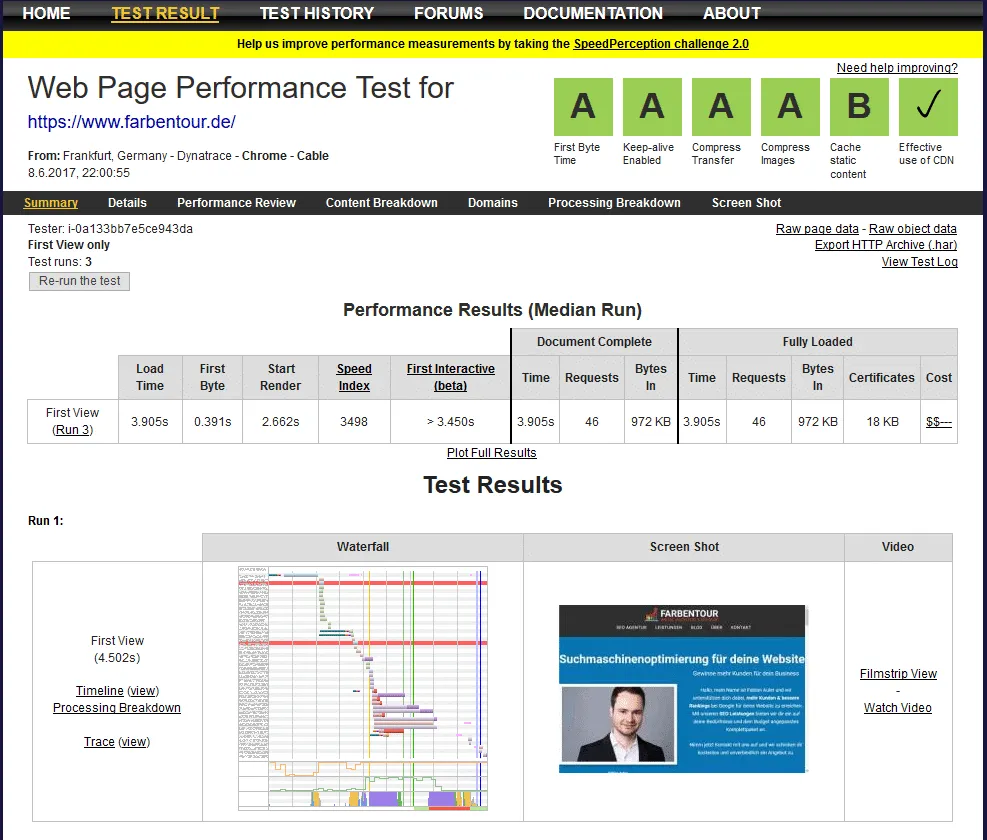
The loading times should be taken into account in every SEO analysis. The longer your page takes to load, the worse for your visitors and your rankings. With Webpagetest.org you can subject the loading times of your website to a detailed analysis.
Core Web Vitals (LCP, INP, CLS)
Concretely, Google today observes three performance metrics as Core Web Vitals:
- LCP (Largest Contentful Paint): When is the largest visible element of the page loaded? Target value: under 2.5 seconds.
- INP (Interaction to Next Paint): How quickly does the page respond to clicks and inputs? Target value: under 200 milliseconds. INP replaced the old metric FID (First Input Delay) in March 2024.
- CLS (Cumulative Layout Shift): How strongly do elements shift during loading? Target value: under 0.1.
You find the current values of your website in the Search Console in the “Core Web Vitals” area or via PageSpeed Insights. Both sources combine field data from real users (CrUX) with lab data – both are relevant for the analysis
Server Log Files
The analysis of the server log files can provide information about how often the Google crawler visits your site. Especially on very large websites with very many subpages, problems with rankings and indexing can occur if the Google crawler comes to the site too rarely.
Possible problems can be, for example, duplicate content. With the tool Screaming Frog (Log File Analyser) you can read out and evaluate the server log files.
Errors in the source code
Was the website or template programmed well and with only a few errors? Or are there numerous programming errors that make life hard for the Google crawl? On the website W3.org you can analyze your website in this regard. Keep in mind that a few errors are no reason to panic ;-).
In technical SEO there are a multitude of further factors that should be checked. These are, for example
- Alternate link errors
- Canonical link errors
- Title tag and meta description
- Alt attributes
- XML sitemap
- Heading structure (H1 headings used correctly, etc.)
Listing all possible technical errors here now would, however, go beyond the scope of the article. For the technical analysis, I recommend enlisting the help of tools – e.g. Screaming Frog, Seobility.net, Audisto and many more.
Backlinks
Links, also called hyperlinks, are still super important today for good rankings on Google. Therefore, in every analysis it is also important to analyze the internal as well as the external links.
Internal linking
First of all, the internal links on a website are immensely important to show Google and co. which subpages are especially important and which are not. Important landing pages with which you want to achieve good rankings should be intensively linked internally in order to distribute as much link power there as possible. More on this topic can be found in the blog post: Internal linking – why internal links are important.
Link profile off-page analysis
Which links have been built so far? Could there be a suspicion of manipulation? Analyzing the backlinks is a very important component of every SEO analysis. How you evaluate backlinks you can also find on the blog.
Brand search: how many people search directly for your brand?
The search for your own brand (brand search) is a separate indicator of SEO strength. A brand that is regularly entered directly signals trust to Google and often gets better trust for its content.
What you can check in the analysis:
- Search volume of brand keywords: How often is your brand (with and without an industry addition) searched for? Visible with Sistrix, Google Trends or the Search Console (filter “Queries containing –> yourbrand”).
- Brand vs. non-brand traffic: What percentage of your organic traffic comes via brand searches? A rising brand share is a growth signal.
- Brand visibility in the SERPs: In the brand search – are you really in position 1 there, do you have sitelinks, a Knowledge Panel?
- Off-SERP mentions: Where is the brand mentioned in forums, social media and specialist media, even without a link?
A strong brand significantly shortens the path to good rankings. Brand search makes this lever measurable in the analysis.
AI visibility and GEO analysis
The classic SEO analysis no longer ends at Google rankings. AI answer systems like Google AI Overviews, ChatGPT, Perplexity, Claude and Gemini draw their sources from the web – and if your domain is not cited there, you lose visibility that does not even appear in classic visibility curves.
What a modern SEO analysis additionally checks:
- Citations in AI answers: Is your domain cited in AI Overviews, ChatGPT answers or Perplexity? Tools like Profound, Otterly or Peec.AI track this systematically.
- AI crawler control: Are GPTBot, ClaudeBot, PerplexityBot, Google-Extended allowed or blocked in the robots.txt? Make a conscious decision per crawler.
- Answer suitability of the content: Are the most important statements high up in the text, clearly formulated and with unambiguous facts? This form is what makes content citable for language models in the first place.
- Brand mentions in AI training data: Is the brand mentioned in sources that typically end up in AI training data (Wikipedia, Reddit, large specialist media, Wikidata)?
While Google rankings can be measured via established tools, AI visibility is even less standardized. A regular manual check of the most important topic prompts in the common AI tools is, however, by now a mandatory task of the analysis.
Why an analysis is so important
A detailed SEO analysis is extraordinarily important in order to identify the current SEO state of a website. From this, optimization potentials can be discovered and an SEO strategy or roadmap can be created.
Without a sensible analysis, you optimize your website only by luck, and as we all know, that cannot really be helpful.
-Fabian
>> Our checklist for a detailed SEO audit you can find here.
Need a GEO check?
Get in touch for more visibility – in search engines and AI answers.
- More visibility and leads via Google and AI chats
- Sustainable SEO & GEO strategies
- Personal support


