
Link Building & Digital PR
The Wikipedia Principle and Its Effect on SEO (incl. Case)

In this blog post I want to show you whether a wiki format, also called an online dictionary or encyclopedia (reference work), can improve your SEO and how Wikipedia managed to achieve such high visibility on Google.
Difference: Wiki vs. Dictionary (Glossary)
Glossaries, dictionaries, and encyclopedias are reference works for terms including explanations. The difference: a wiki is an encyclopedia whose information can not only be read but also edited by the users. A dictionary and Glossary are usually not editable by the users.
The Success of Wikipedia
The online encyclopedia Wikipedia is one of the largest sites on the web in terms of traffic and visibility. According to Statista.com, the number of visits in March 2020 amounted to 5.28 billion. Source: https://de.statista.com/statistik/daten/studie/1021463/umfrage/anzahl-der-visits-pro-monat-von-wikipediaorg/
The numerous pieces of information that are gathered there by the large community and continually reviewed and supplemented by experts, the search-engine-friendly information architecture, the many Backlinks and much more all contribute to this encyclopedia being so successful in the organic search results.
More and more websites are therefore imitating Wikipedia's success model. A well-known example from the SEO scene is the highly regarded Ryte Wiki. According to Sistrix, this wiki is organically a complete success.

But what makes Wikipedia so special? Why are wikis, but also dictionaries or glossaries, so successful? Does it ultimately not matter whether the content is placed in a wiki?
The Structure of Wikipedia
Wikipedia is a pure information platform and, based on public demand and reach, is counted among the mass media. How can such a platform with so many pages and so much information manage to get Google and its users to visit Wikipedia so often and reward it with good rankings?
How is the content structured?
The structure of the content on Wikipedia is explained in the style guide itself: https://de.wikipedia.org/wiki/Wikipedia:Formatvorlage/Musterartikel. As a rule, the introduction already contains a definition of the term. For example, the term “SEO” is defined in advance and the question “What is SEO?” is answered without a long introduction or any other fluff, right at the top of the visible area, above the fold. The term is usually explained in just a few sentences.

The introduction is followed by the well-known Table of Contents. Here the user can jump directly to the topics of interest in the text using anchor links. This is especially user-friendly, since everyone can quickly find their way around.
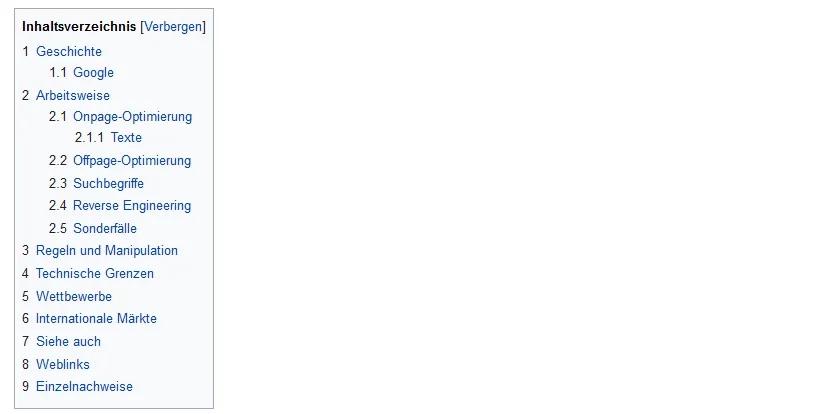
After that, in the case of the wiki article on SEO, the details are covered extensively. Most Wikipedia articles are packed with a lot of content and offer comprehensive information on various subtopics. In the SEO article, for instance, OnPage optimization and OffPage optimization are covered, along with technical optimizations and much more. Anyone who wants to engage with the topic of SEO has a starter article here that quickly explains everything important.
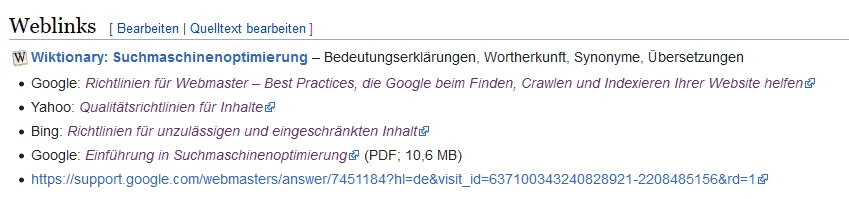
Also indispensable in any wiki article: the source references. As with any bachelor's or master's thesis, the authors here also have the task of citing sources as evidence for their statements.
Through this type of structure, the information-driven search intent in particular is satisfied. Anyone who wants to know something quickly finds an answer on Wikipedia.
And the community?
Wikipedia offers everyone the opportunity to revise articles and discuss topics with one another. However, changes must be approved in advance so that spammers have no chance of manipulating articles.
Herein lies a particular strength of the platform: thanks to swarm intelligence, the texts are continually optimized and brought up to date.
Information architecture
Wikipedia has a very flat information architecture. There is no depth in which the content could hide. Every article can be accessed with just a few clicks. In addition, the topics are organized into parent and child categories as well as related terms and are always linked to one another. The large number of internal links in particular helps Google to successfully crawl the website for new information.
Link profile
Wikipedia does not engage in active link building and therefore all backlinks have been placed organically. Google is therefore likely to place a great deal of trust in this link profile. Many articles in places have over 10% or more hard anchor texts. The article on “Badminton”, for example, even has the exact anchor text “Badminton” at 30%.
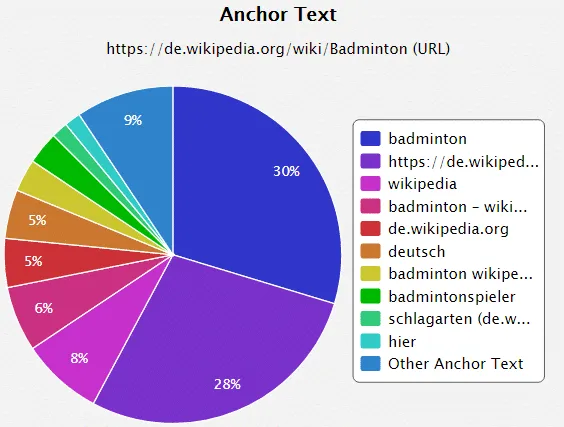
Over the years, the platform has received millions of backlinks all on its own. An immense trust signal to Google …
So what does Wikipedia do right?
In summary, the success of Wikipedia can be listed based on a few points:
- Lexical content: Everything for the user, no frills, the term / the topic (Keyword) is explained immediately in the introduction.
- Cleanly structured text: Through the table of contents, subheadings, bold highlighting, and much more, the reader quickly finds their way around.
- The articles have depth: not just a simple explanation, many topics are explained comprehensively.
- Every article must be backed up with sources; for this there are the subheadings Literature, Sources, and Web links.
- An active community: it continually updates all articles or creates new topics on Wikipedia.
- Flat information architecture: Through the menu and items such as “topic portals”, every article on the platform can be reached with just a few clicks (max. 5). This also allows Google to access the content more easily.
- The link profile is extremely strong: Very many websites link to Wikipedia again and again as a source.
Variation of wikis: Glossaries and dictionaries – reference works simply go down well with Google
In the SEO world, the dictionary from SEO Küche and the glossary from SEM-Deutschland are very well known for their high visibility. Even though these are not “wikis”, since the texts cannot be edited by a community, the success formula of the encyclopedia Wikipedia is adopted here:
- The texts do not treat the topics superficially, but in places go very deep into detail and are covered as comprehensively as possible;
- The lexical structure of the texts meets the needs of the users and thereby also makes Google happy;
- There is no waffling – in the introduction it is explained directly what a topic is about;
- The flat information architecture ensures that every article can be reached via an overview page with just 2-3 clicks.
- Through the high number of high-quality pieces of content, trust and thus also the relevance of the website in the eyes of Google increase = the overall quality of the website is raised and thereby the rankings rise
What can you learn from Wikipedia for search engine optimization? Do I now have to have a wiki or dictionary too?
First things first: No, you do not have to have a wiki, glossary, or dictionary to achieve good rankings. Wikipedia and other online dictionary formats perform so well because they are holistic and clearly structured and the content gets to the point. In addition, the articles primarily answer information-driven search queries and provide real added value with their text (information on the topic that you otherwise cannot find so easily). So the success has nothing to do with the name! You could also call it a blog, magazine, or whatever else.
The content is simply perfect for Google users: Without advertising, distracting sentences, or long waffling. The user can immediately pick out their answer and then move on to other things.
This type of content can also be called lexical content. This is exactly what Google loves. In our following case you can see that this type of content creates a basis of trust for Google. As a result, on the website in the case, even pure advertising/service pages for transactional search terms were pulled up to TOP positions.
Our Case: QTRADO Logistics
For the website qtrado-logistics.de, we have now been handling the optimization for the search engines for some time. Since the beginning of the year, together with the marketing team, we have created a wiki (you could also call it something else – that doesn't matter), a collection of terms from the logistics world.
Each topic is answered as comprehensively as possible. The introductions typical of Wikipedia are written: no long intro, the term is explained immediately within a few sentences and further follow-up questions are answered in the body text. Every article thus has a certain depth and a high information value.
There is good internal linking: every article was sensibly linked internally and can be reached immediately via a large “wiki overview page”. In this way, every article can be accessed from the homepage with 2 clicks.
The text structure is clean; the visitor comes to the website and finds an answer to their question. In doing so, we have continually optimized the texts and are still working on them in order to obtain the perfect texts.
The results are exciting: The website has already achieved solid rankings for numerous shorthead keywords with high search volume:

Here TOP rankings were achieved for important terms such as “logistics” (search volume over 22,000 per month), “production logistics”, “freight forwarder”, and many more.
The interesting thing about this: the service pages and the homepage were optimized for transactional keywords, such as “logistics Krefeld” – these have also improved significantly (currently position 1). Through the wiki approach, Google seems to place special trust in this website, which is why the service pages also came forward in the rankings.

Summary
- Your website does not need a wiki or glossary to get good rankings. It's about the quantity and quality of the content, so that the website receives trust from Google and thereby gains relevance. This can be achieved well through a large wiki or glossary, but it also works through a blog or advice section. The SEO blogger Backlinko, for example, has an “SEO Hub” https://backlinko.com/hub/seo with all the important terms and tutorials for beginners.
- Wiki articles answer (when they are structured correctly) the information-driven search intent particularly well. They are written in a factual, neutral way and the answer to the question “What is topic xyz?” is immediately apparent in the introduction. Through source references, the statements are backed up and the author can demonstrate their expert knowledge. This has become very important especially for YMYL websites in the area of E-A-T!
- A wiki, or several wiki articles, can increase the overall quality (the added content value) of a website and thereby also raise the trust (and the relevance) in the eyes of Google. It doesn't matter whether the articles are called “wiki” or anything else. It's about the content: Through the term explanations, beginners in particular are introduced to a topic and the informational search intent is (when the content is structured correctly) answered in the best possible way.
- Our small case of QTRADO Logistics also shows: Through the wiki articles, the service pages of the domain have also come forward in the rankings. So through the logistics wiki, the trust and relevance on Google increased.
- Often only individual service pages are optimized while the overall quality of the content is disregarded. A wrong approach: The entire website must always be taken into account during optimization.
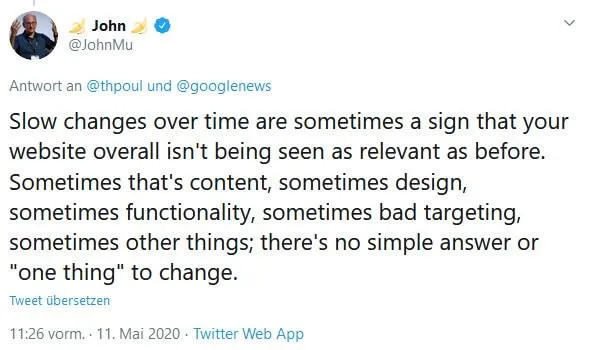
- Further proof: Slow deteriorations in rankings are a sign of the decreased relevance of a website (according to Google spokesperson John Müller): https://www.seo-suedwest.de/5816-google-langsame-verschlechterungen-der-rankings-sind-zeichen-fuer-gesunkene-relevanz-einer-website.html.
And now you! What is your opinion on the topic of wiki and glossary? Have you already been able to gather experiences (positive as well as negative) with it?
Need a GEO check?
Get in touch for more visibility – in search engines and AI answers.
- More visibility and leads via Google and AI chats
- Sustainable SEO & GEO strategies
- Personal support


