
E-Commerce & Online Shops
E-Commerce SEO Case Study


Ecommerce SEO Case Study
How we increased an online shop's traffic
by 755%!
Organic Web traffic via Google & Co. offers high revenue potential for online shops. In this Ecommerce Case we explain our SEO strategy and the OnPage and OffPage measures that led to success.
We show you how, using effective SEO measures, to achieve Top Rankings and gain more visitors. Step by step – transparent and easy to follow.
Table of Contents
The Most Important Facts at a Glance
The best comes at the … beginning. At least part of it, for all the impatient ones.
Here is what we achieved at a glance:

Results:
- TOP 10, TOP 3, and TOP 1 placements were achieved for important keywords in Google's organic search results, such as “fire extinguisher,” “buy fire extinguisher,” “CO2 fire extinguisher,” and “foam fire extinguisher.”
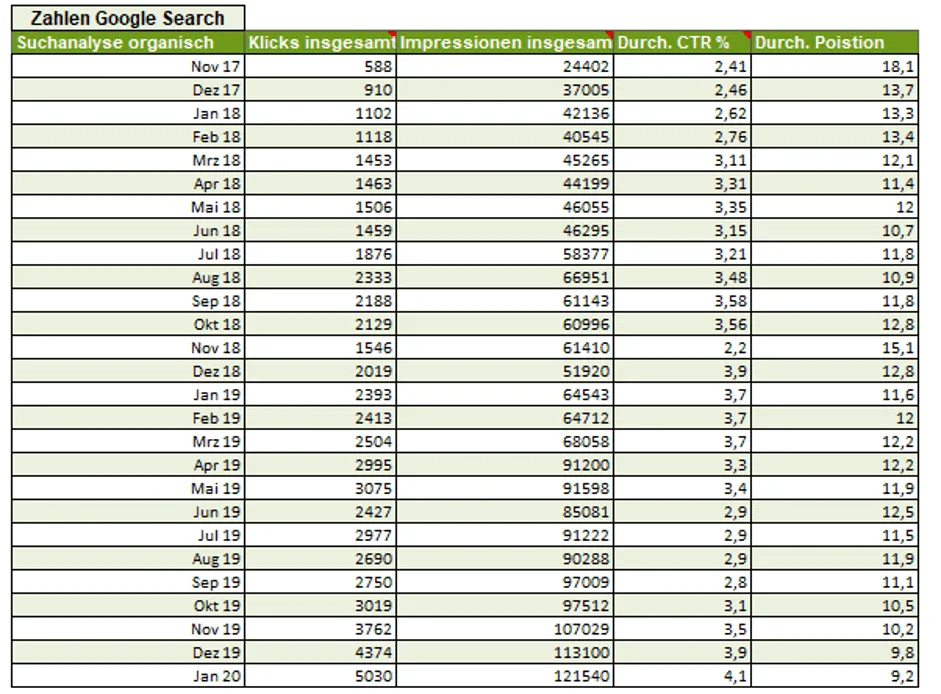
- According to Google Search Console, monthly clicks via organic search rose from 588 clicks (November 2017) to a total of 5,030 clicks (January 2020). That is a total traffic increase of 755.44%.
- A revenue increase of 75%.
- Visibility rose from 0.0021 to 0.2552 SI points according to Sistrix (January 2020).
Tasks and Goals
The shop was to regain more traffic, better rankings, and more conversions via Google's organic search.
Our task was to analyze why the aforementioned crash occurred and which measures had to be taken so that the shop would regain traffic and rankings.

Measures for Success – An Overview
In order to achieve the set goal, the following steps first had to be worked through:
Current State
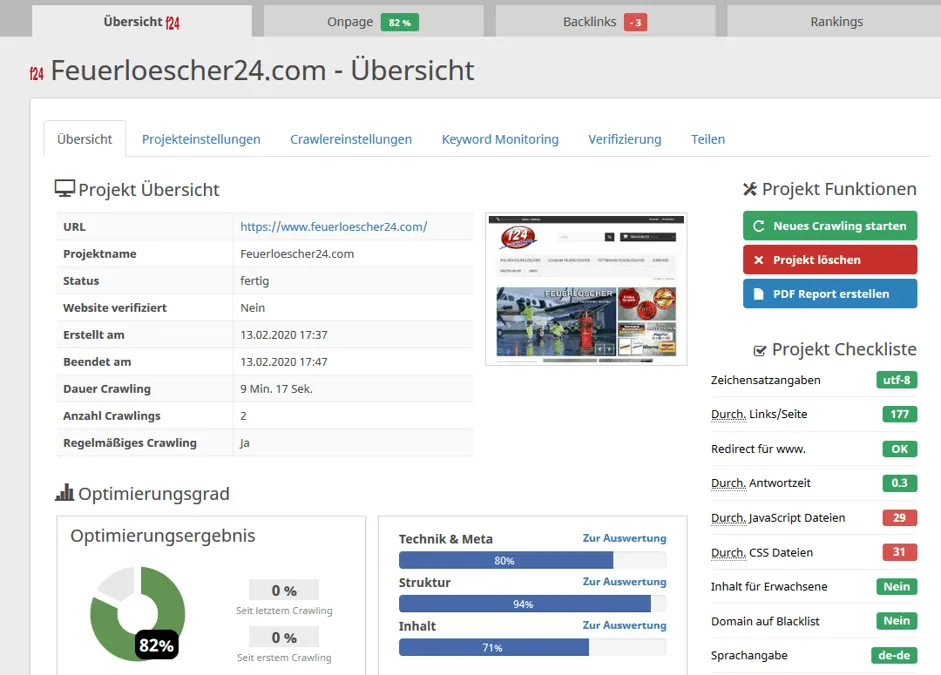
In addition to the visibility already mentioned, the status of the website had to be captured in an SEO Audit that reveals which errors exist on the website that can lead to problems during indexing by Google, and what optimization potential is there, through which better rankings can be achieved?
It was also recorded which URLs already Traffic received and which did not appear in search at that time – this requires an analysis with Google Analytics and Search Console.
Besides the Search Console, we identified the optimization potential on the website itself with the tools Screaming Frog and Seobility. With these three tools, small to medium-sized websites and shops in particular can be analyzed effectively.
Of course, the tools are only as good, as the user can interpret the reports. Only with experience in SEO can such tools be properly understood and accordingly successful measures can be derived.
The analysis of the link profile we carried out with the tool Majestic.com and ahrefs. These SEO tools reliably capture as many of the domain's links as possible, and a link audit can likewise be reliably analyzed using the tools' TrustFlow and CitationFlow values.
The monitoring was set up with tools such as Search Console, Sistrix, and the ranking tracker Serpwatcher.
Strategy
Based on the audit, it is possible to develop an SEO strategy. With which measures can the desired goals be achieved? What needs to be done to achieve maximum success?
That is exactly what is defined in the SEO strategy. A catalog of measures helps with this, as does a project plan, so that no task is overlooked. It is especially important with SEO to set the right priorities – if you don't optimize the most important levers first, it can really take a very long time before results become visible.
Implementation
The strategy is implemented across four major task areas. First, keyword research was carried out to find all relevant search terms that potential customers enter into Google search and to develop content.
To keep an overview, a mind map with all important URLs is always created, so that everyone involved knows which URLs should target which keyword and be optimized accordingly.
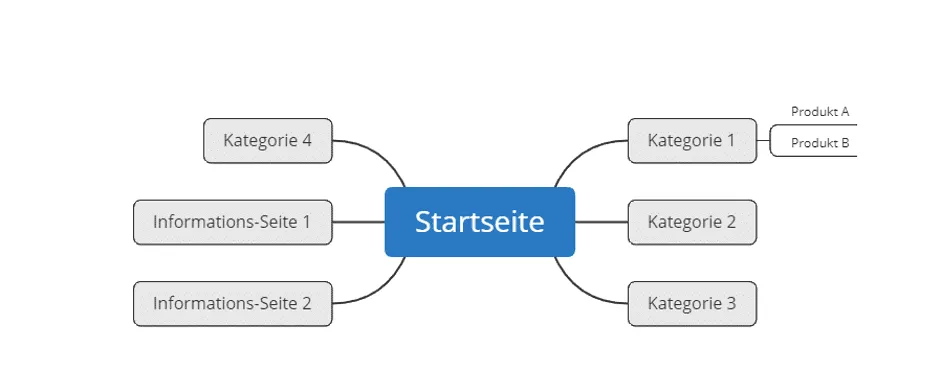
With OnPage optimization, the goal is to optimize the website as well as possible so that Google understands it and can index it flawlessly. Of course, not only Google is taken into account, but also and above all the user. What information (user intent) is the user looking for, and how can I present it to them on the website in the best possible way? Because Google especially rewards user-centered websites.
Strictly speaking, the content (content) can also be counted as part of OnPage optimization. However, since this shop had particularly little content, this point was a separate service, because almost every category needed additional content that had to be optimized for visitors and keywords.
With OffPage optimization, the goal is to analyze the existing backlinks. Are there harmful, negative backlinks that prevent rankings? Or are there too few good backlinks? And if so, how can new, premium backlinks be built?
Monitoring
Monitoring, also known as performance tracking, is an essential key to any optimization.
- Are the goals being achieved through the measures taken?
- Does the SEO strategy need to be readjusted?
That is exactly what can be found out through monitoring.

SEO Audit: What Went Wrong on the Website?
During the audit, several optimization opportunities came to light that explained why the website had performed so poorly and crashed so suddenly in 2013. But let's take it step by step:
The information architecture of the website was very unstructured at the beginning. For example, there were multiple URLs for the same product, categories were too similar to one another, texts repeated themselves across different URLs (duplicate content).
On top of that, title tags and meta descriptions had not been properly optimized until then. A large number of the URLs had no meta information, which is why Google then automatically assembled them itself in the SERPs. These automatically generated entries are not optimized and are usually far less pleasant to read than when you handle this step yourself.
In addition, there were only very few URLs with helpful content, such as a calculator for the required extinguishing agent units (feuerloescher24.com/content/9-Loeschmitteleinheiten).
The URLs with the greatest optimization potential, such as the categories, were virtually not filled with any content at all. For a full-text search engine like Google, however, content is enormously important.
So there was a large number of optimization opportunities:
- On the category and product pages, there was too little or no content at all that would have provided any added value.
- Poor structure of the information and site architecture. Important pages were hidden far too deep within the website.
- 102 pages had duplicate content problems.
- 15 pages had a 404 status code (broken links). These error pages also make crawling more difficult for the Google bot (web crawler).
- 23 internal redirects were found. This creates redirect chains that can also be bad for crawling.
- 53 pages were, due to the previous keyword optimization, in competition with one another (keyword cannibalization).
- The loading times were above average.
- Pages without search intent (such as the imprint) were not set to noindex,follow.
- More than 50 pages had no individual title tag and 36 pages had no individual meta description.
- Heading structure: There were multiple H1 headings per URL, and the H headings were generally not placed in a consistent order. For example, an H4 heading followed an H2 heading, and so on.
- Images had no ALT tags.
- Especially in the body text, there were no or only a few internal links to the important category pages.
These and many other errors on the website prevented good rankings for the shop.
And the link profile?
But what did the link profile look like, and why did the domain at the end of 2013 so severely lose its visibility:
Through the Google Penguin 2.1 update, the shop lost a lot of visibility. Thanks to the analysis of the link profile, it quickly became clear: a large number of weak links had been built here that were either not topically relevant or pure spam.
- Due to the previous poor link quality, the shop had lost so much visibility.
In addition, there were no strong backlinks in the link profile that could have shown Google that the shop deserved to move further up in the rankings.

Strategy Development
The audit revealed that the domain first had to be freed from the bad links.
If Google does not trust the domain, all further measures are pointless. So the site first needed a clean link profile.
After that, keyword research was to follow, in order to be able to optimize as many URLs as possible for one or more keywords. Without keyword research, the optimization would have been like flying blind; with the research, we knew which terms to optimize for.
After that, all of the OnPage measures on the website and the content creation for all important URLs (categories, products, etc.) were to be carried out. Finally, the building of new, high-quality backlinks was to follow.
Summary of the SEO Strategy
- Recovery of the domain from the penalty by removing/disavowing all harmful links
- Keyword research to identify further optimization opportunities
- Fix all OnPage errors on the website and, in particular, build a sensible information architecture
- Add relevant information/texts to provide added value on the website – especially on the category pages
- Build new strong backlinks to push the website further forward
- Set up monitoring to have performance tracking over all measures
With the SEO strategy, in addition to the action plan it is also important to set priorities, because due to limited resources not all tasks can be tackled at the same time.

Implementation of the Strategy
During implementation, it is important to strictly adhere to the measures from the strategy. Only then can the website be properly optimized step by step and as quickly as possible (by SEO standards) achieve success.
Removing Harmful Links
The first important step was to get out of the penalty from the 2.1 Penguin update of that time . For this, the bad links from the link profile were identified and either removed by contacting the site operators or, if the webmaster did not respond, manually devalued by means of the Google Disavow Tool.
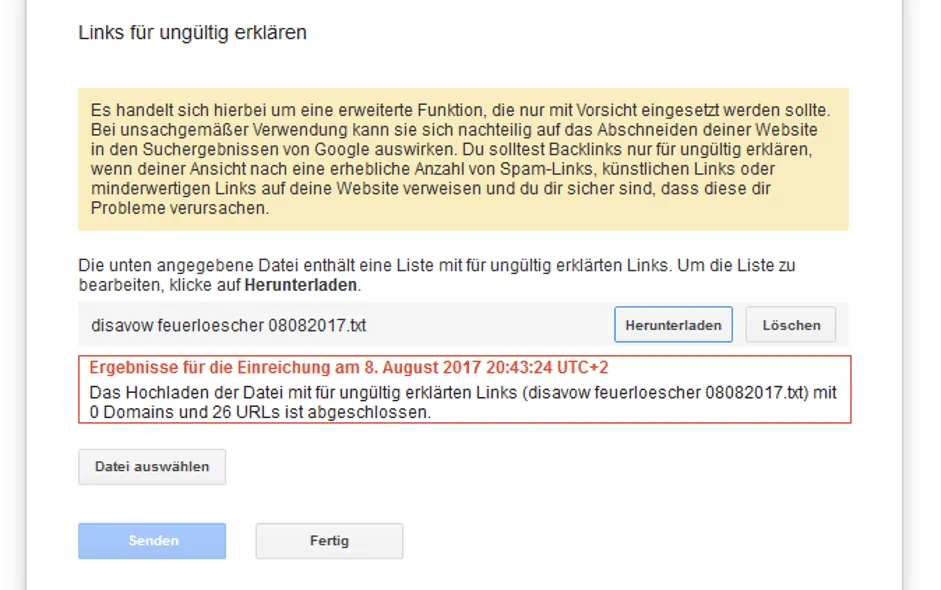
The list contains all URLs that we classified as harmful. The corresponding pages were, among others:
- not topically relevant
- from link farms, i.e. pages that served solely for link manipulation,
- burdened by other negative characteristics, such as foreign languages or links from websites with adult content.
Tip: Instead of individual URLs, you can also devalue entire domains with the command domain: “AnyDomainHere.de”.
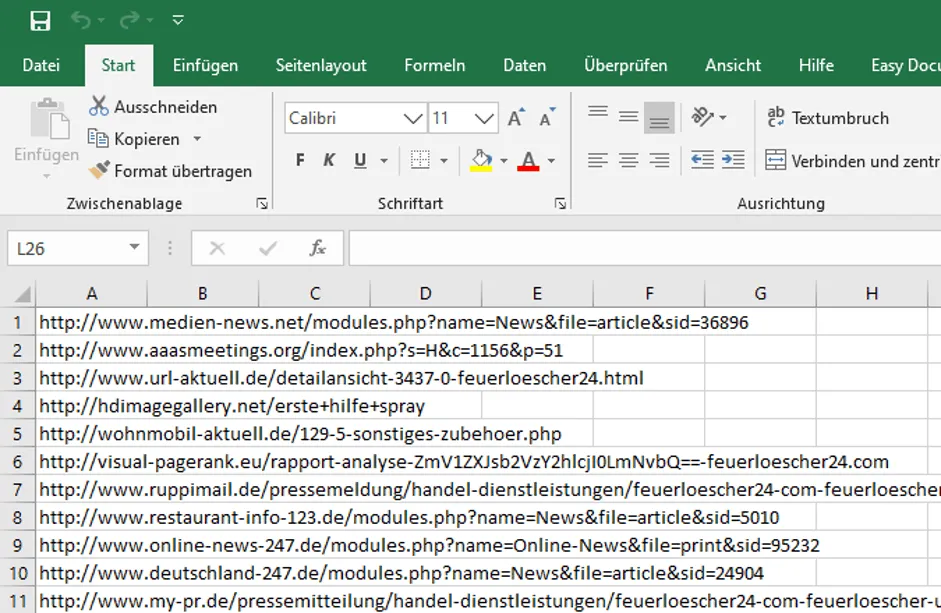
Important: When removing or devaluing backlinks, the utmost caution is always required! If good, strong backlinks are accidentally devalued, this can lead to ranking drops.
Keyword Research
Keyword research always starts with the customer themselves. The customer explains their business to us and lists important terms from their industry and for their customers. When researching suitable search terms that we can optimize the shop for, this is the first important step.
With this basic set of terms we can then create a master keyword set using tools and research. This file then contains all the search terms that the shop is to be optimized for.
For this shop, we used, among others, tools such as kwfinder.com, Sistrix.com, and, of course, the classic Google search.
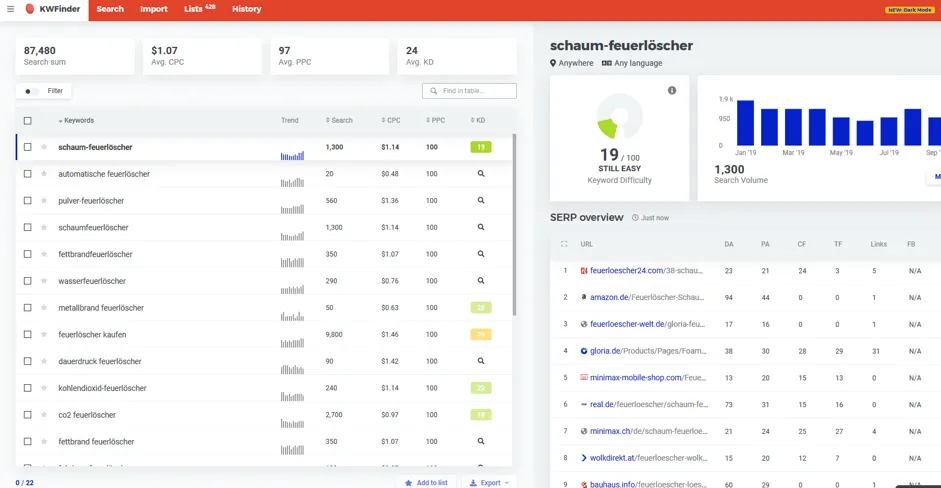
kwfinder briefly explained
This tool can generate a particularly large number of keyword ideas. If you enter a keyword here, e.g. “fire extinguisher,” further keyword ideas appear in combination with the term you entered (see image).
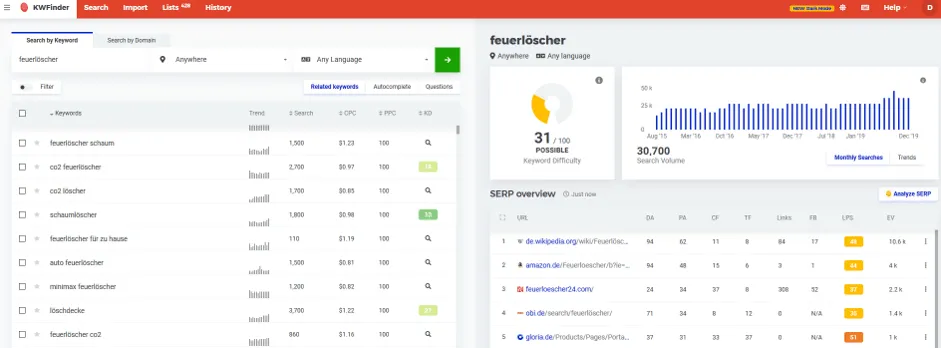
The kwfinder is one of the main tools during research. Here we collect all the ideas, check the monthly search volume, and much more. The only drawback of this tool: the competition assessment is unfortunately not realistic for small to medium-sized shops and can therefore be ignored.
SISTRIX briefly explained
With Sistrix, you can analyze the rankings of your own website as well as those of competitors. Here you can quickly see who has optimized for which keywords. Sistrix also offers the option of displaying keyword ideas for a search term (see image).
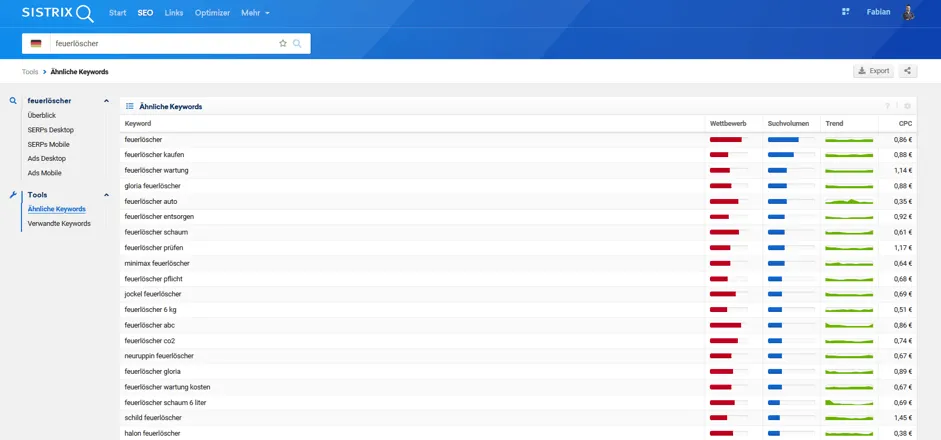
Sistrix and the KWFinder are paid tools that are indispensable for any research. The next tool, Google itself, is of course free.
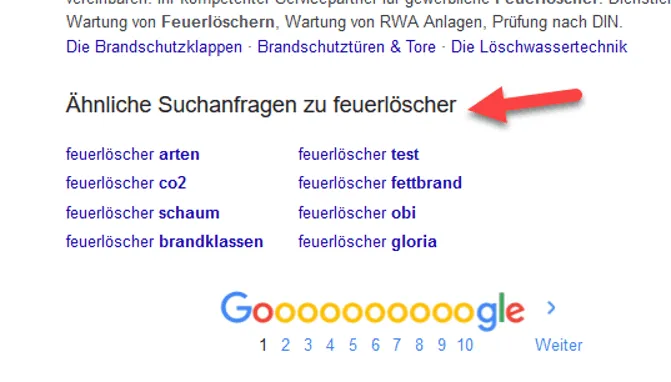
Google as a keyword tool briefly explained
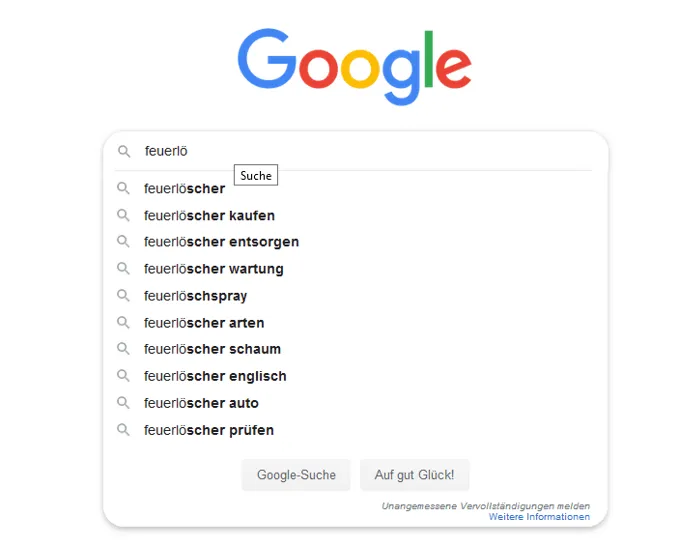
Using the classic Google search, you can easily collect further keyword ideas. The autofill function already displays some search suggestions
The keyword set (excerpt)
Thanks to the collaboration with the customer (this is where the first keyword ideas come from) and research into further keyword opportunities, we were able to create a solid keyword master file. Here is an excerpt from it:
Once the keyword list is in place, we begin the next steps toward OnPage optimization.
OnPage Optimization
Let's move on to the active implementation of the OnPage optimization. Here, all the points that are intended to improve the rankings are now implemented.
Title Tags
First, we implemented the optimization of the title tags. This is a particularly big lever that can be implemented quickly. The problem was that previously more than 20 URLs were optimized for the keyword “fire extinguisher.” Thanks to the keyword research, we were able to assign each category its own keyword in the title tag. In addition, each URL (that was supposed to rank) received an individual title tag and its own meta description. Here is an example of how we optimized the homepage:

Large selection and low prices as a USP. Caution: low prices alone are usually not a real USP, hence the addition “large selection.”
The title tag is cut off because it is too long, which is not a problem, however, since all the important information can be found in the Google search.
In the meta description, in addition to special characters (✓), further shop benefits such as “free shipping” were listed to encourage clicks. We subjected all the important pages that are meant to rank to exactly this process.
For the title tag, the rule of thumb is: always place the main keyword of the respective URL at the beginning (in combination with the word “buy”) and, if possible, mention a USP. If there was not enough space in the title tag, the USP was left out.
For the meta description, it is similar: mention the keyword, use special characters, and list USPs that are meant to encourage clicks.
Broken Links / 404 Errors
15 URLs that were linked in the shop had a 404 status code, meaning these URLs had been deleted and returned the error “URL not found.” Something like this is not only unpleasant for users, but also bad for indexing and crawling by the Google bot. By removing the links or setting the correct links, these errors were fixed.
Internal 301 Redirects
Internal redirects can, under certain circumstances, use up additional crawl budget. This is not optimal for indexing, because why would you have internal redirects at all? We therefore removed all redirects and instead pointed directly to the correct URLs – without a redirect.
Poor Information and Site Architecture, Duplicate Content Problems, and Keyword Cannibalization
These points represented a particularly large lever in the optimization. Duplicate content and keyword cannibalization are not errors that lead to a penalty. However, they can cause considerable problems during indexing. If several URLs are optimized for the same keyword, the Google crawler does not know which URL should rank for which keyword.
Therefore, we removed the duplicate content and always optimized each URL that was supposed to rank for a specific keyword. This way, we could show Google which URL should be found for which keywords.
If we could not delete a page, we set it to noindex,follow. In total, we were able to free 102 pages from the duplicate content problem and, on 53 pages that were in competition with one another, change the previous keyword optimization and thus resolve the keyword cannibalization.
The poor information architecture caused rankings to be prevented.
Example of the then-unsuitable information and site architecture:
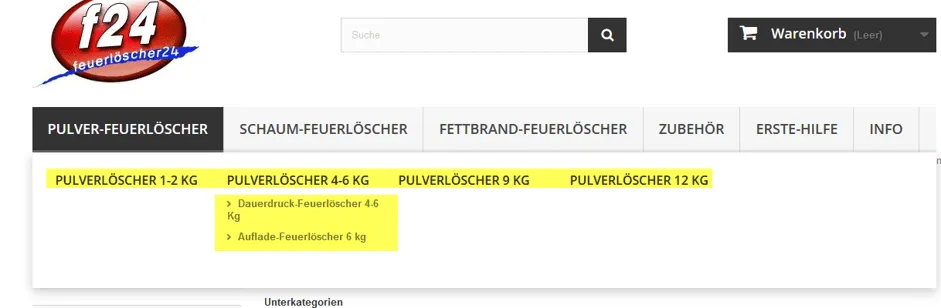
The main category “powder fire extinguishers” consists of the filter pages “powder fire extinguishers 1-2 KG,” “4-6 KG,” “9 KG,” and “12 KG.”
These filter pages were repeatedly called up by Google in the SERPs for the keyword “powder fire extinguishers,” the main category. As a result, the rankings jumped back and forth – sometimes a subpage was in the TOP 100, and then the main category appeared again. So Google had great difficulty coping here.
Since we did not want to delete the filter pages (the user wants this breakdown, because in terms of quantity and price it makes a considerable difference whether you buy a 2 kg or a 12 kg extinguisher), we had to set these filter pages to noindex,follow.
The results were quick to see: the main category finally began to rank for the main keyword “powder fire extinguishers.”
However, there was another problem with the categories: before you got to see the products, you first had to click through the subcategories.
The process, using an example:
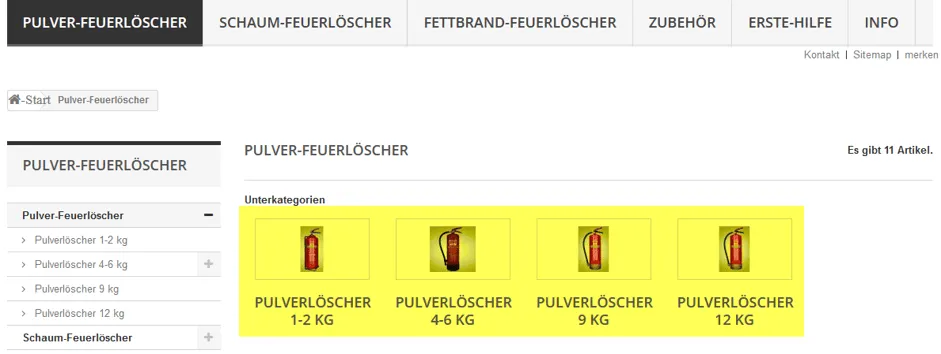
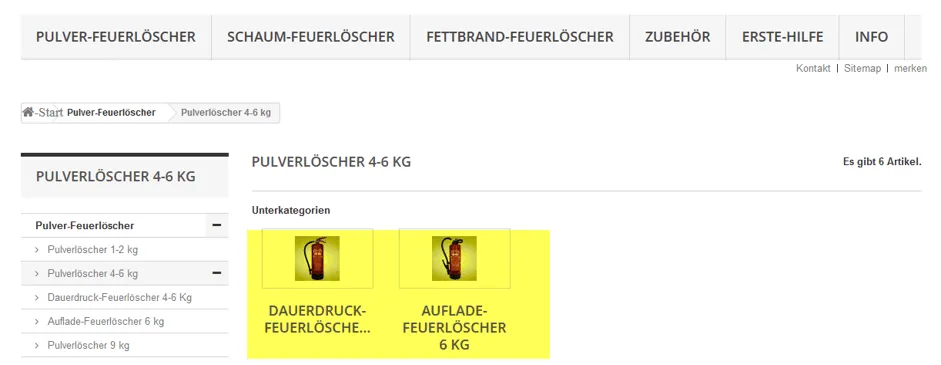

From the main category, it took 3 clicks to reach the products – that is too long for the user and for indexing by Google. Products should already be built into the main category.
Instead of products, the main category initially only listed a very short text (1-2 sentences) and the associated subcategories. The optimization consisted of first displaying all products in the main category.
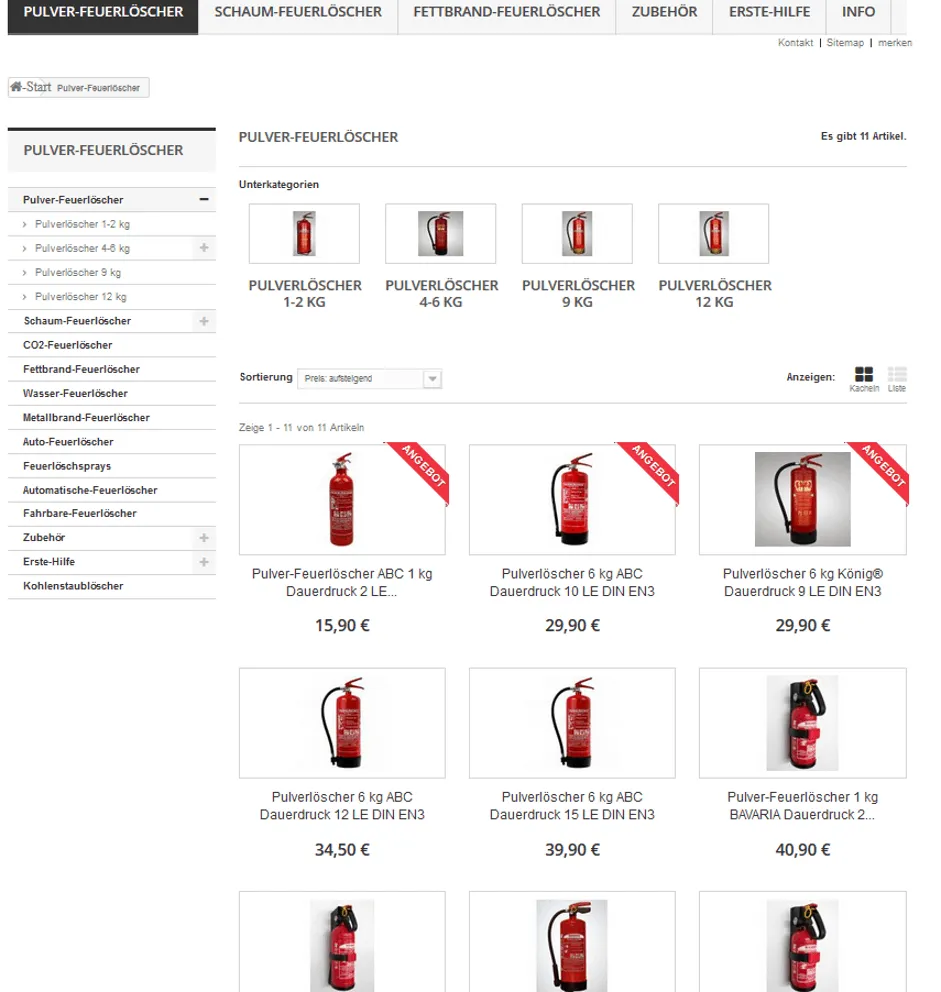
This was actually a simple step that nevertheless had a big impact. Google and users naturally want category pages that display the products directly. Nobody wants to have to click through first.
Since the subcategories (filter pages such as “2 L foam extinguisher”) could not be deleted, as mentioned, they remained on noindex,follow to avoid keyword cannibalization.
Note on category optimizations: it would be cleaner to sort different product types within one category via a filter, which is normally standard in shops – this optimization is planned for the future.
Thin Content / Missing Texts on the Category Pages
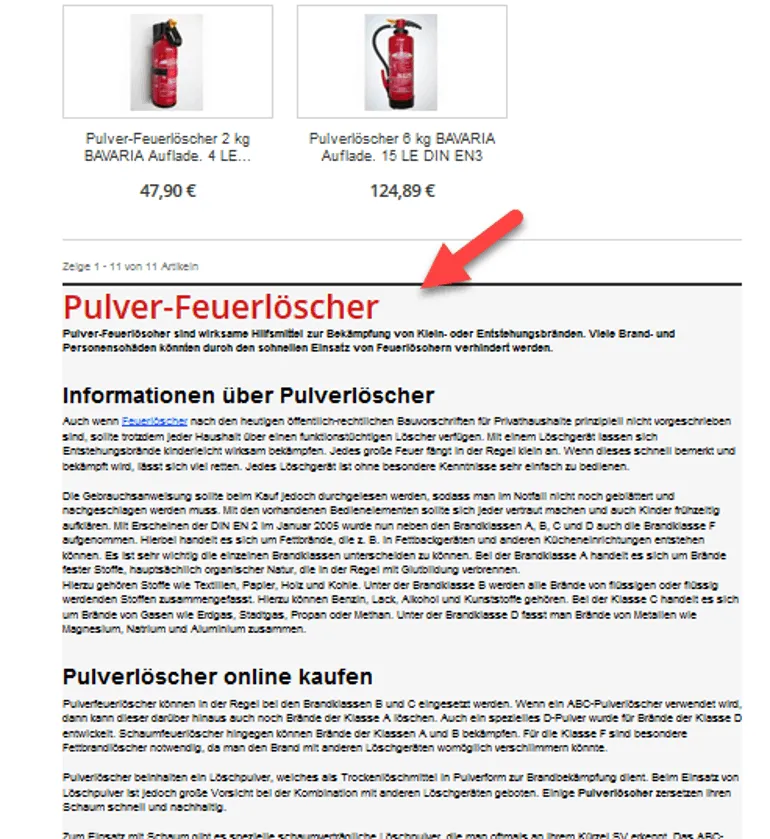
On the category pages, there was virtually no content. There was only a heading and 2-3 links to the next subcategories. Such pages can hardly rank well, because they provide no added value for the user and are therefore also of no use to Google.
In addition to the already mentioned integration of products, we created texts for the respective main categories that were supposed to rank, e.g. for the category “powder extinguishers.”
We derived the content of the category texts partly from the keywords and partly from the users' questions. Particularly often, for example, the question arises for which fire class the offered fire extinguisher is approved and from when fire extinguishers are mandatory.
Content on the Homepage
On the homepage, too, there was no text, only links and images to the categories and products. Since the homepage was supposed to rank for the keyword “fire extinguisher,” we had to integrate body text here as well. The keyword “fire extinguisher” is a very generic term, and the search intent here varies.
Some users seem to only want to inform themselves about the various types of fire extinguishers, while others want to buy one directly.
We therefore decided on the following solution: on the homepage, the links and images to the products should remain, but there should also be enough information to be found in order to satisfy users who are looking for information.
We therefore created texts with as much information as possible on the topic of fire extinguishers, including tables and images of the fire classes. With this step, we wanted to satisfy both the transactional (the user wants to buy something) and the informational (the user wants information) intent.
The Loading Times Were Above Average
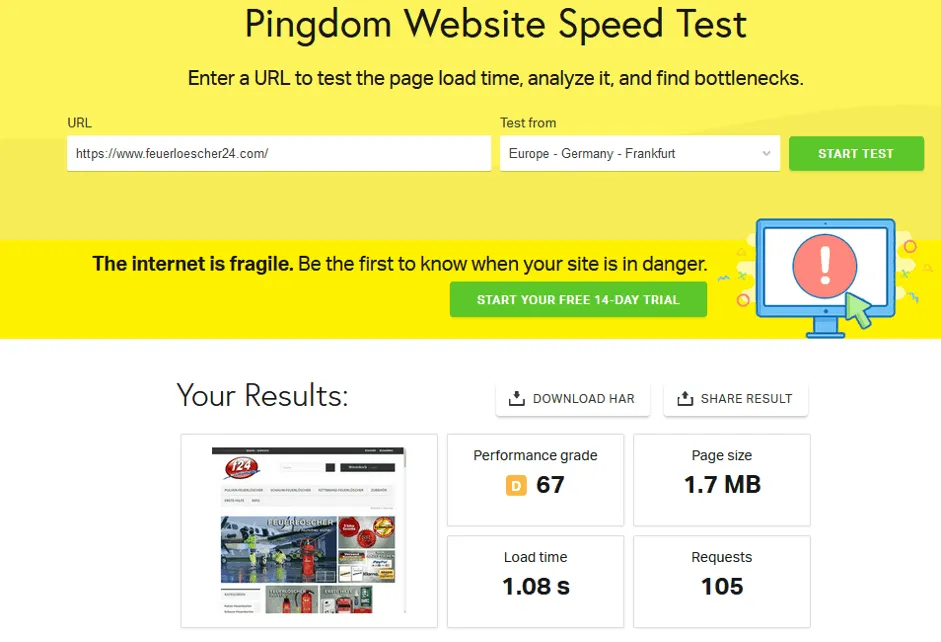
Before the optimization, there were loading times of 5-7 seconds for the homepage and category pages. Until then, no caching was used, the server response times were far too high, and much more increased the loading time. A caching plugin was installed in the shop, images were compressed, and so on.

The loading times for the homepage have since been at approximately 1 second according to Pingdom, which is already a good value.
Pages Without Search Intent
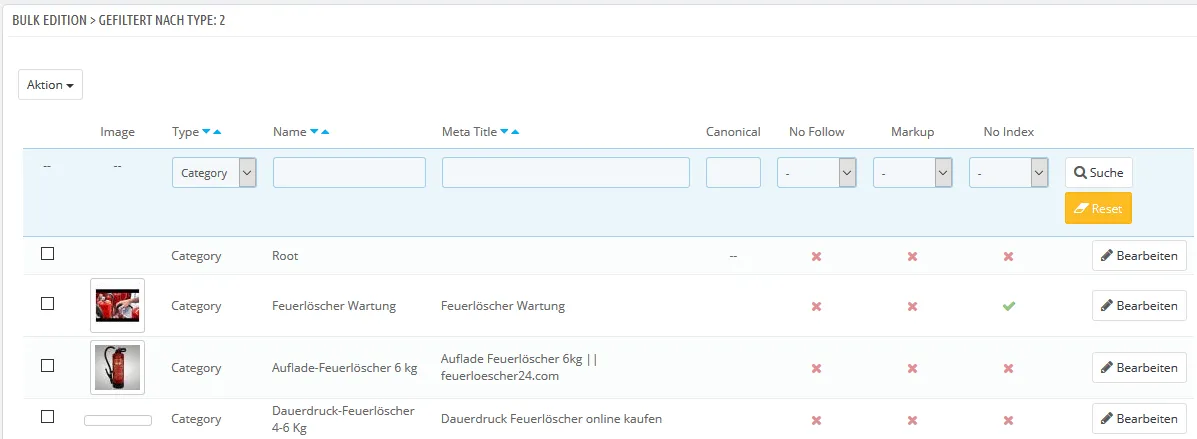
Why should we stuff the search engine index with pages that have no relevance anyway? We therefore set pages that could not be deleted but also have no search intent (pages such as the imprint and privacy policy, which have no place in the search index) to noindex,follow. The indexing of the individual pages is controlled via the two modules “SEO Center: Bulk Edition” and “SEO Noindex,follow.”

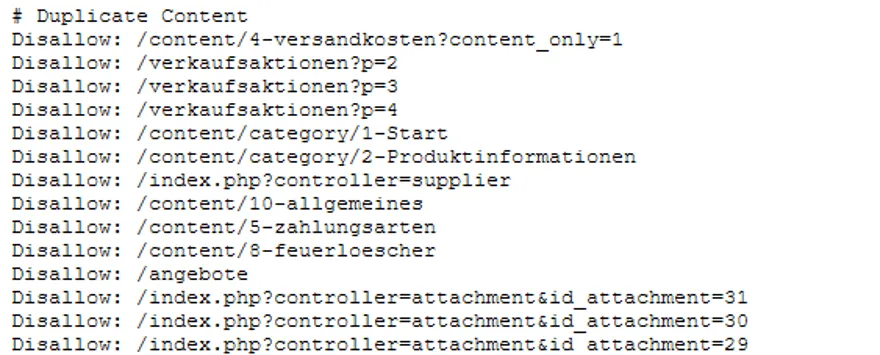
URLs such as the shopping cart, which could not be set to noindex via the CMS system, were blocked by means of Robots.txt for the search engines . But also duplicate content had to be fixed through it in places, because these pages could not be set to noindex via the CMS.
Further Optimizations:
- Images Without ALT Tags
A classic: equip all images in the shop with a suitable ALT tag. This is a bit of tedious work, but it makes the images look better in Google image search and thus the shop as well, and brings corresponding improvements in the rankings.
- Heading Structure
There were multiple H1 headings on the category and product pages, and the H headings had also not been placed in a consistent order. For example, first came an H2, which was followed by an H4 heading. This adjustment is not the single most important ranking factor, but with a complete, gapless sequence the page is cleanly optimized here as well.
- Internal Links
Internal links to the most important category pages were placed in the body text in order to have all important categories permanently linked here.
- Pages Without SSL Encryption
In some places there were images that were not loaded via SSL encryption, which caused the effect that some URLs were displayed as “insecure” in the browser. By encrypting correctly, all images were ultimately loaded via SSL.
OffPage Optimization
In addition to the already described devaluation of all harmful links, we built just two backlinks through partnerships – that's it. We did not actively build any more links.
It should be noted, however, that the site already has many backlinks and that here we did not have to build hundreds of new backlinks anymore, but rather gave the domain enough trust through two strong links to improve the rankings.

Monitoring and Performance Tracking
Monitoring is enormously important and was set up right at the beginning of the SEO campaign and continued without interruption. Because only with valid data can the successes of the implementations be measured and the right further measures be derived from them. This is how we could see that the shop's homepage began to rank well thanks to the long body text – a proof that this type of text was successful.
For monitoring we relied on three or four major tools:
- Google Search Console
- Google Analytics
- Serpwatcher
- (Sistrix)
Via Google Search Console and Google Analytics, we were able to track the performance of every single URL and see how the (organic) traffic developed. Via the Search Console, we also saw the CTR developments, rankings for keywords, important notifications in case the page had serious indexing problems , and much more.
Via Serpwatcher, we set up the keyword set of the shop in order to keep an eye on the daily development of the keyword rankings. We also used Sistrix to see the shop's overall performance.

Results in Detail
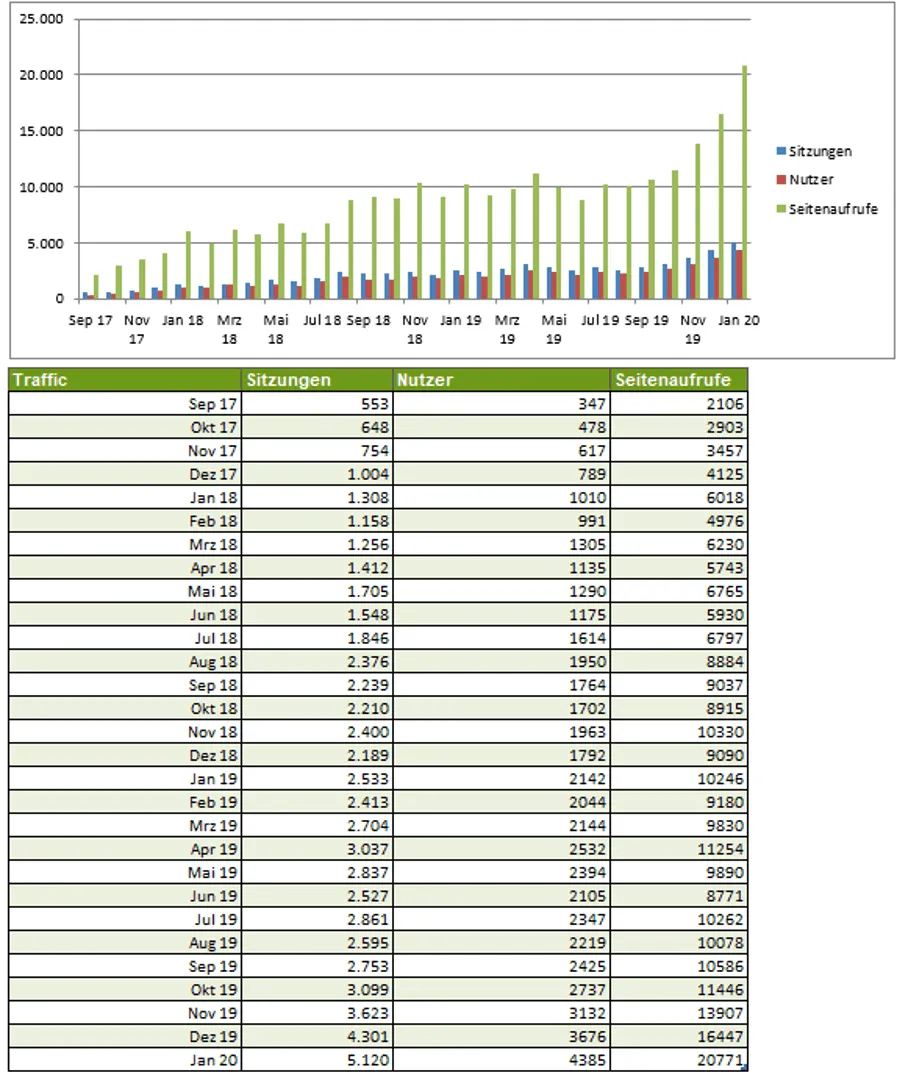
The optimizations started in August 2017 and up to now (January 2020), a traffic increase of 755% could be measured according to Search Console.
Certain optimizations, such as even better loading times, could not yet be implemented due to problems with the CMS.
And nevertheless, the shop received an enormous traffic increase and TOP keyword rankings were achieved.
The current visibility according to Sistrix (as of 01/31/2020)
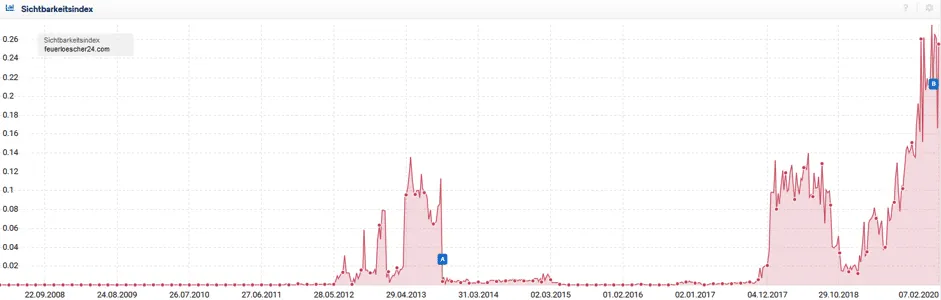
After a downward trend in fall/winter 2018, the visibility curve rises steeply again.
The drop in visibility can be explained by the fact that the shop was no longer listed in the TOP 10 for the keyword “fire extinguisher” for a few months.
The special thing about it: The traffic from organic search still increased during this period, because the site generates a lot of traffic via mid and longtail keywords.
Traffic development (as of 01/31/2020)
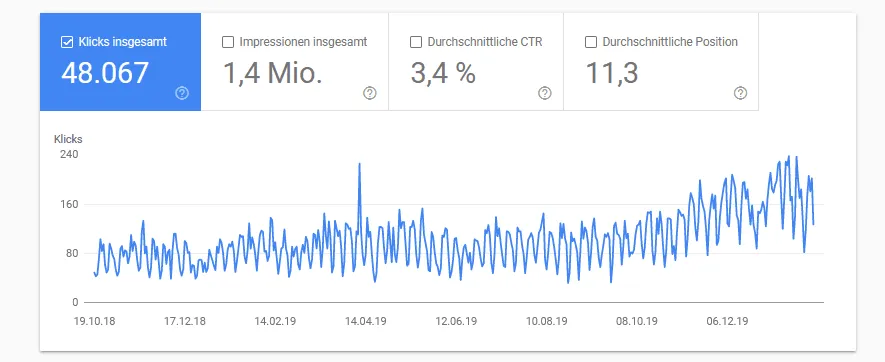
According to Google Search Console, the number of clicks could be increased from 588 clicks in November 2017 to 5,030 clicks in January 2020. That is an organic traffic increase of 755.44%!
Also nice to see: the traffic grew steadily from month to month. There was hardly a month in which the traffic dropped. Here is an excerpt with all the figures from the customer report:
Ranking Development
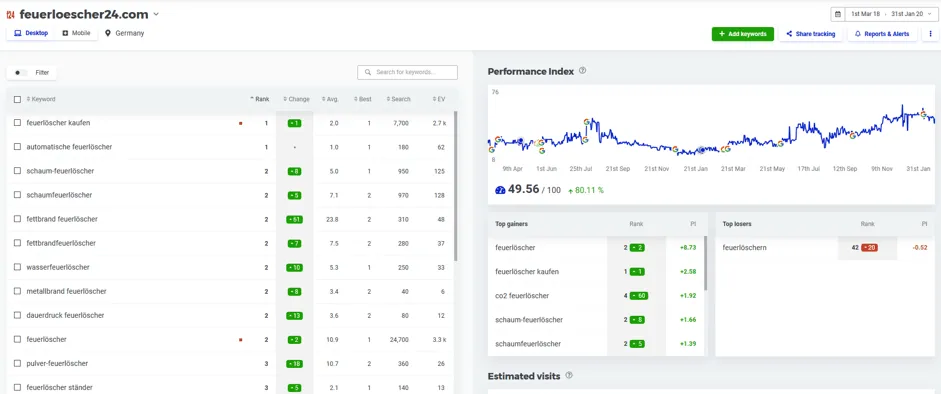
We tracked the development of the rankings with the tool Serpwatcher.com:
Here you can clearly see the development of the rankings and visibility according to the tool from 03/01/2018 to 01/31/2020 (unfortunately, you cannot go further back in the past with this tool).

For the Future
Further optimizations are planned for the future.
For example, there are still the subcategories that have so far only been set to noindex,follow. Here, deletion would be appropriate, and a filter system directly through the respective main category would be more suitable – the fewer clicks, the better for the users and thus also for Google. With the current solution, Google currently seems to have no problems, however.
So far, only a few structured data have been added. Even though these are not a ranking factor, your own SERPs can be visually improved, for example by means of FAQ markup and star ratings, and thus the CTR can be optimized.
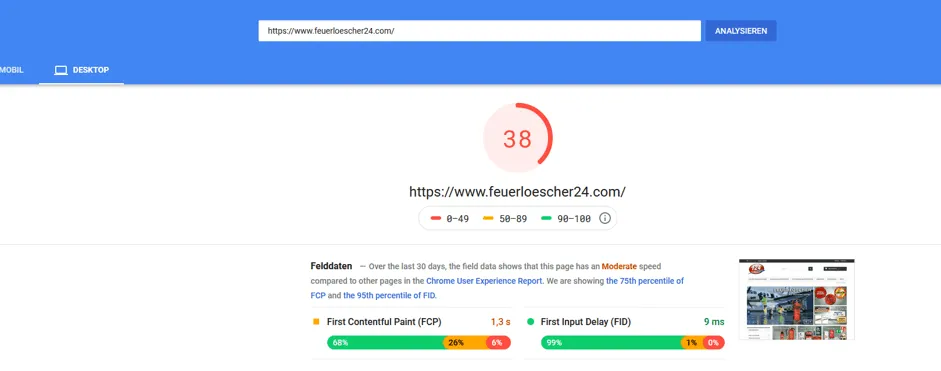
The loading times are far from good, even though they are currently at approximately 1.1 seconds. According to the testing tool from Google, there is still a lot of room for improvement here.

Learnings
For good rankings and a lot of traffic via organic Google search, only the right and important levers need to be optimized, and with enough time the Google traffic can flow in via the free search.
- Only staying power leads to success:
The traffic did increase by 755%, but it took 2 years and 5 months (August 2017 – January 2020) until the traffic went up so strongly.
SEO must be viewed over the long term; good rankings don't come overnight. Just implementing all the optimization points, the analysis, the audit, etc., simply takes time. On top of that, Google itself needs time to understand all the changes. Anyone who brings time to SEO will ultimately be rewarded!
- Shortcuts via shabby backlinks are of no use at all:
On the contrary, as you can see, the shop was penalized for its many bad links. Only through the devaluation of the links was the shop able to rank again.
- Always OnPage before OffPage:
Building new backlinks right away would not have had a big effect. On the website, there was no added value for users; why would Google rank something like that? First, the major OnPage blunders have to be fixed before moving on to OffPage optimization.
- Don't panic just because Sistrix or some visibility curve goes down:
A drop in the SI curve from Sistrix does not necessarily mean that you are losing traffic or have even been penalized. In this case, you can see very nicely that the short-term loss of the good ranking for the traffic-strong keyword “fire extinguisher” had no impact on the traffic.
A large part of the traffic comes via longtail keywords. You should never make yourself dependent on 1-2 keywords, but rather have a large keyword set (as far as the niche allows) and optimize for it. (Focus on mid and longtail)
- Small errors are not a problem, or rather, the website does not have to be perfect:
Even non-perfect websites can rank – as long as the most important optimizations have been implemented.
- Content is important:
The category pages in particular need content. It was also helpful to fill the homepage with sufficient content. Here is another case study on the importance of content.
- Setting pages to noindex can help:
Since we could not / were not allowed to delete the filter pages from the menu, we had to set them to noindex,follow so that no keyword cannibalization would arise here. No problem for Google in this respect – every category now ranks for the right keywords.
- Pages can also be excluded via the Robots.txt:
If pages cannot be set to noindex via the system, they can also be blocked via the Robots.txt – not a nice step, but it works.
- Give Google clear instructions on which URL should rank for which keyword:
Important: as far as possible, each URL should be optimized for a specific keyword. Pages like the imprint, etc., cannot be optimized, of course, but why should they be? Important are the URLs, that are meant to sell: products and categories.
- Loading times are important, but not THE big ranking factor:
Google forgives a lot here; even if the page speed value is poor according to Google, what matters is the actual loading time. And at 1.1 seconds, that is definitely fine.
- To make the shop rank, we only needed a few backlinks:
Backlinks are important, yes, but not the quantity, rather the quality. In addition, the shop already had many backlinks. After cleaning up the bad backlinks, the link profile was clean, and by setting two high-quality links, there was enough trust from Google, and corresponding rankings became possible.
Conclusion
The biggest challenge in SEO is maintaining continuity and patience.
Not every project will see traffic constantly going up. There can also be months in which there is less traffic than before – that is a completely normal process. SEO simply takes time!
Many people also forget to follow the SEO basics. Clear rules and a process plan help to approach SEO correctly and celebrate successes.
Do you need support? Did you like the case study and also need support optimizing your shop? No problem, just send us an email via our contact form. Get in touch now Service

Fabian Auler ... is the founder and owner of Farbentour Online Marketing GmbH, a specialist author at the Springer Gabler Verlag, and regularly publishes articles in online publications. He is also a speaker at industry conferences such as the SCM Praxistage, the Content World, and the (SEO) Campixx, and has been recognized as a TOP 100 SEO Influencer. According to iBusiness.de, his agency is among the 100 most important SEO service providers.
Follow us:
Need a GEO check?
Get in touch for more visibility – in search engines and AI answers.
- More visibility and leads via Google and AI chats
- Sustainable SEO & GEO strategies
- Personal support


